
Part 8 — Undercoating in Florida: Does Your Vehicle Really Need It?
What do you envision when you hear the word “undercoating?” Many people might say they picture a car somewhere in Michigan, Maine or upstate New York, pushing through a February snowstorm while highway crews dump salt on the roadway.
Very few people would probably think of Florida, where there is no snow, no icy highways, and certainly no road salt. Even so, Florida vehicles do face corrosion problems – problems created not by highway salt but by salt air, saltwater, humidity, heavy rain, sand and Florida’s constant moisture.
For some Florida vehicles — especially trucks and SUVs used near the coast — protecting the underside makes sense.
Rust Doesn’t Care Where You Live
Rust requires a combination of iron or steel, oxygen and moisture, and Florida has plenty of all three. Now, add salt, which acts as an electrolyte. Electrolytes accelerate the electrochemical process that causes corrosion.
That’s why vehicles driven on salted northern highways develop severe rust on their undersides. But road salt isn’t the only way salt reaches a vehicle.
In many of Florida’s coastal communities, microscopic salt particles are carried through the air and deposited on vehicles, buildings, outdoor furniture and practically everything else. You don’t have to drive your vehicle into the Gulf of Mexico to expose it to salt — living near it can be enough.
The Florida Corrosion Problem
Florida’s environment creates several conditions that can be surprisingly hard on the underside of a vehicle:
Salt air is the most obvious near the coast. The closer you live to the Gulf or Atlantic, the greater the potential exposure. Vehicles parked outdoors may receive a continual light coating of airborne salt.
Humidity compounds the problem. Florida routinely experiences high humidity, meaning moisture can linger on metal surfaces for long periods. The underside of a vehicle contains countless seams, brackets, welds, cavities and crevices where moisture can collect.
Rain is our constant companion in Florida. Thunderstorms dump enormous amounts of water; roads flood; puddles form. Water gets thrown into wheel wells and sprayed across suspension components, subframes and other exposed surfaces. For some people, notably boat owners, there is direct saltwater exposure, which really increases the probability of corrosion.
Boat Owners Should Pay Particular Attention
Backing down a boat ramp can expose the rear of a vehicle to saltwater and saltwater spray. Depending on the ramp, tide, and how far the vehicle is backed in, that exposure can extend well beyond the trailer. Repeated week after week, year after year, it can become significant.
Anyone who regularly launches a boat in saltwater should make rinsing the vehicle and trailer part of the routine. But rinsing and undercoating perform different jobs:
- Rinsing removes contaminants after exposure.
- Undercoating is intended to create a protective barrier before that exposure happens.
For a Florida truck that spends its weekends at Gulf Coast boat ramps, that extra barrier may be worth considering.
Beach Driving Creates Another Challenge
Florida is one of the few places where vehicles can still be driven on certain beaches. It’s fun, but it’s not particularly kind to cars and trucks because it exposes a vehicle’s underside to sand, moisture and salt.
Sand can collect around suspension components, wheel wells, brackets and other areas. Damp, salty sand trapped against metal creates exactly the kind of environment corrosion likes. Even vehicles that never actually drive on the beach may encounter sand and salt around coastal parking areas, marinas and waterfront roads.
The occasional trip may not be a reason to panic, but repeated exposure is another matter.
What Exactly Is Undercoating?
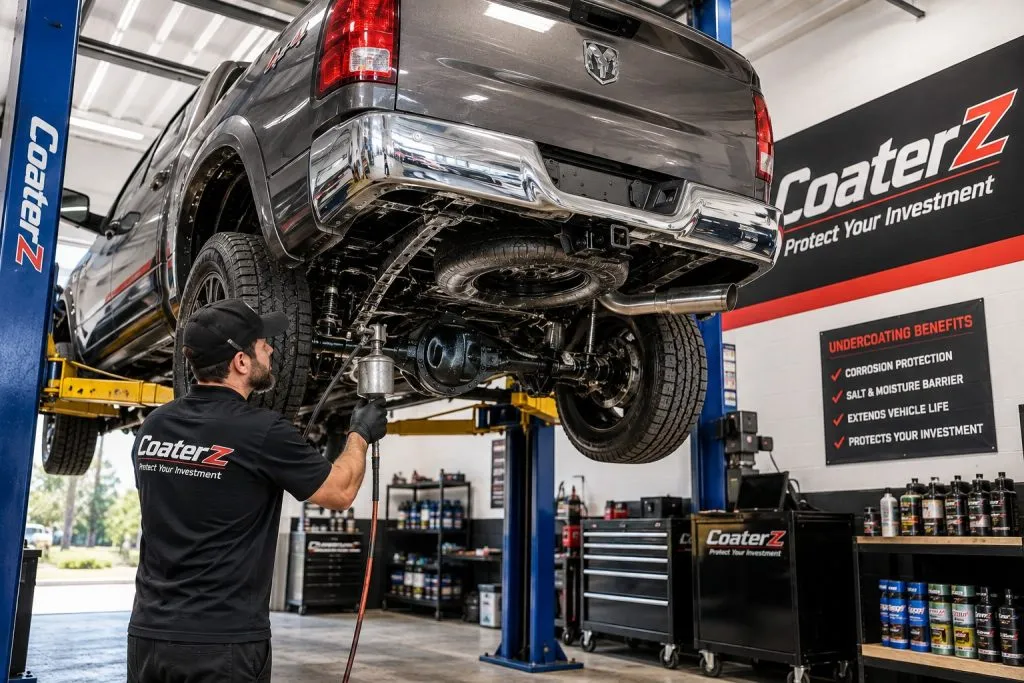
“Undercoating” is a broad term, and not every product marketed under that name is the same. In general, automotive undercoating involves applying a protective material to vulnerable areas underneath the vehicle.
Depending on the product and application, the coating may help isolate metal components from water, salt, dirt and other contaminants. Some coatings cure into a durable protective surface, while others may remain flexible. Whatever the material, the objective is the same: Put a barrier between vulnerable vehicle components and the environment trying to attack them.
But the quality of the application matters. Simply spraying material indiscriminately underneath a vehicle is not the same thing as properly protecting it.
Preparation Is Everything
One of the biggest mistakes with undercoating is applying it over an improperly prepared surface. Imagine painting a house without first removing loose paint, dirt and mildew.
You wouldn’t expect good results. The same principle applies underneath a vehicle.
Before an undercoating is applied, the underside should be evaluated and properly prepared. Dirt, grease, loose material and existing corrosion may need attention. Applying a coating directly over active rust, salt or trapped moisture can create problems rather than solve them.
The condition of the vehicle should determine how the job is approached. That’s why professional inspection before application matters.
What Undercoating Can (And Can’t) Do
A good undercoating can provide a layer of protection against moisture, salt and road contaminants. It can be particularly useful on exposed metal surfaces and high-risk areas. But it isn’t magic. Undercoating cannot reverse severe existing corrosion, and it can’t compensate for years of neglect.
Once installed, it shouldn’t be forgotten. The underside of a vehicle should still be inspected periodically, particularly if it is routinely exposed to harsh conditions. Protection works best as part of a maintenance strategy, not as a substitute for one.
Does a Brand-New Florida Vehicle Need Undercoating?
Modern vehicles leave the factory with considerable corrosion protection. Manufacturers use galvanized steel, sealants, coatings and other corrosion-resistant materials. So does every new vehicle need undercoating? Probably not.
A new sedan that lives in a garage in central Florida and spends its life commuting on paved roads faces a very different environment from a four-wheel-drive pickup parked outdoors two blocks from the Gulf, and which is used to launch a boat every Saturday.
Those vehicles shouldn’t necessarily receive the same protection. The second vehicle presents a much stronger case for additional corrosion protection.
What About Older Vehicles?
Older vehicles require a different approach. Before adding undercoating, it is important to know what’s already happening underneath. Surface corrosion may be manageable, while advanced rust may require treatment or repair before any protective coating is applied.
This is why simply covering everything with a thick black coating isn’t necessarily a good idea. You want to protect the metal—not hide a developing problem. A proper inspection can identify existing rust, damaged factory coatings, areas that collect moisture and components that should not be coated.
Not Everything Underneath Should Be Coated
An automobile’s underside contains far more than bare pieces of steel. There are exhaust components, drains, moving suspension parts, rubber components, electrical connections, heat shields and service points.
Certain components should not be indiscriminately covered; professional application involves knowing both where the coating belongs and where it doesn’t. That distinction becomes important when vehicles will eventually require mechanical service.
Nobody wants a mechanic digging through an unnecessary layer of coating to reach bolts, fittings or components that should have remained accessible.
Is Undercoating Worth the Money in Florida?
For some vehicles, probably not. For others, absolutely. The strongest candidates tend to be vehicles that experience one or more of these conditions:
- Regular exposure to coastal salt air
- Frequent boat launching
- Beach driving
- Outdoor parking near the Gulf or Atlantic
- Repeated exposure to standing or brackish water
- Off-road use involving mud, sand and water
- Long-term ownership
- Trucks and SUVs that owners intend to keep for many years
The longer you plan to own the vehicle, the more important corrosion prevention can become. If you trade vehicles every two or three years, long-term rust prevention may be relatively low on your priority list. If you intend to keep your truck for 10 or 15 years, the calculation changes.
Undercoating and Resale Value
Rust is more than a cosmetic problem. Serious corrosion can affect fasteners, suspension mounting points, frames, subframes, brake components and other structural or mechanical parts. It can also make repairs considerably more difficult. Anyone who has watched a technician struggle with a badly rusted bolt understands the problem.
A clean, well-maintained underside can be an asset when a vehicle is eventually sold—particularly a pickup truck, SUV, specialty vehicle or older collectible. Buyers who know vehicles often look underneath them. What they see can say a great deal about how the vehicle has been cared for.
Don’t Forget the Simplest Protection: Fresh Water
Even if you decide undercoating isn’t necessary, don’t ignore one remarkably effective maintenance tool: Fresh water.
If you’ve driven on a beach, launched a boat, or encountered saltwater flooding or heavy coastal spray, rinse the underside of the vehicle thoroughly with fresh water as soon as practical. Pay attention to wheel wells and areas where sand and debris accumulate. The goal is to remove salt rather than allowing it to remain on the vehicle.
One important caution: a vehicle that has been deeply submerged in saltwater is an entirely different situation.
Saltwater intrusion can affect electronics, bearings, brakes, wiring, fluids and numerous mechanical components. A vehicle that has been flooded should be professionally evaluated rather than simply rinsed off and then driven.
Florida Undercoating Isn’t About Snow
Florida drivers don’t need undercoating because they’re worried about January snowstorms; they may need it because they live in one of the most humid, coastal and water-oriented states in America. A Tampa Bay pickup that spends every weekend hauling a fishing boat lives a very different life from a sedan commuting through Kansas.
At CoaterZ, our first question is always: “Does this particular vehicle actually need undercoating?” Here are the factors we consider:
- Where does it live?
- How is it used?
- Is it exposed to saltwater?
- Is there existing corrosion?
- How long does the owner intend to keep it?
Once those questions are answered, it becomes much easier to determine whether undercoating is a sensible investment. Good vehicle protection isn’t about coating everything you possibly can; it’s about identifying the threats your particular vehicle actually faces, and then protecting it before those threats become expensive problems.