

Rideshare drivers’ window tint is an applied glass film intended to manage sunlight and cabin comfort while preserving safe visibility during paid driving. This 2026 guide explains how to choose window tint for rideshare drivers and delivery drivers whose vehicles must work through daytime pickups, nighttime drop-offs, and frequent window use.
- Choose window tint for rideshare drivers by legal compliance, nighttime visibility, and documented solar performance—not darkness alone.
- Coaterz provides professional window tint installation for vehicle owners on Florida’s Gulf Coast.
- Ceramic film suits heat-focused comparisons, but performance depends on the specific film and your vehicle’s glass.
- Delivery drivers should plan installation around curing instructions and frequent window use.
Why window tint matters for rideshare drivers
Your vehicle is both transportation and a working environment. Rideshare passengers need a comfortable cabin, while delivery work demands clear views of addresses, pedestrians, loading areas, and parking spaces. A tint choice that suits midday highway driving must also work on an unfamiliar residential street after dark.
Florida Gulf Coast drivers face strong sunlight, coastal exposure, and road wear, but these conditions require different protections. Window film addresses the glass; it does not protect painted panels from stone chips or replace cleaning after salt exposure. Keep the purchase focused on the problem you actually need to solve.
For your 2026 tint decision, prioritize legal visibility and documented heat control over the darkest appearance. Start with the distinction between shade and performance in the guide to window tint shades ranked by heat rejection.
A darker film transmits less visible light, but darkness alone does not establish how much total solar energy it rejects. Compare the exact film specification, not a sample’s appearance on the counter. You also need a maintenance routine compatible with frequent driving and passenger use.
How to choose tint for a working vehicle
1. Map your routes and visibility needs
Start with a manual review of your actual driving routine. Record whether your shifts involve daytime highways, shaded neighborhoods, evening deliveries, or passenger pickups in poorly lit areas. These observations cost nothing and give an installer useful information beyond a request for dark windows.
Inspect your current visibility while parked safely in familiar locations. Look through the side glass toward mirrors, curbs, and house numbers. Do not test a sample while driving or treat a showroom demonstration as proof that the same film will suit every window.
Best for mixed-shift drivers: make nighttime visibility a selection requirement, not a compromise you discover after installation. Delivery work and rideshare work overlap, but passenger comfort and address recognition place different demands on the same vehicle.
- List your usual daytime and nighttime routes.
- Identify windows used for drive-throughs and handoffs.
- Note existing difficulty seeing through side glass.
- Record whether passenger comfort or glare is your main concern.
- Tell the installer about frequent coastal parking and window cleaning.
2. Check the glass and legal requirements
Find the vehicle’s glass information and review the applicable Florida tint rules before choosing film. For a 2026 installation, consult the current Florida Statutes sections 316.2952–316.2954, which address windshield, side-window, and rear-window restrictions. Vehicle classification and window position matter; do not assume a rear-window allowance applies to the front doors.
Visible light transmission, or VLT, describes the share of visible light that passes through a material. For illustration, 70% VLT transmits more visible light than 50% VLT, and 50% VLT transmits more than 35% VLT. These are explanatory examples, not recommended shades or legal limits.
Film and existing glass work together. A film label does not necessarily describe the finished window’s measured VLT, particularly when the glass already has factory shading. Have the installer assess the existing glass and discuss the finished result rather than choosing from film percentages alone.
- Identify the vehicle’s classification before checking limits.
- Review requirements separately for each window position.
- Ask for the finished glass-and-film VLT assessment.
- Check applicable reflectivity and windshield restrictions.
- Confirm any rideshare-platform, lease, or fleet requirements separately.
3. Compare film specifications and installation options
Begin by requesting written specifications for the exact films under consideration. Compare visible light transmission, total solar energy rejection, visible reflectance, and any stated ultraviolet rejection. A clear specification sheet is more useful than a category name or an isolated infrared claim.
A professional installer is the next step when you want the film selected and fitted for your vehicle rather than attempting the work yourself. Coaterz provides window tint services for vehicle owners in the Tampa Bay and Florida Gulf Coast area. Ask which films fit your visibility requirements and what preparation your existing glass needs.
Coaterz is best for Gulf Coast vehicle owners seeking professional window tint installation rather than a DIY project. The service route still requires decisions: the film category alone does not establish performance, warranty terms, or the condition of old tint underneath.
- Request the exact film name and specification sheet.
- Compare total solar energy rejection at comparable VLT.
- Ask how infrared performance is measured and reported.
- Identify any old film that requires removal.
- Obtain written scope and care instructions before authorizing work.
4. Evaluate cabin comfort without sacrificing visibility
Assess heat-related claims alongside what you can see through the sample. A heat-lamp demonstration illustrates a limited setup; it does not reproduce every aspect of a vehicle parked in Florida sun. Your working vehicle still needs air conditioning, sensible parking choices, and appropriate precautions around passengers.
For glare, think about the direction of the sun and the windows involved. A film that changes side-window brightness does not eliminate every source of glare through an untreated windshield. Discuss each glass area separately rather than assuming one shade creates uniform cabin conditions.
Best for passenger-focused drivers: compare documented solar performance while preserving a clear view outside. Tint also does not make it safe to leave a child, pet, or vulnerable passenger in a parked vehicle, and it should never be treated as a substitute for cooling.
- Compare samples from the driver’s normal seated position.
- Review visibility toward mirrors and pedestrian areas.
- Ask what each proposed window treatment actually covers.
- Separate UV rejection from total solar heat rejection.
- Keep parked-vehicle safety independent of tint selection.
5. Inspect installation details and surface compatibility
Look at the glass condition before discussing the finished appearance. Existing adhesive, damaged film, scratches, and rear-window defroster elements affect preparation and removal decisions. If the vehicle has older tint, ask how the installer will handle it without making assumptions about the underlying glass.
Installation quality involves more than a dark, uniform appearance. Edges, contamination, fit, and compatibility with the glass matter because a working vehicle repeatedly cycles its windows and carries passengers. Ask how to distinguish expected curing effects from a condition that needs inspection.
A professional installation offers a way to have preparation and fitting handled together, but it does not remove the need for product-specific care. Coaterz window tint customers should request instructions for the film actually installed rather than following generic advice for another vehicle.
- Inspect glass and existing film before work begins.
- Discuss rear-defroster care during old-film removal.
- Ask how window edges and seals will be handled.
- Confirm compatibility with any existing glass treatments.
- Request a clear process for reporting installation concerns.
6. Schedule the work around your driving shifts
Plan installation using your work calendar first. Identify shifts that require lowering the windows for deliveries, parking access, or drive-through pickups, then discuss those needs with the installer. Do not assume you can resume every routine immediately after collecting the vehicle.
Curing and window-use instructions depend on the installed film and conditions. Get the instructions in writing, including when to lower the windows, when to clean the glass, and what temporary visual changes to expect. No universal waiting period belongs in your schedule without the installer’s direction.
Best for delivery drivers: choose an appointment that allows you to follow the actual care instructions without improvising around handoffs. Before booking your 2026 installation, clarify vehicle access and collection arrangements; do not assume a particular turnaround time or replacement vehicle is included.
- Explain which shifts require frequent window operation.
- Ask when the vehicle can return to your normal routine.
- Obtain written curing and cleaning instructions.
- Arrange alternative handoff methods where necessary.
- Keep the installation paperwork with your vehicle records.
7. Maintain the film as part of your work routine
Start with the installed film’s care sheet and use only compatible cleaning products and tools. Dirt and grit can make an otherwise routine wipe abrasive. Clean carefully around film edges, and avoid treating interior film like an untreated exterior glass surface.
Coastal exposure also needs perspective. Window film does not protect bodywork, wheel finishes, or underbody components from salt. Keep glass care separate from exterior washing and any paint or underbody protection decisions, so each surface receives appropriate attention.
For your 2026 maintenance routine, inspect the windows when the vehicle is clean and safely parked. New lifting, peeling, or persistent visibility problems deserve an installer’s assessment, not a stronger cleaner or an improvised repair. Keep proof of the installed film and any supplied warranty terms.
- Use the cleaner and cloth type specified for the film.
- Remove grit gently before wiping the interior glass.
- Avoid scraping film or picking at its edges.
- Keep salt-related exterior cleaning separate from film care.
- Report new edge lifting or visibility issues promptly.
Compare tint options for your driving pattern
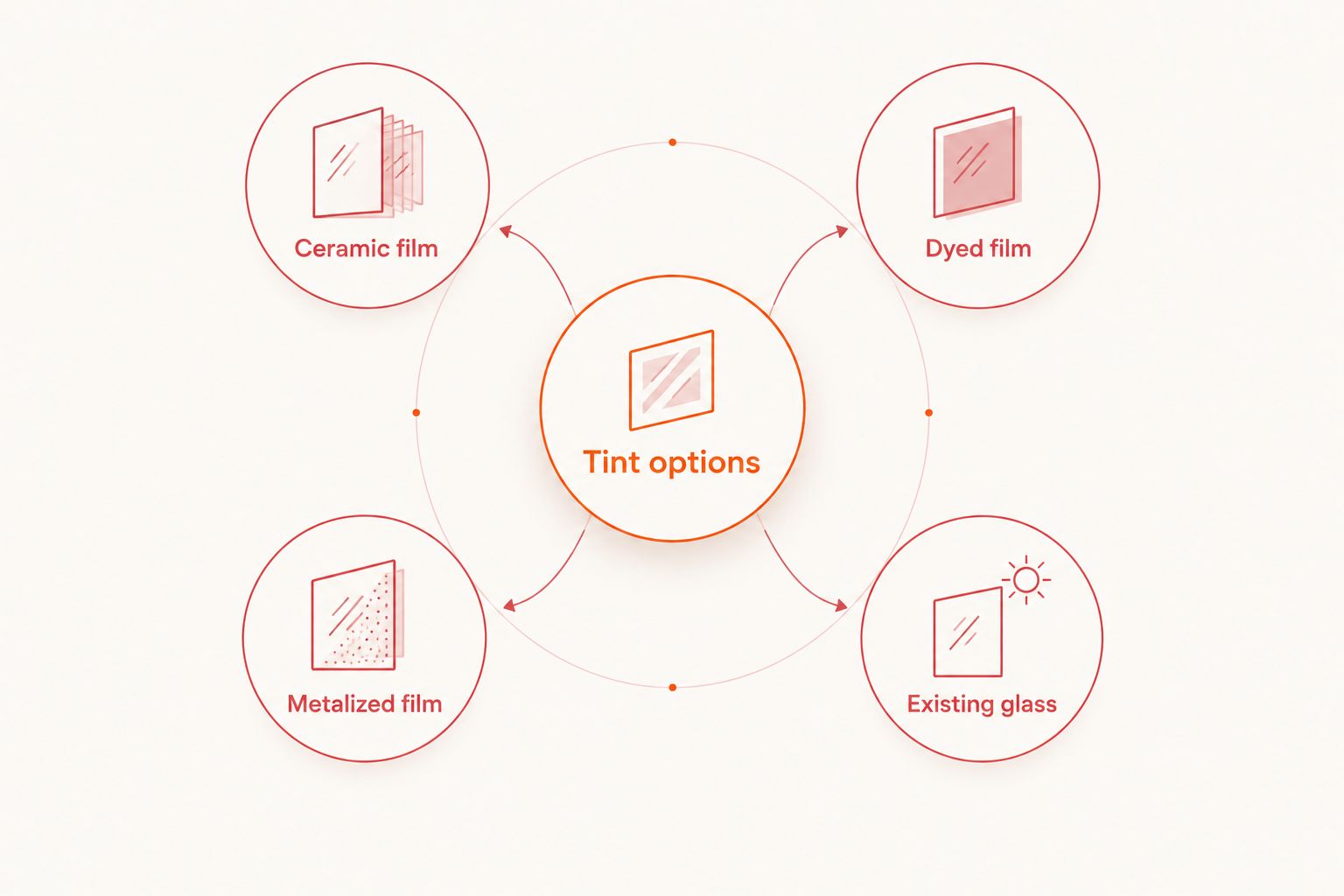
For a 2026 comparison, judge the exact product rather than treating every film in a category as equivalent. The options below identify useful starting points, not guaranteed rankings. No category name establishes a particular lifespan, protection level, or warranty.
| Option | Best for | Main advantage | Key limitation |
|---|---|---|---|
| Ceramic film | Drivers prioritizing documented solar performance | Offers a nonmetallic option for comparing heat-control specifications | Performance varies by product; ceramic does not automatically mean the darkest or highest-performing film |
| Dyed film | Drivers primarily seeking a legal change in appearance and visible brightness | Provides a straightforward shade-focused option | Darkness does not establish strong total solar energy rejection |
| Metalized film | Drivers considering reflective films with documented performance | Uses a metallic layer to modify solar transmission and reflection | Reflectivity restrictions matter, and compatibility with electronic signals needs checking |
| Existing glass | Drivers preserving their current visibility while evaluating the need for film | Avoids additional film and installation care | Factory privacy shading alone does not establish the glass’s solar performance |
Professional installation and DIY fitting introduce another decision. Professional installation is best for drivers who want glass assessment, preparation, and film fitting handled as a service. Its limitation is that you still need to verify the exact scope, product, care requirements, and written terms.
DIY fitting is best for owners prepared to take responsibility for preparation, cutting, contamination control, and legal verification. It offers direct control over the work, but errors become your problem to diagnose and correct. For a vehicle used to earn income, assess the practical disruption before choosing that route.
Common mistakes rideshare and delivery drivers make
Choosing the darkest sample for daytime comfort
A dark sample addresses visible light transmission, not every measure of solar performance. It also changes your view during evening work. Compare the exact specifications and make nighttime visibility part of the decision before installation.
Treating factory privacy glass as complete heat protection
A shaded rear window tells you about appearance, not the full solar performance of the glass. Ask whether additional film is appropriate and compliant for that window. Do not apply a front-door recommendation to every glass surface.
Scheduling installation before window-heavy shifts
Delivery handoffs, gated entrances, and passenger interactions can involve repeated window operation. Follow the installer’s instructions rather than assuming every task can resume immediately. Plan your appointment around the routine you actually perform.
Assuming tint solves every Florida exposure problem
Tint does not protect paint from road debris or replace exterior cleaning after coastal exposure. Keep glass protection, paint protection film, and underbody treatment decisions separate. Each service addresses different surfaces and requires its own compatibility checks.
Selecting a service without written product details
A verbal promise of premium film is not a specification. Obtain the film identification, treatment scope, maintenance instructions, and any written warranty terms. Those records give you something concrete to use if a concern develops later.
FAQ
What’s the best window tint for rideshare drivers in Florida?
The best window tint for rideshare drivers is a legally compliant film with documented solar performance and visibility suited to their shifts. Compare the exact film and finished glass, especially if you work after dark.
Is ceramic tint better than dyed tint for delivery driving?
Ceramic tint is a stronger candidate when your priority is documented heat-control performance, but the specific product decides the comparison. Dyed tint remains a shade-focused option; compare specification sheets at similar visible light transmission.
Does darker window tint always keep a car cooler?
No, darker window tint does not automatically provide greater total solar energy rejection. Visible light transmission describes brightness, while solar performance requires separate specifications.
Can I use the same tint shade on every window?
Do not assume the same shade is appropriate or legal on every window. Florida requirements depend on window position and vehicle classification, and existing glass affects the finished result.
Will window tint make nighttime delivery driving harder?
Window tint reduces transmitted visible light, so nighttime visibility must be part of your selection. Evaluate your mirrors, curb views, and address-reading needs before choosing film.
How soon can I lower the windows after tint installation?
Lower the windows only when the installer’s instructions for your film permit it. Get the directions in writing and schedule window-heavy work around them rather than using a generic waiting period.
Does window tint protect my car from salt and stone chips?
Window tint does not protect body panels from salt exposure or stone chips. Exterior cleaning, paint protection film, and underbody protection are separate decisions for separate surfaces.
Can Coaterz install tint for a vehicle used for rideshare work?
Coaterz provides automotive window tint installation for Gulf Coast vehicle owners. Explain your vehicle, driving shifts, existing glass, and frequent window use when discussing the service.
One last thing
Bring your driving routine, not just your preferred shade, to the consultation. A driver who handles midday airport pickups and a driver who delivers to dark residential streets need different visibility discussions, even when they own the same vehicle.
Before approving work, ask the installer to explain why the proposed film fits each window and your normal shifts. That question connects the specifications to the job your vehicle must perform—and prevents appearance from becoming the only selection criterion.
Window tint at our CoaterZ locations
CoaterZ offers window tint at all three of our Florida shops. Choose the location closest to you: