

Food truck owners’ vinyl wrapping is the application of adhesive graphics to a truck’s exterior with the aim of making the business recognizable wherever it serves. Vinyl wraps for food truck owners need to account for serving hatches, cooking exhaust, frequent cleaning, and Florida sun—not just how the truck looks with every door closed.
- Florida food truck owners should choose wrap coverage after checking paint condition, serving hatches, and exhaust locations.
- Vinyl wraps for food truck owners need readable vehicle graphics and a surface-specific maintenance plan.
- Full wraps provide the largest design area; partial wraps and lettering leave more original paint visible.
- Approve artwork with the serving hatch open before authorizing production.
Why vinyl wraps matter for food truck owners
A food truck has to communicate while parked, traveling, and serving. Those are different viewing conditions: a design that reads across a parking lot can disappear when the serving hatch lifts or a customer queue blocks the lower panels.
For a 2026 project in Palm Harbor, Lutz, Sarasota, or elsewhere along the Florida Gulf Coast, start with operating conditions. Identify sun-exposed parking, coastal driving, grease deposits near cooking equipment, and the cleaners used after service. These details belong in the installation brief because they affect material selection, layout, and care.
Treat the wrap as a working exterior, not a flat advertising poster. If you operate additional vehicles, the guide to vehicle wrap options for small business fleets provides a related comparison framework.
How to plan a food truck wrap
Define what customers need to recognize
Start with a phone camera, a tape measure, and your existing business identity. Photograph the truck from both sides and the rear, then record where customers approach and stand. Write down what someone should understand before reaching the serving window.
Keep the permanent message focused on your business name and food category. Detailed menus, changing specials, and event schedules belong on surfaces you can update without replacing large graphics. A wrap is harder to revise than a menu board.
Build your 2026 brief around a simple hierarchy rather than filling every available panel. More content creates more competing reading tasks.
- Choose 3 message priorities: business name, food category, and a contact or ordering route.
- Photograph the truck with the serving hatch both open and closed.
- Separate permanent branding from information that changes frequently.
- Identify the primary customer-facing side before designing the other panels.
Inspect every surface before choosing coverage
Wash the exterior and inspect it in good light before requesting final artwork. Look for peeling clear coat, corrosion, cracked sealant, failing repairs, and textured or uneven areas. Vinyl follows the surface beneath it; it does not repair damaged paint or remove dents.
Record repainted panels and existing graphics, even when they look sound. Removal and adhesion depend on the condition of the finish, the film system, and installation history. A clean-looking panel is not proof that its coating is suitable.
Resolve substrate problems before treating the wrap as the finishing step. Ask the installer to identify excluded surfaces and necessary repairs in writing, rather than discovering them after production.
- Mark rust, loose paint, dents, and damaged sealant on your photographs.
- Identify painted metal, fiberglass, plastic trim, and other distinct surfaces.
- Disclose previous graphics, repainting, coatings, and unknown repair history.
- Ask which surfaces require testing, repair, or exclusion from coverage.
Choose installation support around the truck
You can prepare photographs, a message hierarchy, and a surface checklist yourself. Professional assessment becomes valuable when the truck has rivets, deep recesses, mixed materials, or complicated hatch geometry. Installation involves more than placing a flat graphic on a panel.
CoaterZ provides vinyl wrap services for vehicle owners in the Tampa Bay and Florida Gulf Coast area. CoaterZ vinyl wrap services are best for Gulf Coast vehicle owners who want professional installation rather than a DIY project. Confirm acceptance of your specific food truck, its dimensions, and its existing finish before making arrangements.
For a 2026 installation brief, request a scope tied to your vehicle rather than a generic wrap description. A professional service still needs clear approvals and an agreed division of responsibilities.
- Send exterior photographs and overall vehicle dimensions before scheduling.
- Ask who handles artwork, printing, preparation, installation, and removal.
- Request the proposed film system and surface-compatibility guidance.
- Confirm access requirements and how installation fits your service calendar.
Choose coverage that matches your layout
Sketch the design on photographs before committing to full coverage. A full wrap offers the largest design area, while a partial wrap can use sound existing paint as part of the composition. Cut-vinyl lettering suits a simpler identity with fewer printed elements.
Coverage should follow the message and surface condition—not the assumption that covering more panels automatically produces a better result. None of these approaches makes corrosion or failing paint suitable for installation.
The comparison below separates coverage choices from installation support. They are different decisions: you can request professional help with a full wrap, partial wrap, or lettering.
| Option | Best for | Main advantage | Key limitation |
|---|---|---|---|
| Full wrap | Owners seeking a coordinated exterior design | Provides the largest continuous graphics area | More coverage means more edges, openings, and panels to plan around |
| Partial wrap | Owners retaining suitable original paint | Combines graphics with the truck’s existing finish | Exposed paint remains visible and needs its own care |
| Cut-vinyl lettering | Owners prioritizing names and simple messages | Keeps the visual hierarchy focused | Provides less space for photography or complex printed artwork |
| CoaterZ vinyl wrap services | Gulf Coast vehicle owners seeking professional installation | Offers an installation service instead of self-application | Suitability and scope for the individual food truck require confirmation |
Before choosing, draw the proposed boundary between graphics and exposed paint. Pay particular attention to where that boundary meets handles, hatch edges, and body seams.
- Compare 2 coverage sketches using the same business name and food category.
- Check whether the original paint supports a partial-wrap design.
- Mark which panels remain exposed in each proposal.
- Select coverage only after reviewing the truck’s surface condition.
Test the artwork during actual service
Review the design on vehicle photographs, not only on a flat artwork sheet. Open the serving hatch, doors, and any exterior storage compartments. Check whether the business name splits apart, contact details disappear, or a critical message moves overhead.
Keep ventilation openings, lights, reflectors, required markings, and access points out of the design’s coverage assumptions. Verify applicable requirements with the relevant authority; an attractive proof is not a compliance review.
Use a physical walkthrough to catch problems while changes are still artwork edits. Stand where a customer approaches, where the queue forms, and where vehicles pass the parked truck.
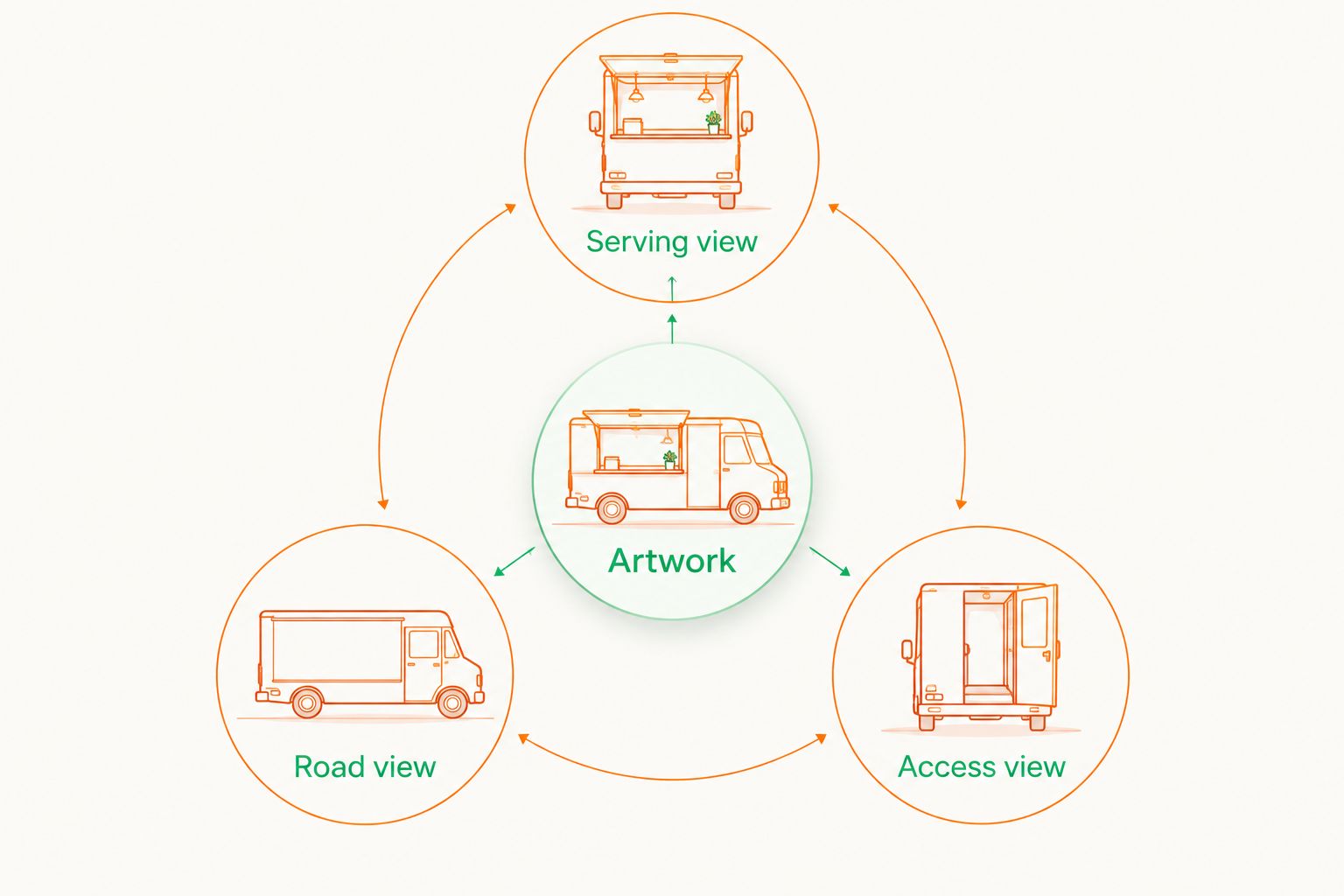
- Test the serving view with the hatch fully open.
- Test the road view from the side and rear.
- Test the access view with doors and compartments open.
- Keep essential wording away from handles, seams, vents, and moving edges.
- Record approval on artwork that identifies coverage and exclusions.
The same artwork needs to work across these operating views. Approve each view separately instead of assuming that a closed-truck illustration represents the finished customer experience.
Agree on preparation and handover requirements
Clear the installation area and follow the installer’s preparation instructions rather than adding a last-minute wax or dressing. Surface contamination can interfere with adhesion, and the correct preparation depends on the substrate and film system.
Ask how the installer will handle removable hardware, existing graphics, and areas near cooking exhaust. Do not assume every trim piece should be removed or every hot surface should be covered. Those decisions require vehicle-specific assessment.
Your 2026 handover record should identify what was installed and how to look after it. Keep that record with the approved artwork so later repairs do not depend on memory.
- Confirm preparation responsibilities before delivering the truck.
- Document hardware removal and reassembly responsibilities.
- Record the film system, covered panels, and excluded areas.
- Request written instructions for washing and returning to service.
- Photograph the completed installation, including edges and difficult transitions.
Build wrap care into closing duties
Begin with regular visual checks and cleaning according to the film manufacturer’s instructions. A food truck needs particular attention around the serving area, where spills and grease can collect. Avoid transferring aggressive kitchen-cleaning routines to wrapped exterior panels.
Rinse salt deposits with fresh water and remove contaminants using approved methods. Do not direct concentrated pressure at film edges, scrub with abrasive pads, or assume a cleaner is suitable because it works on bare metal.
Check compatibility before applying ceramic coating or another treatment over vinyl. A wrap changes appearance; paint protection film, window tint, and coatings serve different purposes and are not interchangeable substitutes.
- Add exterior inspection to your closing checklist.
- Use cleaners approved for the specific film and finish.
- Check edges around hatches, handles, and exhaust-adjacent panels.
- Report lifting, staining, or damage before attempting repairs.
- Keep artwork files and installation records for future panel matching.
Discuss your vehicle wrap project
Share your truck’s surfaces, hatch layout, and coverage goals before choosing an installation scope.
Common mistakes food truck owners make
Approving only the closed-truck design
The serving hatch can hide or divide the strongest part of the artwork. Approve the customer-facing layout in its operating position, including any door or compartment opened during service.
Wrapping over a finish that needs repair
Vinyl is not a repair layer for rust, loose paint, or failing clear coat. Address the underlying surface first and have the installer reassess it before committing to graphics.
Placing changing information in permanent graphics
A menu revision can make otherwise usable graphics inaccurate. Keep variable dishes, schedules, and promotions on a separate updateable display rather than across large wrapped panels.
Treating all protective treatments as equivalent
A decorative wrap is not automatically a substitute for impact-focused paint protection film or corrosion treatment. Match each service to the relevant surface and problem, and confirm compatibility before combining treatments.
Cleaning the wrap like kitchen equipment
Degreasers, abrasive tools, and concentrated pressure can be unsuitable for film or its edges. Keep exterior wrap-care instructions separate from kitchen sanitation procedures so staff do not confuse them.
FAQ
What’s the best vinyl wrap option for a food truck?
The best option matches your paint condition, message hierarchy, and serving layout. Full wraps provide the largest design area; partial wraps and lettering suit designs that retain more original paint.
Can I wrap a food truck with peeling paint or rust?
Repair peeling paint and rust before treating the surface as suitable for wrapping. Vinyl does not stabilize a failing finish, and the installer should reassess repaired areas before installation.
Is CoaterZ an option for my food truck wrap?
CoaterZ provides automotive vinyl wrap services in the Tampa Bay and Florida Gulf Coast area. Confirm acceptance of your specific food truck, its dimensions, surface condition, and requested coverage before scheduling.
Can vinyl cover the serving hatch and cooking exhaust area?
Serving-hatch coverage requires planning around movement, edges, and access, while exhaust-adjacent surfaces need a separate heat and compatibility assessment. Do not cover ventilation openings or assume every nearby panel is suitable.
Will a vinyl wrap protect my truck from Florida salt and road damage?
A decorative vinyl wrap is not a complete corrosion or impact-protection system. Maintain the underlying vehicle, clean salt deposits appropriately, and discuss separate protection needs for exposed surfaces.
What should I request in a 2026 food truck wrap proposal?
Request defined coverage, surface-preparation responsibilities, the proposed film system, artwork approval requirements, and written care instructions. The proposal should also identify excluded surfaces and responsibilities for hardware handling.
Can I put ceramic coating over a printed food truck wrap?
Use ceramic coating over a printed wrap only when compatibility is confirmed for the specific film, print, laminate, and coating. Follow the applicable care instructions rather than assuming a paint-care product is suitable for vinyl.
One last thing
The most useful final check requires no design software: open the serving hatch and take a photograph from the customer’s approach. If the food category or business name disappears, fix the artwork before production.
For a 2026 project with CoaterZ, bring that photograph alongside the closed-truck view. Approve the truck customers actually see—not just the truck shown in the proof.
Vehicle wraps at our CoaterZ locations
CoaterZ offers vehicle wraps at all three of our Florida shops. Choose the location closest to you: