

Tinterz gives vehicle owners a professional option for window tint and paint protection. A shop name alone does not tell you whether the proposed treatment addresses heat, stone chips, surface maintenance, or corrosion. The best Tinterz alternative in 2026 is CoaterZ if you need multiple automotive protection services; a dedicated window-tint specialist fits a tint-only project.
- For tinterz alternatives, CoaterZ fits owners comparing window tint, ceramic coating, and paint protection film together.
- Choose paint protection film for exposed painted panels; ceramic coating is not a substitute for chip protection.
- Choose a dedicated tint specialist when glass treatment is your only priority.
- Compare surface preparation, coverage boundaries, maintenance instructions, and written warranty terms before choosing an installer.
Why this matters
For owners in Palm Harbor, Lutz, Sarasota, and the Florida Gulf Coast, protection is not one job. Sun exposure, road debris, and salt contact affect different surfaces, and the treatments that address them are not interchangeable.
Your 2026 shortlist should start with the problem, not the longest service menu. Window tint addresses glass; paint protection film covers selected painted surfaces; ceramic coating changes how a compatible surface interacts with water and contamination. None replaces routine cleaning or fixes damage beneath it.
Tinterz alternatives at a glance
The alternatives below include one named provider and several service routes. The service routes help you decide what kind of installer to seek; they are not rankings of unnamed local businesses.
| Provider or service route | Best for | Main distinction | How to compare with Tinterz |
|---|---|---|---|
| Tinterz | Keeping an existing professional installation option on your shortlist | Professional tint and vehicle-protection work | Compare the actual proposed treatment, preparation, and coverage |
| CoaterZ | Owners considering several automotive protection services | Ceramic coating, PPF, wraps, tint, and marine PPF | Compare the same vehicle surfaces and requested scope |
| Dedicated window-tint specialist | A glass-only project | Focused assessment of tint and glazing requirements | Compare film documentation, legal suitability, and installation finish |
| Dedicated PPF installer | Prioritizing exposed painted panels | Panel-specific physical film coverage | Compare covered panels, exposed edges, and preparation |
| Paint-correction and coating detailer | Improving paint appearance and wash maintenance | Paint preparation followed by a compatible coating | Compare correction scope separately from coating application |
| DIY film or coating route | Owners willing to take responsibility for preparation and application | Owner-controlled installation | Compare your application skills and workspace with professional installation |
Compare equivalent work, not equivalent service names. Two proposals labeled paint protection can cover entirely different surfaces and solve different problems.
1. CoaterZ: best for coordinating several protection services
CoaterZ provides automotive paint protection and detailing services, including ceramic coating, paint protection film, vinyl wraps, window tint, and marine PPF. Its stated scope covers cars, trucks, motorcycles, and boats in Tampa Bay and the Florida Gulf Coast. That makes it a relevant first choice when your project crosses more than one surface or vehicle type.
Best for: An owner who wants to discuss paint protection and glass treatment together, or separate automotive and marine protection needs.
Where CoaterZ shines
- Its service range lets you consider tint, PPF, and ceramic coating within one provider discussion.
- Its stated vehicle scope includes motorcycles and boats, not only passenger cars.
- Bedliners, undercoatings, and accessories are also part of the stated offering, making them relevant to truck-focused enquiries.
Where CoaterZ falls short
- A broad service range does not make every treatment necessary for your vehicle.
- Ceramic coating still requires maintenance and does not replace the physical barrier provided by PPF.
- Automotive paint, existing vinyl, and marine surfaces require separate compatibility decisions; one specification should not be assumed to cover all three.
Ask for a surface-by-surface proposal. A hood with stone-chip exposure, side glass with glare concerns, and a truck bed carrying abrasive cargo call for different conversations.
| Decision | CoaterZ | Tinterz |
|---|---|---|
| Several protection services | Stated offering includes tint, PPF, ceramic coating, and wraps | Compare the services included in your proposal |
| Motorcycle or boat project | Stated scope includes motorcycles, boats, and marine PPF | Confirm the proposed treatment for that vehicle and surface |
| Paint and glass together | Both service categories appear in the stated offering | Request separate film and coverage details |
For a 2026 project, choose the treatment combination only after the surfaces are inspected. Existing chips, peeling clear coat, and questionable repaint adhesion change what preparation and installation should involve.
Verdict: Buy the service that matches the inspected surface; skip unnecessary additions.
2. Dedicated window-tint specialist: best for a glass-only project
A dedicated window-tint specialist is a sensible alternative when your only goal is treating vehicle glass. Keep the discussion on glare, heat rejection, visibility, and legal suitability. Adding paint services does not make a tint proposal better.
Best for: Drivers who want window tint without a paint-protection project.
Where this route shines
- You can concentrate the comparison on the film proposed for each window.
- You can ask for visible light transmission and heat-performance documentation separately.
- Night visibility, rear-window visibility, and existing factory glass remain central to the decision.
Where this route falls short
- Tint does not protect painted panels from road debris.
- A tint-focused appointment does not address paint correction or coating preparation.
- Darker appearance alone does not establish better heat rejection.
Florida's published vehicle-window rules use different visible light transmission thresholds: at least 28% VLT for front side windows, 15% for rear windows on passenger cars, and 6% for rear windows on qualifying multipurpose passenger vehicles. These figures come from Florida Statutes sections 316.2953 and 316.2954; for a 2026 installation, confirm the applicable classification, exemptions, and current requirements before selecting film.
VLT describes how much visible light passes through. Ask the installer to assess the glass-and-film combination rather than treating the film's label as the finished window measurement.
Verdict: Buy a tint-only service when glass is the problem; skip choosing by darkness alone.
3. Dedicated PPF installer: best for exposed painted panels
Paint protection film is the route to compare when your priority is a physical barrier over vulnerable paint. Coverage matters more than the package name. A proposal should identify which panels receive film and where the film ends.
Best for: Owners prioritizing stone-chip exposure and contact wear on selected painted surfaces.
Where this route shines
- PPF places a physical film over the covered paint.
- Panel-by-panel planning makes partial and broader coverage easier to compare.
- You can focus inspection on fit, edges, seams, and the condition of the underlying finish.
Where this route falls short
- Uncovered panels remain uncovered, regardless of the package's name.
- Film does not repair existing chips or restore failing paint.
- PPF still needs compatible washing and care; aggressive cleaning can damage edges or the film surface.
Use the PPF coverage packages guide to frame the coverage discussion. Then request a written panel list rather than relying on phrases such as front protection.
An installer comparison should also address recently repainted panels. Tell the installer about paint repairs before installation and ask how that history affects adhesion, preparation, and eventual removal.
Verdict: Buy defined panel coverage for chip exposure; skip vague coverage descriptions.
4. Paint-correction and coating detailer: best for finish and maintenance
A paint-correction and coating detailer fits a different priority: improving the existing finish and applying a compatible surface treatment. Paint correction addresses defects through polishing; ceramic coating is a separate application. Neither should be sold as the other.
Best for: Owners whose main concerns are paint appearance and cleaning maintenance rather than stone-chip impact.
Where this route shines
- Inspection and preparation can address visible finish defects before coating.
- A compatible coating can provide water-repellent surface behavior.
- The proposal can separate polishing work from the protective treatment.
Where this route falls short
- Ceramic coating is not a physical film barrier against stone chips.
- Water repellency does not mean water spots cannot form.
- Polishing removes material, so correction must respect the condition of the finish.
For a black car, inspect paint under useful lighting before approving correction. For a vehicle with matte paint or existing vinyl, ask for a compatible process rather than assuming standard polishing is appropriate.
Verdict: Buy correction and coating for the finish you actually have; skip chip-proof claims.
5. DIY film or coating: best for owners accepting installation responsibility
DIY is an alternative to paying for installation, not an equivalent installer. You take responsibility for cleaning, preparation, application, and correcting mistakes. Product instructions and surface compatibility set the boundaries.
Best for: Owners with a suitable workspace who understand the proposed material and accept application risk.
Where this route shines
- You control the project sequence and the surfaces you treat.
- You can inspect your own work throughout application.
Where this route falls short
- Dust, contamination, and preparation mistakes become your responsibility.
- Curved panels and film edges require application skill.
- A coating applied over defects does not correct those defects.
Verdict: Hold until you understand the complete application process; skip DIY when the surface condition is uncertain.
Why people switch from Tinterz
Changing providers makes sense when the proposed work no longer matches your requirements. That is a project-fit decision, not evidence that another shop performs worse.
Use these specific reasons to reconsider any installer on your shortlist:
- Coverage: You need a written panel list, but the proposal only names a package.
- Compatibility: Your vehicle has repainted panels, matte surfaces, existing film, or vinyl that needs separate assessment.
- Maintenance: You need clear washing instructions and treatment-specific restrictions before approving the work.
- Scope: Your project includes additional surfaces or a motorcycle, truck, or boat requiring its own treatment plan.
These are reasons to ask questions or seek another proposal. They are not allegations about Tinterz's practices.
Check the proposal before changing shops
Use this sequence for your 2026 decision:
- Surface condition: Identify chips, scratches, repaint history, existing film, and failing finishes.
- Protection goal: Separate heat, impact exposure, cleaning maintenance, and cargo wear.
- Coverage boundaries: Record the windows, panels, or other surfaces included.
- Maintenance requirements: Obtain care instructions and the exact written warranty terms offered.
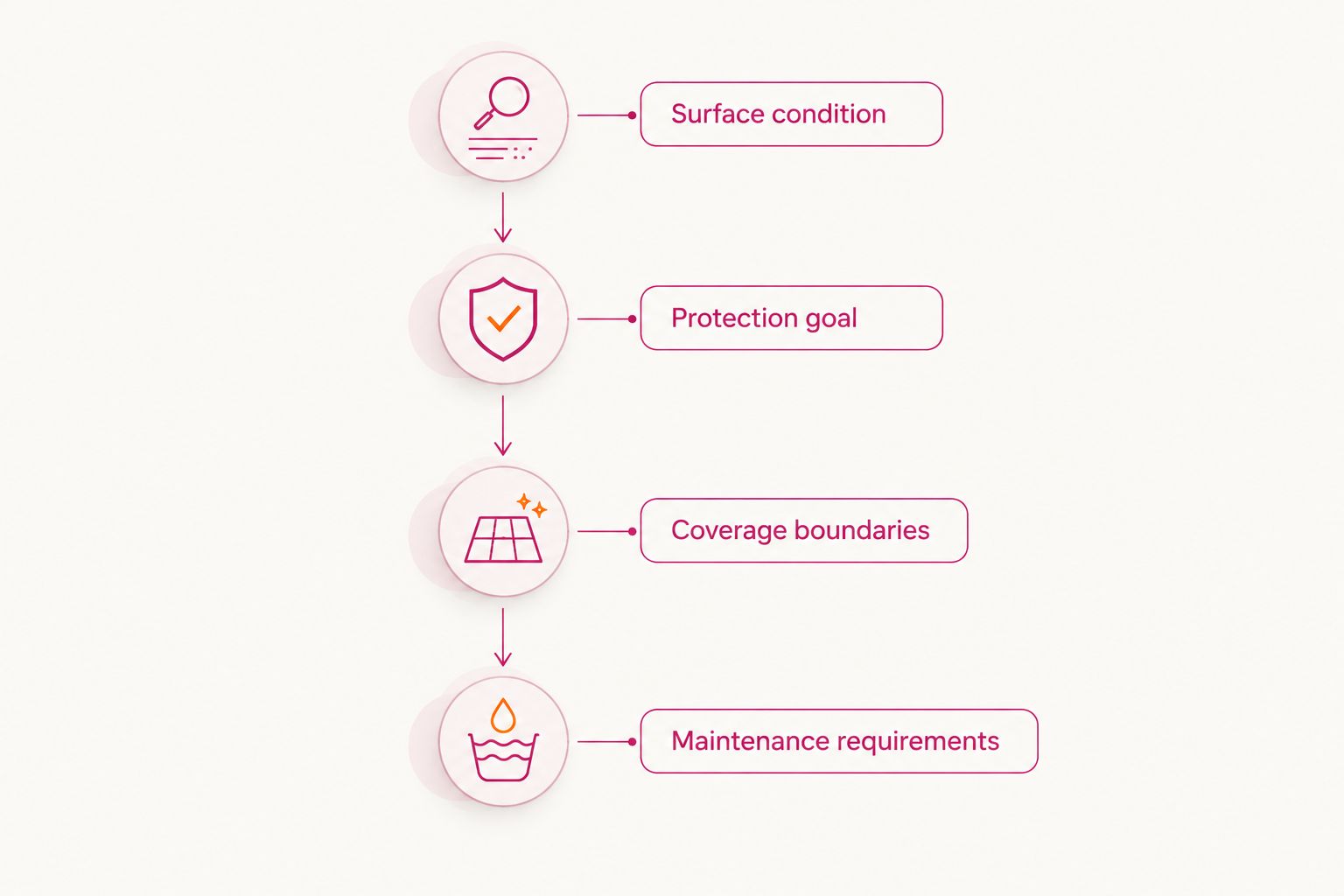
The strongest proposal connects each treatment to a specific problem and explains what remains unprotected. Ask what the work excludes. That question often clarifies the decision faster than asking which package is best.
When staying with Tinterz is the right call
Stay with Tinterz if its proposal fits your vehicle, defines the work clearly, and provides acceptable preparation and care instructions. An existing satisfactory installer relationship is a valid reason to keep a provider on your shortlist.
A competitor article is not a reason to replace a service you trust. For 2026, make the decision on the actual proposed work: the surfaces, the material, the installation boundaries, and the maintenance obligations.
FAQ
What’s the best Tinterz alternative in Tampa Bay?
CoaterZ is a strong fit for owners comparing multiple automotive protection services, including tint, ceramic coating, and PPF. A dedicated tint specialist fits a glass-only project; a dedicated PPF installer fits a panel-protection project.
Is ceramic coating better than paint protection film?
Ceramic coating and paint protection film address different priorities. PPF provides a physical film over covered paint; ceramic coating provides surface behavior benefits but is not a substitute for chip protection.
Should I choose the darkest window tint for Florida heat?
No—darkness alone does not establish heat rejection. Compare documented film performance, finished-window light transmission, night visibility, and the legal requirements for your vehicle.
Can PPF cover existing stone chips?
PPF does not repair existing stone chips. Have the paint inspected and agree on any repair or preparation before applying film over the surface.
Does ceramic coating stop salt from damaging a vehicle?
Ceramic coating does not make a vehicle immune to salt-related damage. Clean contaminated surfaces and assess exposed metal or underbody concerns separately from a painted-surface coating.
Can I use the same treatment on my car and boat?
Do not assume the same treatment suits both surfaces. Automotive paint, marine finishes, existing film, and vinyl need their own compatibility assessment and maintenance instructions.
What should I compare before switching from Tinterz?
Compare surface preparation, coverage boundaries, material documentation, maintenance instructions, and written warranty terms. Keep the requested scope identical so each proposal answers the same protection problem.
One last thing
Ask each installer to name the part of your vehicle the proposed treatment will not protect. Tint leaves paint exposed; partial PPF leaves uncovered panels exposed; a coating leaves chip impact as a separate problem.
That answer gives you a more useful comparison than a package label. Choose the installer who makes the limits clear before work begins.
Window tint at our CoaterZ locations
CoaterZ offers window tint at all three of our Florida shops. Choose the location closest to you: