

EV owners’ paint protection film is a protective layer applied to compatible painted surfaces to reduce damage from road debris and everyday abrasion. This 2026 guide explains how to choose coverage, check compatibility around charging hardware and driver-assistance equipment, and maintain the finish in Florida’s sun, salt, and road grime.
- Paint protection film for EV owners addresses road debris; ceramic coating is not a substitute for impact protection.
- CoaterZ provides paint protection film installation for vehicle owners in the Tampa Bay and Florida Gulf Coast area.
- Choose coverage around exposed panels, charging-port use, and your driving routine—not the electric badge.
- Confirm paint condition, sensor boundaries, film care, and written warranty terms before approving installation.
Why paint protection film matters for EV owners
Choose PPF for the damage you want to prevent, not simply because your vehicle is electric. Electric propulsion does not make every painted surface suitable for the same film or installation method. Your model’s panel shapes, paint condition, camera locations, and charging-port arrangement determine the installation details.
For owners in Palm Harbor, Lutz, Sarasota, and the Florida Gulf Coast, the protection plan should address road debris and coastal contamination separately. Film creates a physical barrier over covered paint; washing still removes salt residue, grit, insects, and other contaminants. Neither film nor ceramic coating eliminates maintenance.
Start with the driving patterns covered in this guide to PPF kits for daily-driven cars, then adapt coverage to your EV. For a 2026 purchase or an existing vehicle, the useful question is which surfaces need protection—not which package sounds most extensive.
How to choose and maintain PPF for your EV
1. Map your driving exposure before choosing coverage
Build a coverage plan yourself before requesting an installation proposal. Walk around the clean vehicle and identify where it encounters debris, handling, and repeated contact. Separate existing damage from areas you want to protect against future wear.
Highway driving puts the front of the vehicle in the path of road debris. Charging adds a different consideration: repeated handling near the charging flap and adjacent paint. Do not assume that every EV needs charging-area film; inspect how you actually use the vehicle.
For your 2026 coverage plan, make 1 written panel map. Mark each area as essential, optional, or excluded, and use the same map when comparing proposals.
- Record your regular highway, neighborhood, and coastal routes.
- Inspect the bumper, hood, mirror caps, and lower painted panels.
- Check whether charging cables or your hands contact adjacent paint.
- Identify existing chips, scratches, and repainted sections.
- Separate impact protection from appearance and cleaning goals.
2. Inspect the paint and identify sensitive surfaces
Wash the vehicle according to its care instructions, then inspect it in clear light. Film follows the surface beneath it; it does not repair chips, stabilize failing paint, or make scratches disappear. A new delivery also needs inspection rather than an assumption that its finish is ready.
Photograph 3 views of any questionable area: the whole panel, the defect close-up, and the adjoining edge. These are inspection records, not proof that film will adhere safely. Ask the installer to assess repaired paint, textured surfaces, existing coatings, and any signs of peeling before installation.
Confirm compatibility before approving paint correction or film application. Matte finishes need finish-appropriate methods, and cameras, radar areas, lamps, and other components require model-specific treatment rather than a blanket promise.
- Document chips, clear-coat damage, stains, and scratches.
- Disclose repainting, body repairs, and existing surface treatments.
- Identify gloss paint, matte paint, textured trim, and wrapped areas separately.
- Locate cameras, sensors, lamps, charging-flap edges, and access points.
- Request a clear plan for surfaces that should remain uncovered.
3. Choose an installer around the installation details
Compare installers using a written checklist before choosing a service. Ask what film will be installed, which panels are included, where seams will sit, and how edges will be finished. Photos of completed work help you assess finish quality, but they do not replace answers about your vehicle.
CoaterZ is best for Tampa Bay EV owners seeking professional paint protection film installation. The service is relevant to owners who want installation handled professionally rather than attempting the work themselves. Review CoaterZ as a local service option, then request a vehicle-specific assessment.
Professional installation still requires decisions from you. Confirm the exact scope, preparation work, compatibility limitations, and written terms; do not treat the provider’s name as a substitute for those details. Your 2026 proposal should identify the actual film rather than relying only on descriptions such as premium or self-healing.
- Ask for the film’s exact manufacturer and product identification.
- Request the panel list, seam locations, and edge-treatment plan.
- Confirm how sensitive equipment and charging hardware will be handled.
- Separate paint preparation from film installation in the scope.
- Read exclusions, maintenance requirements, and removal terms in writing.
4. Select coverage by panel exposure
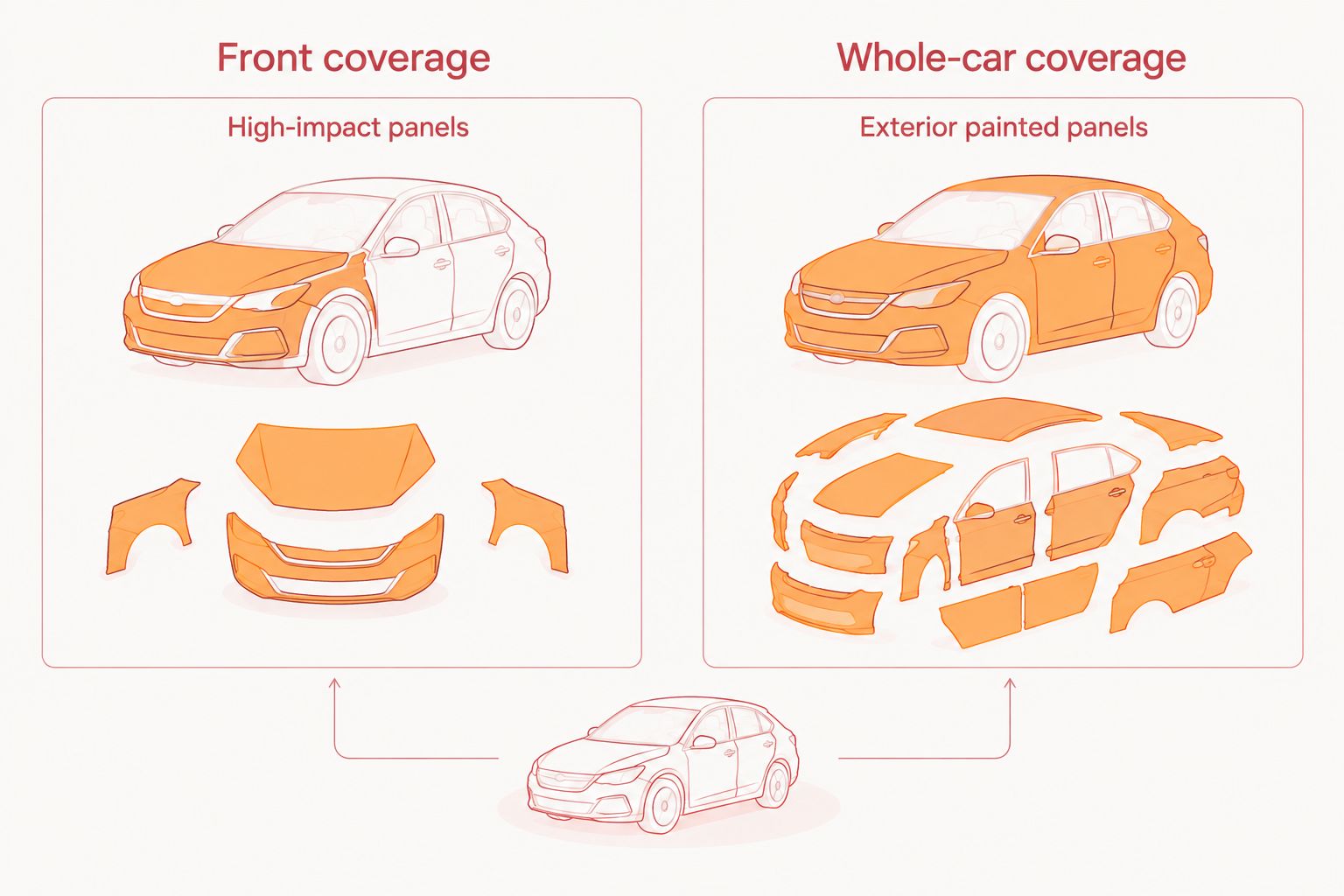
Start with a panel-by-panel comparison rather than choosing the largest coverage option automatically. Front coverage targets selected forward-facing areas. Whole-car coverage extends protection across more compatible exterior painted panels, but also involves more edges, seams, and surfaces to inspect and maintain.
Ask whether front coverage includes the full hood, full fenders, bumper, and mirror caps. Those terms are not interchangeable with partial-panel coverage. A partial hood section leaves some paint uncovered and creates a boundary across the panel.
Protect high-impact panels first when road debris is your main concern. Choose broader coverage when protecting the appearance of more painted surfaces is the priority. Neither approach makes the vehicle immune to deep scratches, collisions, or damage outside the covered areas.
- Front coverage: prioritize selected high-impact panels.
- Whole-car coverage: include agreed exterior painted panels.
- Confirm full-panel versus partial-panel coverage on the hood and fenders.
- Discuss charging-flap clearance without bridging a moving gap.
- Record exclusions for trim, glass, lamps, sensors, and other surfaces.
5. Separate impact protection from finish maintenance
Decide what problem each treatment needs to solve before combining services. PPF adds a physical film layer over selected surfaces. Ceramic coating is a surface treatment associated with water repellency and easier cleaning; it is not an equivalent barrier against flying stones.
If you want ceramic coating over PPF, ask whether the specific coating is approved for that specific film. Compatibility matters more than a generic claim that the combination works. A treatment intended for bare paint is not automatically appropriate for film, matte finishes, or every surrounding material.
Window tint addresses glazing, not painted-panel impact damage. Undercoating addresses different vehicle surfaces and must account for the EV’s manufacturer instructions, battery enclosure, drainage, and service access. Do not bundle unrelated treatments without a separate suitability check.
- Choose PPF when covered-panel impact protection is the main objective.
- Consider ceramic coating when easier surface cleaning is the priority.
- Confirm film-and-coating compatibility before combining treatments.
- Keep glass treatments separate from paint-protection decisions.
- Require an EV-specific suitability check for underside treatments.
6. Establish a care routine before collection
Ask for written aftercare before you collect the vehicle. Installation and care instructions depend on the film and any associated coating, so a generic waiting period or cleaning method is not a reliable substitute. Follow the supplied instructions for the first wash, cleaning products, and any inspection appointment.
Use 2 separate wash mitts as a practical way to keep wheel-cleaning grime away from painted and filmed surfaces. Rinse contamination before contact washing, and avoid directing concentrated pressure into film edges. Remove insects and bird droppings using an approved method rather than scrubbing the film aggressively.
For your 2026 maintenance routine, pay attention to edges and charging-area use as well as the broad panel surfaces. Water beading does not prove that every edge remains secure or that the film is undamaged.
- Keep the film identification, installation record, and care instructions together.
- Follow product-specific directions for washing and drying.
- Keep wheel-cleaning tools separate from paint-cleaning tools.
- Inspect seams and edges for lifting, trapped contamination, or damage.
- Report concerns before attempting polishing, adhesive work, or removal.
Compare protection options for your EV
The right 2026 choice depends on the surface and the problem. This comparison separates film coverage from maintenance treatments; it does not assume that all films, coatings, or installation methods have identical specifications.
| Option | Best for | Main benefit | Key limitation |
|---|---|---|---|
| Professionally installed front PPF | EV owners prioritizing exposed front panels | A physical barrier on agreed forward-facing surfaces | Uncovered panels remain exposed; package boundaries need confirmation |
| Professionally installed whole-car PPF | EV owners prioritizing broader paint coverage | Film across more compatible exterior painted panels | More installation boundaries to inspect; excluded surfaces still need separate care |
| DIY pre-cut PPF | Owners prepared to handle installation and accept finish trade-offs | Direct control over a defined installation project | Alignment, contamination control, curves, and edge finishing require skill |
| Ceramic coating | Owners prioritizing cleaning and surface water repellency | A treatment that supports finish maintenance | Not a substitute for film’s physical impact barrier |
| Regular washing without film | Owners choosing maintenance without an added film layer | Removes contaminants and supports routine inspection | Does not add a physical barrier against stone impacts |
Professional PPF wins when your priority is a physical barrier on selected painted panels. Its limitations remain important: damage can penetrate film, untreated areas stay exposed, and removal needs an assessment of the underlying paint. DIY film has the same need for surface compatibility but puts installation quality in your hands.
Common mistakes EV owners make with paint protection film
Assuming electric vehicles need a special protection rule
An EV badge does not establish paint quality, film compatibility, or coverage needs. Choose around the actual finish and panel exposure. Treat charging hardware and driver-assistance equipment as installation constraints, not reasons to cover every nearby surface.
Treating ceramic coating as stone-chip protection
Ceramic coating and PPF solve different problems. Choose coating for its surface-maintenance role and film for a physical barrier on covered areas. Combining them still requires product-specific compatibility and care instructions.
Approving coverage without charging-flap clearance
A coverage proposal should identify where film stops around a moving flap, adjoining edges, and access points. Ask how the installation preserves normal operation. Do not accept a continuous-looking finish if it interferes with opening or closing hardware.
Assuming self-healing means damage-proof
Self-healing describes a property of certain films under specified conditions, not immunity to every scratch. Read the exact product description and care guidance. Deep cuts, punctures, lifted edges, and existing paint defects require separate attention.
Neglecting salt residue because the paint is covered
Film protects covered paint; it does not make coastal contamination disappear. Keep washing part of the ownership routine and check lower panels and edges. Avoid adding underside protection without confirming compatibility with the EV’s components and manufacturer guidance.
FAQ
What’s the best paint protection film coverage for an EV daily driver?
Coverage of exposed front panels is the starting point when road debris is your main concern. Confirm the bumper, hood, fenders, and mirror coverage individually, then add other panels according to your driving and handling routine.
Does an electric car need different PPF from a gas-powered car?
Electric propulsion alone does not establish a different film requirement. Paint finish, panel shape, existing repairs, and equipment boundaries determine compatibility and installation details.
Is ceramic coating better than PPF for an EV?
Ceramic coating is not better than PPF for physical impact protection. Coating supports surface maintenance, while film adds a physical barrier on covered panels; choose according to the problem you want to address.
Can paint protection film go around an EV charging port?
Film placement around a charging port needs a vehicle-specific assessment. Confirm paint compatibility, flap clearance, edge placement, and normal opening and closing before approving the work.
Can PPF cover EV cameras and sensors?
Do not assume PPF is suitable over cameras or sensor areas. Require model-specific guidance and keep any area excluded by the vehicle or film instructions uncovered.
Does self-healing PPF repair stone chips?
Self-healing PPF does not repair chipped paint beneath the film. Any self-healing claim applies to the specified film and conditions, not to deep damage or defects in the underlying finish.
Can CoaterZ install paint protection film for a Tampa Bay EV owner?
CoaterZ provides automotive paint protection film installation in the Tampa Bay and Florida Gulf Coast area. Request an assessment for your EV’s finish, proposed coverage, charging hardware, and sensitive equipment.
One last thing
Check charging-flap operation during the handover, not after your next charging stop. Open and close it normally, inspect adjacent film edges, and confirm that access is unchanged. For a 2026 installation, keep the approved coverage map alongside the care instructions so you know exactly what is protected.
Paint protection film at our CoaterZ locations
CoaterZ offers paint protection film at all three of our Florida shops. Choose the location closest to you: