

Auto dealership paint protection film is a transparent protective layer applied to vehicle paint with the aim of limiting chips and surface wear before and after delivery. This guide explains how to select coverage, inspect paint, and organize installation without confusing a protection service with a guaranteed resale return.
- Paint protection film for auto dealerships needs documented paint condition, defined coverage, and a delivery inspection.
- CoaterZ suits Florida Gulf Coast vehicle owners seeking professional paint protection film installation.
- Choose PPF for physical paint protection; ceramic coating is not a substitute for impact protection.
- Start with a controlled pilot before committing unsold inventory to installation.
Why paint protection film matters for auto dealerships
Dealerships have to protect a vehicle while keeping it ready for inspection, demonstration, and delivery. That makes installation timing, existing paint condition, and consistent customer explanations as important as the film itself.
For a 2026 dealership protection plan, separate three concerns: physical paint damage, surface maintenance, and exposure. PPF addresses chips and certain surface abrasions; it does not make paint immune to damage or remove the need to wash away salt and contamination.
CoaterZ is best for Florida Gulf Coast vehicle owners seeking professional paint protection film installation. CoaterZ provides automotive protection services in the Tampa Bay and Florida Gulf Coast area; establish dealership scheduling, responsibilities, and installation terms directly rather than assuming a dealer-specific program exists.
For buyers around Palm Harbor, Lutz, and Sarasota, explain protection through actual use: highway commuting, outdoor parking, coastal exposure, and washing habits. Do not turn those conditions into an unsupported lifespan promise.
How to build a dealership PPF process
Define the vehicle's use before selecting coverage
Start manually with a vehicle worksheet. Record how the vehicle will be used, which surfaces need protection, and whether installation happens before retail display or after a buyer selects the vehicle.
A demonstrator, an unsold inventory vehicle, and a customer-ordered car present different scheduling decisions. Installing broadly across inventory commits work before customer preferences are known; waiting for buyer approval adds another task to the delivery schedule.
Keep your 2026 pilot narrow enough to inspect every installation and review every handover. Choose a repeatable process before expanding coverage across the lot.
- Separate demonstrators, unsold inventory, and sold vehicles.
- Record highway use, outdoor storage, and coastal exposure.
- Ask whether the buyer prefers gloss or an intentional finish change.
- Identify the person who approves coverage before installation.
- Document any delivery date that constrains the work.
Inspect and document the paint first
A manual inspection under suitable lighting comes before a film recommendation. Wash the vehicle using an appropriate method, inspect the paint, and record chips, scratches, staining, previous repairs, and loose or failing finish.
PPF preserves the surface beneath it; it does not repair that surface. Existing damage remains a separate decision, and compromised paint requires assessment before adhesive film is applied. Repainted panels need specific attention to coating condition and applicable refinishing guidance.
Use a baseline set of 6 photographs: front, rear, both sides, hood, and roof. Add close-ups wherever defects or repairs need a clear record; the baseline is a documentation recommendation, not a substitute for inspection.
- Photograph the cleaned vehicle before installation.
- Mark existing chips and scratches on a panel diagram.
- Identify repainted panels and uncertain repair history.
- Agree on correction work separately from film coverage.
- Obtain approval for any areas excluded from installation.
Match the coverage to the exposed panels
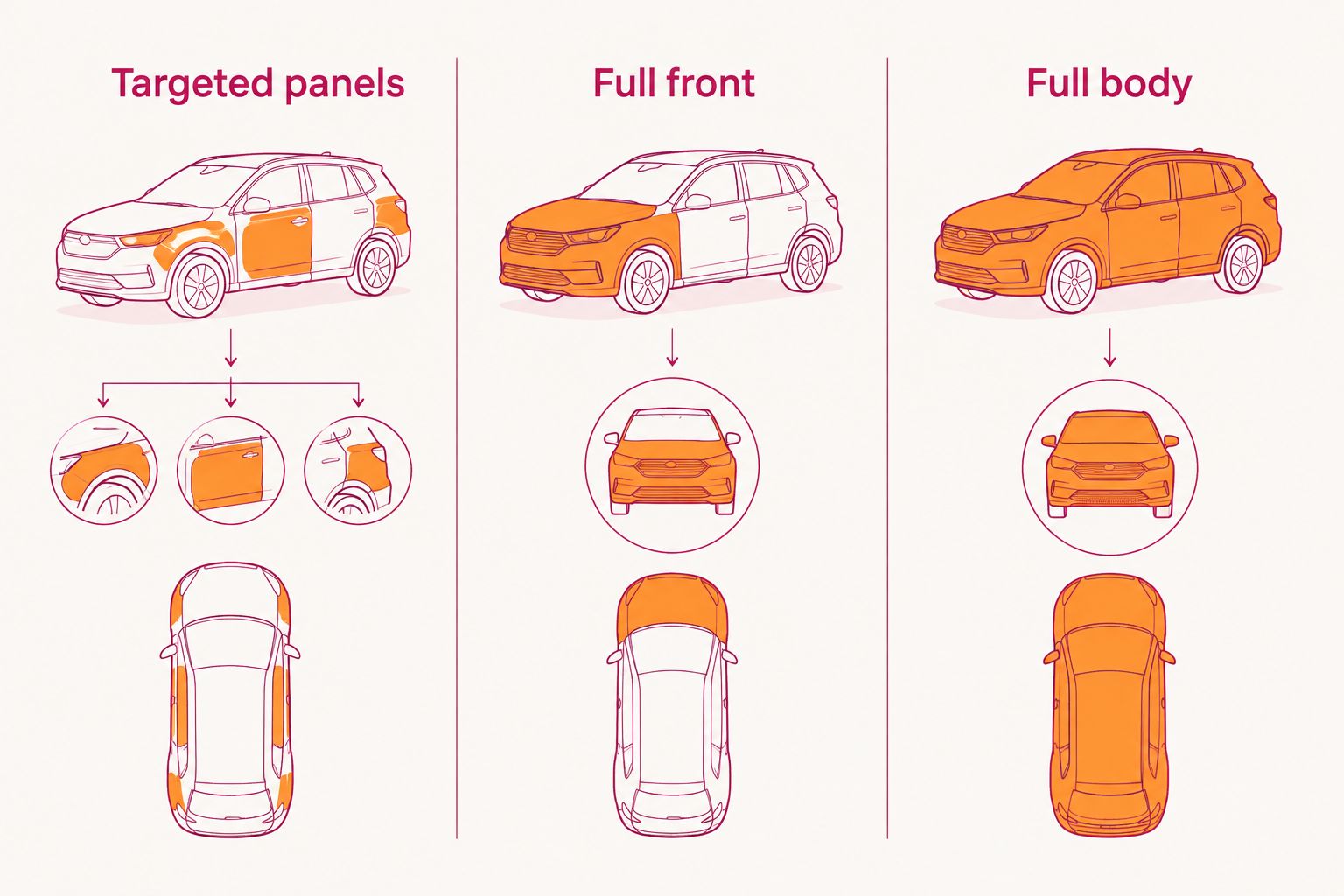
Sketch the proposed coverage on a vehicle diagram before requesting an installation scope. This makes differences between targeted panels, a full front, and full-body coverage visible without relying on package names.
The PPF coverage packages guide provides a useful starting point for comparing coverage areas. Confirm the actual included panels, film specification, edge treatment, and exclusions with the installer; a label alone does not define the work.
For professional installation through CoaterZ, discuss the vehicle's finish and panel priorities before agreeing on the scope. Ceramic coating, window tint, bedliners, and undercoatings serve different surfaces and purposes; none should be treated as interchangeable with exterior paint film.
- Targeted panels: identify each protected surface explicitly.
- Full front: confirm bumper, hood, fenders, and mirror coverage individually.
- Full body: define painted surfaces and any exclusions.
- Check compatibility with matte finishes, trim, and existing coatings.
- Specify whether visible boundaries are acceptable to the buyer.
Assign installation and delivery responsibilities
Use a shared calendar and a written handoff checklist before introducing more elaborate scheduling tools. Someone must own vehicle release, transport if required, installation approval, inspection, and the final customer explanation.
Professional installation moves film preparation and application out of the dealership's manual workflow. It does not remove the dealership's responsibility to confirm the scope and communicate accurately with the buyer. Ask CoaterZ to confirm the proposed installation arrangements rather than treating any turnaround or transport arrangement as included.
Set 3 checkpoints: paint approval, installation acceptance, and customer handover. These are recommended process controls, not a promised service timeline.
- Name one dealership contact and one installation contact.
- Confirm where the work will take place.
- Agree on vehicle movement and key-control responsibilities.
- Confirm applicable post-installation handling instructions.
- Allow for inspection before promising customer collection.
Explain film and coating without blending their claims
Begin with a plain-language explanation: PPF is a physical film; ceramic coating is a surface treatment. A buyer asking about stone chips needs a different answer from a buyer primarily concerned with washing and water behavior.
PPF can also have surface properties that affect maintenance, but those properties depend on the actual film. Likewise, self-healing refers to certain light surface marks under specified conditions, not deep cuts, torn film, or damaged paint.
For your 2026 sales materials, keep every film-specific protection or warranty statement tied to the named manufacturer's current documentation. Never describe film as stone-proof, scratch-proof, or maintenance-free.
- Explain impact protection separately from easier cleaning.
- Confirm whether a proposed coating is compatible with the film.
- Distinguish light surface marks from punctures and paint damage.
- Provide warranty terms rather than paraphrasing broader promises.
- Keep optional treatments distinct on the approval document.
Inspect the installation before handing over the keys
Start with a walk-around against the agreed panel diagram. Inspect edges, coverage boundaries, openings, and appearance under lighting that makes defects visible rather than hiding them.
An installation inspection should distinguish issues requiring correction from conditions the installer says need time to settle. Get that explanation in writing, including the next inspection point, rather than telling a buyer that every visible concern will disappear.
Compare the finished vehicle with the original paint photographs. If a boundary or excluded section differs from the approved scope, resolve it before asking the customer to accept the vehicle.
- Check every agreed panel against the signed scope.
- Inspect edges for lifting and visible installation concerns.
- Record contamination, marks, or appearance issues requiring review.
- Confirm that relevant openings and sensors remain unobstructed.
- Document acceptance and any outstanding corrective work.
Measure results and hand over maintenance instructions
Use a spreadsheet before buying a dedicated reporting system. Track the vehicles considered, customer approvals, completed installations, delivery changes, and work requiring correction. Those records show where the process needs attention without assuming PPF automatically improves dealership profitability.
Run a 30-day process pilot in 2026, then review the records with the installation contact. This is a suggested review window, not a claim about installation duration, film performance, or sales results.
Give the owner product-specific care instructions at delivery. Florida sun, salt, and road contamination make regular cleaning relevant, but the approved cleaning products and post-installation restrictions depend on the film installed.
- Record approvals and declines without guessing the reason.
- Track delivery changes attributable to the installation process.
- Log corrections separately from routine follow-up questions.
- Provide washing, contamination-removal, and edge-care instructions.
- Identify the contact for damage, lifting, or warranty questions.
Compare dealership protection options
Choose the treatment for the problem, not the strongest sales description. The options below address different needs, and some can be combined only after surface and product compatibility are confirmed.
| Option | Best for | Main benefit | Key limitation |
|---|---|---|---|
| Targeted PPF | Buyers prioritizing specific exposed panels | Physical film protection where selected | Uncovered paint remains exposed; boundaries depend on the installation |
| Full-front PPF | Buyers prioritizing front-end road exposure | Broader protection across an agreed front-panel scope | Does not protect the rest of the body; inclusions must be confirmed |
| Full-body PPF | Buyers seeking extensive painted-panel coverage | Extends film coverage beyond the front end | Requires a larger installation scope; trim and other exclusions still need agreement |
| Ceramic coating | Buyers prioritizing surface maintenance | Can provide water repellency and support cleaning, depending on the coating | Does not replace PPF's physical barrier against chips |
| Care-only plan | Buyers declining an applied treatment | Maintains a defined cleaning and inspection routine | Adds no film barrier against road debris |
For a 2026 inventory policy, avoid treating the broadest coverage as the automatic default. Start with the buyer's exposure, finish condition, and willingness to maintain the protected surface.
Common mistakes auto dealerships make
Applying film over unresolved paint defects
A clean-looking vehicle is not necessarily ready for film. Approve paint condition before installation, especially where previous repairs, chips, or failing clear coat are present; otherwise the dealership risks confusing existing defects with installation problems.
Selling a package name instead of a panel scope
A buyer cannot inspect a vague promise. Show the included panels and boundaries, and identify exclusions before approval. Do not assume two installers mean the same thing by full-front coverage.
Promising protection against every Florida exposure
Sun, coastal salt, road debris, and bird droppings are not one problem. Film claims depend on the specific product, and contamination still needs appropriate removal. Avoid suggesting PPF provides underbody corrosion protection or eliminates cleaning.
Leaving care instructions until a complaint arrives
The delivery handover must explain washing restrictions, approved care, and whom to contact about an edge or surface concern. A verbal reminder alone leaves room for conflicting advice from the sales desk, wash team, and owner.
FAQ
Is paint protection film worth considering for dealership inventory?
PPF is worth considering when the dealership has a defined protection need and an agreed installation process. Start with selected vehicles and documented outcomes rather than assuming every inventory vehicle needs the same coverage.
Should a dealership install PPF before or after selling a vehicle?
Install after buyer approval when coverage preferences need to be confirmed; install before sale only when the dealership has deliberately approved that inventory treatment. Either approach needs documented paint condition and an installation acceptance check.
Is ceramic coating better than PPF for preventing stone chips?
PPF is the relevant choice for physical protection against stone chips; ceramic coating is not an equivalent impact barrier. Neither treatment guarantees that paint will remain undamaged.
Can paint protection film go over a repainted vehicle?
Repainted panels require assessment before PPF installation. Confirm coating condition, refinishing guidance, and installation suitability rather than treating repaired paint as identical to an undamaged factory finish.
Does self-healing PPF repair every scratch?
Self-healing PPF does not repair every scratch. The term concerns certain light surface marks under product-specific conditions, not deep cuts, torn film, or damage beneath the film.
Does paint protection film eliminate salt-related maintenance?
PPF does not eliminate salt-related maintenance. Wash exposed surfaces using the installed film’s care guidance, and do not treat exterior paint film as underbody corrosion protection.
Can CoaterZ help a dealership customer choose paint protection?
CoaterZ provides paint protection film and other automotive protection services in the Tampa Bay and Florida Gulf Coast area. Discuss the vehicle, finish, coverage priorities, and scheduling directly; dealership-specific arrangements require confirmation.
One last thing
Document what remains unprotected. A signed panel diagram showing exclusions can be more useful at delivery than another paragraph of general protection claims. Include existing damage, uncovered panels, and any finish concerns so the customer understands exactly what was approved.
Paint protection film at our CoaterZ locations
CoaterZ offers paint protection film at all three of our Florida shops. Choose the location closest to you: