

Ceramic coating is worth it for a saltwater boat when your goal is easier cleaning and protecting a sound, compatible surface above the waterline—not preventing marine growth on a submerged hull. For your 2026 maintenance plan, choose a coating approved for the actual surface and exposure, and keep freshwater rinsing, surface preparation, and antifouling treatment as separate requirements.
- Is ceramic coating worth it for a boat? Yes for compatible topsides and easier cleaning; not as an antifouling substitute.
- Saltwater boat hull protection starts with distinguishing above-water surfaces from continuously submerged surfaces.
- CoaterZ is a local option for Florida Gulf Coast boat owners considering surface-protection services.
- Choose marine ceramic coating by documented surface compatibility and immersion instructions, not water-beading demonstrations.
Is ceramic coating worth it for a boat hull in saltwater?
Yes for a compatible hull surface above the waterline; do not assume the same answer applies below it. The word hull covers surfaces with different maintenance needs. A glossy hull side exposed to spray is not the same application as a bottom that stays submerged at a marina.
For Florida Gulf Coast owners considering professional protection, CoaterZ provides detailing and protection services for boat owners. Start the discussion with where the boat lives and exactly which surfaces need treatment.
| Treatment | Best for | Main benefit | Main limitation |
|---|---|---|---|
| Marine ceramic coating | Compatible topsides and hull sides where easier cleaning matters | Creates a surface treatment that changes how water and contamination interact with the finish | Does not replace antifouling, repair oxidation, or make the hull scratch-proof |
| Marine wax or sealant | Owners who prefer a renewable surface-care routine | Provides a sacrificial surface treatment for appearance and maintenance | Requires renewal according to the product and exposure; is not antifouling |
| Antifouling coating | Submerged bottoms where marine growth must be controlled | Addresses fouling within the coating's specified use | Is not a substitute for cosmetic protection on glossy topsides |
These are different tools, not interchangeable versions of the same protection. Choose by the problem you need to solve before comparing application methods or maintenance commitments.
Why this matters on the Florida Gulf Coast
Saltwater exposure does not stop when you return to the dock. As spray dries, it leaves deposits that need removal. A surface that sheds water still needs cleaning, especially where water collects around fittings, trim, and horizontal edges.
Sun exposure creates another maintenance concern, but a ceramic coating should not be treated as a blanket guarantee against fading. Any claim about ultraviolet protection must belong to the particular product, substrate, and application—not to the word ceramic.
For a 2026 protection plan in Palm Harbor, Lutz, Sarasota, or elsewhere along the Gulf Coast, separate appearance, cleaning, fouling, and physical damage. One treatment does not solve all four problems. That distinction prevents you from paying for a finish treatment while leaving the actual maintenance issue unresolved.
Above-water hull sides: worth considering for easier cleaning
Best for: owners with sound gelcoat or compatible painted hull sides who want a more manageable wash routine. Hydrophobic means water-repelling. On a properly treated surface, water behaves differently, which can help with rinsing and removing contamination during routine maintenance.
The benefit is not that the boat stops getting dirty. It is that the finish has a treatment designed to make surface care easier. Salt residue, mineral spotting, and other deposits still require attention rather than being left to accumulate.
Preparation determines whether the result looks right. If your hull sides are chalky, stained, or scratched, coating over those defects does not correct them. The surface needs an appropriate cleaning and correction process before application.
The trade-off is a more deliberate installation and aftercare process than simply washing the boat. Ask which cleaners are compatible and how future polishing affects the treatment. Abrasive correction removes material from the surface, so it cannot be treated as routine maintenance that leaves every coating untouched.
Below-water hull surfaces: choose by immersion approval
Best for: an application explicitly permitted by the coating manufacturer for the substrate and immersion conditions. Do not extend an above-water recommendation to the bottom just because both surfaces belong to the same boat.
A boat stored on a trailer has a different exposure pattern from a boat kept afloat. However, brief or intermittent immersion is not automatic permission to use any ceramic coating below the waterline. The product instructions still control the application.
Continuous immersion also introduces a separate question: how will you manage fouling? A water-repelling finish is not, by itself, evidence of antifouling performance. Marine growth needs a treatment and maintenance plan intended for that purpose.
For your 2026 decision, request written confirmation of below-water suitability before approving that area. If immersion suitability is not established, keep the ceramic-coating scope above the waterline. A clearly limited application is better than an expansive promise that the product documentation does not support.
Oxidized or damaged hull surfaces: restore before protecting
Best for: owners prepared to address the underlying finish before adding protection. Ceramic coating is a finishing step, not a repair material. It does not replace gelcoat repair, repainting, or the correction needed to remove deteriorated surface material.
Chalking deserves particular attention. A treatment applied over an unstable or poorly prepared surface does not turn that surface into a sound foundation. Inspect the finish before deciding what protection belongs on it.
Correction also has limits. Deep scratches and damaged gelcoat are different from superficial haze, and aggressive polishing is not the answer to every defect. Ask the installer to distinguish what can be corrected from what needs repair.
The benefit of this sequence is straightforward: you protect the finish you actually want to preserve. The limitation is equally important: restoration adds work, and the finished appearance depends on the underlying surface—not only on the coating applied last.
Why ceramic coating value varies between boats
The value of ceramic coating comes from matching the treatment to your boat and maintenance habits. Use these factors to judge whether it solves a real problem:
- Storage: Trailer, lift, and in-water storage create different exposure conditions. Record the normal arrangement before selecting a treatment.
- Surface material: Gelcoat, paint, metal, plastic, vinyl, and existing film are not automatically compatible with the same formula or preparation method.
- Surface condition: Sound gloss, oxidation, staining, and physical damage require different preparation decisions.
- Waterline position: Spray exposure and continuous immersion need separate suitability checks.
- Maintenance routine: Continued rinsing and compatible washing remain necessary. A coating is a poor match for an expectation of no maintenance.
- Protection goal: Easier cleaning, fouling control, and resistance to impact damage are separate priorities. Identify which one drives your decision.
Do not use a dramatic water-beading video as the deciding evidence. It shows water behavior at that moment; it does not establish service life, surface compatibility, immersion approval, or the condition of the underlying finish.
How to decide before booking a marine coating
A useful 2026 consultation ends with a defined treatment area and an aftercare plan. It should not end with an undefined promise to protect the entire boat.
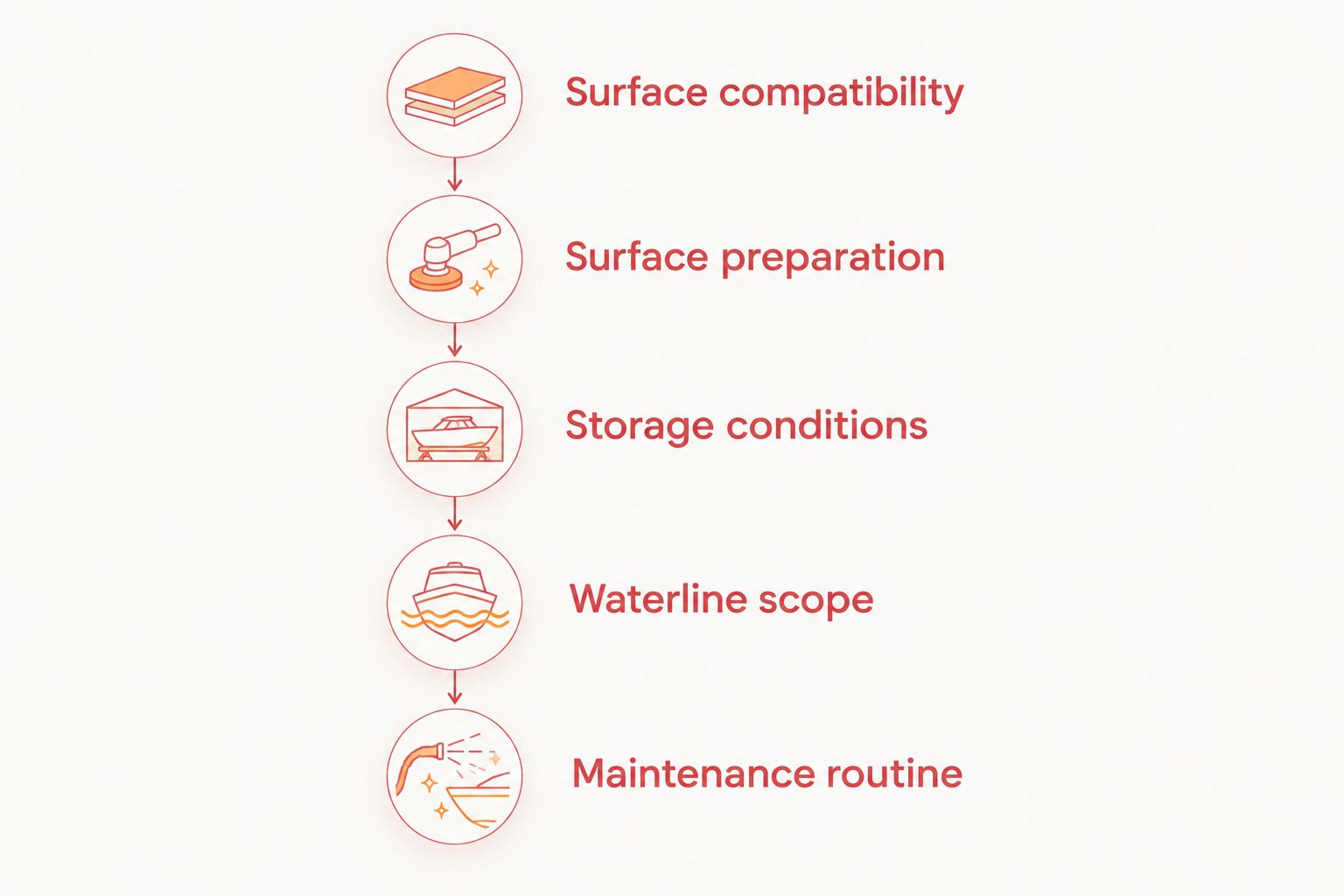
1. Confirm surface compatibility
Identify the finish on each area you want treated. If the hull has been repainted or repaired, tell the installer and provide the finish information you have. Do not assume the current surface matches the boat's original construction.
Ask for the coating's permitted substrates and any exclusions. Include trim, fittings, existing protection film, and areas with a matte or textured finish in that discussion rather than treating everything as glossy gelcoat.
2. Agree on surface preparation
Have the installer identify contamination, oxidation, staining, and defects before application. Clarify what the preparation includes and what will remain visible afterward. A coating appointment should not conceal a disagreement about the expected finish.
Ask how corrected areas will be assessed before coating. The useful outcome is a sound, properly prepared surface—not merely a shinier appearance during the inspection.
3. Describe storage conditions
Explain whether the boat normally stays afloat, sits on a lift, or returns to a trailer. Include how you rinse it after use and which areas are difficult to reach. Those details define the exposure the proposed treatment must tolerate.
If storage changes seasonally, describe both arrangements. A coating selected for one use pattern should not silently become a recommendation for another.
4. Define the waterline scope
Ask the installer to distinguish above-water hull sides, the waterline area, and the submerged bottom. Put that scope in the written proposal so the meaning of hull coating is clear.
Keep existing antifouling treatment in the discussion. Do not approve a coating over it unless the relevant product instructions explicitly support that combination.
5. Confirm the maintenance routine
Request the washing, drying, inspection, and cleaning instructions for the selected product. Ask what to do about persistent deposits before using stronger chemicals or abrasive tools.
Also establish how future polishing, repairs, or repainting will be handled. Those jobs affect the surface treatment and should not be approached as though nothing has been applied.
Bring those answers to the consultation rather than asking only which coating is best. CoaterZ is best suited to Gulf Coast boat owners seeking a local protection-service provider. The right next step is a surface-specific discussion, not an assumption that an automotive coating recommendation transfers unchanged to a boat.
Discuss your boat protection needs
Start with hull condition, storage, treatment area, and the maintenance routine you can follow.
Does ceramic coating stop saltwater damage?
Ceramic coating does not eliminate the need to remove salt residue. It treats a compatible surface; it does not protect every exposed component or turn the boat into a sealed system.
Rinse accessible exterior surfaces with freshwater after saltwater exposure, following the boat and treatment instructions. Pay attention to places where residue collects rather than judging cleanliness only by the large, glossy hull panels.
Keep metal maintenance separate from the hull-finish discussion. A coating specified for gelcoat is not automatically a corrosion-protection system for fittings, fasteners, or underwater hardware. Each material needs an appropriate maintenance method.
Can I skip antifouling if my boat has ceramic coating?
No—ceramic coating is not an antifouling substitute. If your boat's use and storage call for fouling control, choose a system intended for that job and suitable for the hull and operating conditions.
Do not interpret easy cleaning above the waterline as evidence that submerged growth will be prevented. These are different performance requirements, and the application documentation must address the one you actually need.
Is ceramic coating better than wax for a boat?
Ceramic coating is the better fit when you want a coating-based maintenance approach on a compatible, properly prepared surface. Wax or sealant remains an option when you prefer a renewable treatment and accept its product-specific reapplication routine.
Neither choice repairs the finish or replaces antifouling. For a 2026 comparison, judge the preparation, permitted surfaces, aftercare, and documented limitations instead of assuming a universal lifespan advantage.
FAQ
Is ceramic coating worth it for a boat kept in saltwater?
Yes for compatible above-water surfaces when easier cleaning is your goal. For submerged areas, require explicit immersion suitability and keep fouling control separate.
Can ceramic coating go below my boat’s waterline?
Only use a coating below the waterline when its instructions explicitly permit the substrate and immersion conditions. Above-water approval does not establish below-water suitability.
Will ceramic coating stop barnacles growing on my hull?
Do not rely on ceramic coating to prevent barnacles. Use a fouling-control approach intended for your boat’s submerged surfaces and storage conditions.
Do I still need to rinse a ceramic-coated boat after saltwater use?
Yes, a ceramic-coated boat still needs freshwater rinsing and compatible washing. Water-repelling behavior does not remove every salt deposit or prevent spotting.
Can ceramic coating fix chalky gelcoat?
No, ceramic coating does not repair chalky gelcoat. Assess and address oxidation or damaged finish before applying a protective treatment.
Can I use my car’s ceramic coating on my boat?
Use it only if the product instructions permit the boat’s substrate and intended exposure. Automotive suitability alone does not establish marine or immersion suitability.
Will ceramic coating protect my boat from dock scratches?
Ceramic coating does not make a boat scratch-proof. Manage dock contact with suitable fenders and docking practices rather than relying on a surface treatment.
What should I ask a marine coating installer before booking?
Ask about surface compatibility, preparation, waterline scope, storage conditions, and aftercare. Request product-specific documentation for any lifespan, warranty, or protection claim.
One last thing
Ask the installer to mark the treatment boundary at the waterline before you approve the work. That simple step turns an ambiguous promise to coat the hull into a scope you can understand and check.
For your 2026 decision, a clearly defined application matters more than the coating's label. Confirm the surface, exposure, preparation, and maintenance instructions first; then decide whether the cleaning benefit fits how you actually use the boat.