

Spray on bedliner cost in 2026 depends on your truck’s bed size, surface condition, coating system, and installation scope; compare written, vehicle-specific quotes rather than treating an advertised starting figure as the finished job. Rust repair, removal of an old liner, accessory handling, and coverage beyond the bed floor need explicit inclusion or exclusion. The useful comparison is the same prepared surface, covered with the same specified system, under clearly stated workmanship and maintenance terms.
- Compare spray on bedliner cost through matching coverage, preparation, coating specifications, and written exclusions.
- Coaterz provides bedliner services for Florida Gulf Coast vehicle owners; confirm the system and scope before booking.
- Rust repair and old-liner removal belong in the written scope, not an assumption.
- A truck bed coating is not a substitute for underbody corrosion protection.
How much does spray-on bedliner cost in 2026?
Your final installed cost is the quoted scope, including preparation and any separately approved work. A meaningful 2026 estimate identifies what the installer will coat, how the surface will be prepared, and what conditions must be corrected first.
Before comparing quotes, establish whether the bed needs rust assessment before bedliner application. A coating should not be treated as a repair for loose corrosion, failing paint, or damaged metal.
Use this breakdown to make each estimate comparable. These are quote categories to confirm, not a claim that every installer bills them separately.
| Quote category | What the written estimate should identify | What to clarify |
|---|---|---|
| Coverage | Bed floor, sidewalls, wheel housings, tailgate, and rail treatment | Which surfaces are excluded? |
| Preparation | Cleaning, removal of contamination, abrasion, and required primer | What happens if preparation reveals damage? |
| Existing material | Treatment of a previous liner, adhesive, or failing coating | Is removal included? |
| Coating system | Named material and intended substrate | Is it suitable for this bed and its use? |
| Accessories | Removal, masking, protection, and refitting responsibilities | Who handles caps, hardware, and mounted equipment? |
| Handover | Cure instructions, care requirements, and written coverage terms | When can washing, loading, and accessory refitting resume? |
A quote described only as a bedliner installation leaves too much unresolved. Ask for the scope in writing before approving the work, especially if your truck already has a liner or visible deterioration.
Why this matters
Truck owners in Palm Harbor, Lutz, Sarasota, and the Florida Gulf Coast need protection suited to actual use, not just an attractive finish. Sun exposure, salt contamination, wet equipment, and abrasive cargo create different demands; the material specification and maintenance instructions need to address the demands relevant to your truck.
A spray-on liner forms a coating on the prepared truck bed. Its usefulness depends on adhesion, compatible materials, correct application, and care after installation. A uniform texture does not prove that the surface underneath was sound or properly prepared.
For your 2026 decision, separate protection goals from appearance goals. If you need resistance to cargo abrasion, ask about that application; if you need exterior color retention, ask for the coating’s published exterior-use guidance. Neither answer should rest on a generic promise that the finish handles everything.
Why spray on bedliner cost varies
The following scope differences explain why estimates are not interchangeable. Have each installer address the same requirements before deciding which quote offers better value.
- Coverage area: Define the bed floor, inner walls, wheel housings, tailgate, and any over-rail coverage. Extra surfaces must be listed rather than implied by the phrase full bed.
- Surface preparation: Identify the existing substrate, contamination, paint condition, and preparation specified for the selected material. Sound factory paint and a deteriorated previous coating require different assessments.
- Existing liner removal: Establish whether the old material can remain under the selected system or must be removed. Do not assume a new coating can bond reliably to an unidentified liner.
- Repairs before coating: Separate corrosion assessment, metal repair, and paint failure from the coating application itself. Have the installer explain what requires additional approval.
- Coating specification: Record the material, finish, intended use, and manufacturer’s application requirements. Do not assume all sprayed coatings have identical properties.
- Accessory handling: Specify how bed caps, tie-downs, covers, racks, and mounted equipment will be protected or handled. Confirm fit and access after coating.
Coverage: inside the bed or over the rails?
Inside-bed coverage and over-rail coverage are different scopes. If the upper rails remain exposed, the coating does not protect those exposed surfaces; if you want them coated, identify the exact boundary before preparation begins.
Pay particular attention to tailgate edges, removable panels, and existing bed caps. Ask the installer to show the proposed masking lines on your truck so that the written description matches what you expect to see.
Preparation: sound paint or a problem surface?
A clean-looking bed can still carry wax, oil, silicone residue, or other contamination that interferes with adhesion. Preparation needs to follow the selected coating system’s requirements, not a generic cleaning routine.
Visible rust deserves a separate decision before coating. Loose material, failing paint, and damaged metal need assessment; covering them does not establish that the underlying problem has been corrected.
Accessories: retained, removed, or masked?
A bed cover, rack, toolbox, or hitch arrangement can affect access and masking. Give the installer photographs and identify equipment that must remain functional after the work.
Do not assume that thicker material around a mounting point improves the installation. Clearance, fastener access, drainage, and future servicing matter as much as the visible finish.
Which truck bed protection approach fits your use?
Best for a fitted coating: a professionally applied spray-on bedliner, provided the substrate and intended use match the selected system. Its main trade-off is that preparation and application become part of the finished coating; correcting a poor bond is not the same as lifting out a removable accessory.
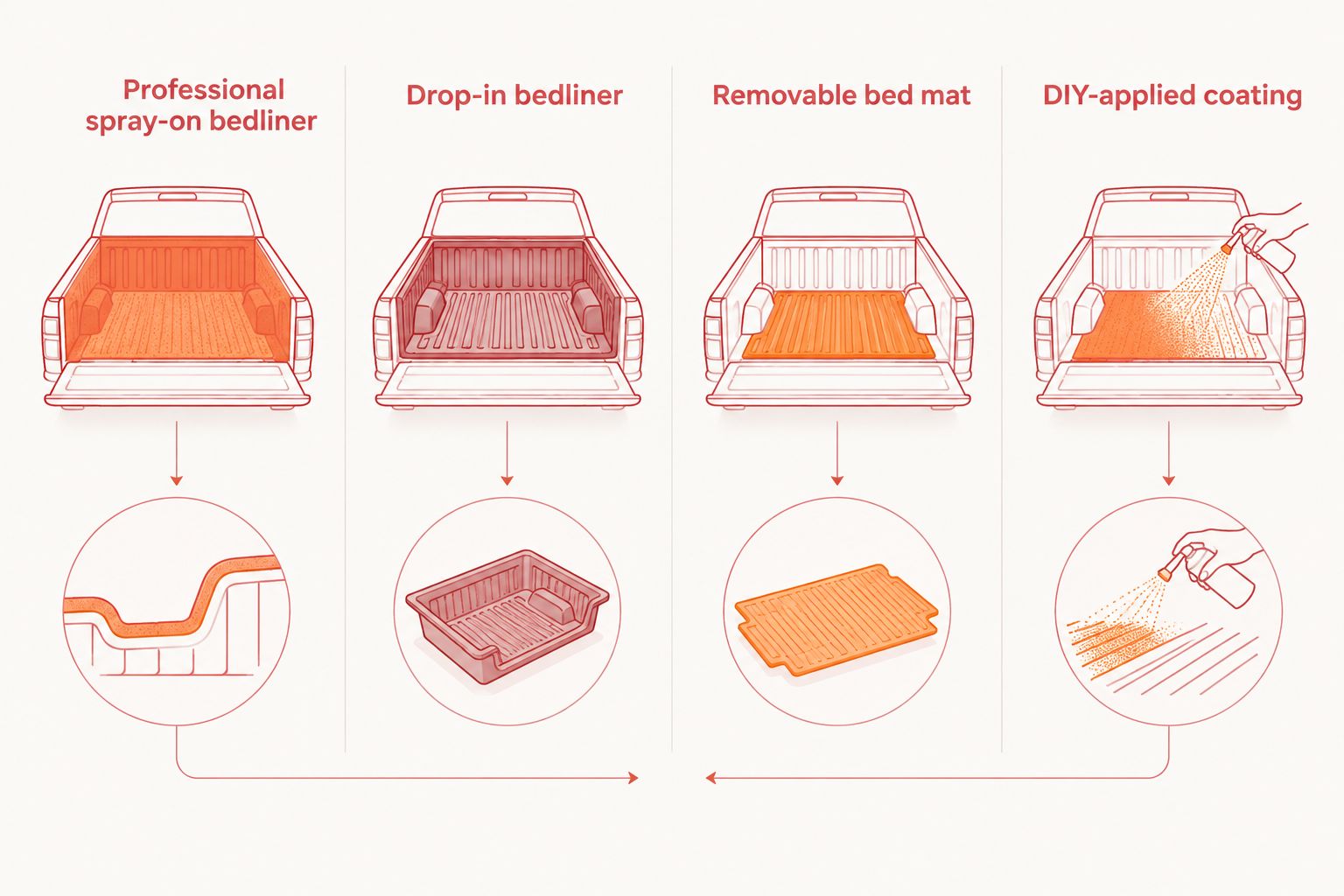
The alternatives below serve different purposes. This comparison addresses fit and limitations, not an unsupported claim that a particular option always lasts longer.
| Approach | Best for | Main benefit | Main limitation |
|---|---|---|---|
| Professional spray-on bedliner | Owners seeking a coating fitted to the bed’s contours | Covers the agreed surfaces without a separate loose liner | Preparation, compatibility, and application quality are critical |
| Drop-in bedliner | Owners seeking a separate molded liner | Provides a physical barrier between cargo and covered bed surfaces | Fit, movement, debris, and moisture beneath it need attention |
| Removable bed mat | Owners focused on the bed floor | Can be lifted to inspect and clean underneath | Does not provide full sidewall or tailgate coverage |
| DIY-applied coating | Owners prepared to perform the specified preparation and application | Gives the owner control of the work process | The owner is responsible for surface preparation, conditions, and application consistency |
A bed mat can suit floor-focused use, but it is not equivalent to coating the bed walls and tailgate. A spray-on liner can suit broader surface coverage, but it still needs cleaning and inspection. Choose the approach that matches where your cargo contacts the truck.
How do you get a comparable bedliner quote?
Send the same information to every installer. For a 2026 comparison, use current written estimates for your actual truck rather than a screenshot of another owner’s installation.
- Identify the truck. Provide the make, model, bed configuration, and photographs. Mention any replacement panels or previous refinishing you know about.
- Show the surface. Photograph the floor, corners, wheel housings, tailgate, rails, existing liner, and visible damage. Include close views of peeling material or corrosion.
- Define coverage. State which surfaces you want coated and which must remain untouched. Ask the installer to confirm the boundaries.
- Describe cargo. Explain whether you carry landscaping equipment, loose materials, wet gear, tools, or recreational equipment. Identify chemical exposure rather than describing everything as heavy use.
- List accessories. Include covers, racks, caps, toolboxes, mounting hardware, and equipment fixed through the bed. Assign removal and refitting responsibilities.
- Request handover terms. Ask for the coating specification, cure instructions, cleaning guidance, exclusions, and any written warranty before booking.
Coaterz bedliner services suit Florida Gulf Coast vehicle owners seeking professional installation rather than a DIY application. Confirm the proposed coating, surface preparation, coverage, and care instructions for your truck; a service category alone does not establish a particular material specification or warranty.
The advantage of professional installation is having the application work handled as a service. The limitation is that you still need to compare the written scope—professional installation does not make different coating systems or coverage packages identical.
Discuss your truck bed protection
Explain your truck’s condition, cargo use, and coverage needs before choosing an installation scope.
Is a spray-on bedliner worth it for a Florida truck?
A spray-on bedliner is a suitable choice when you want a fitted coating across specified cargo-contact surfaces and accept the required preparation and maintenance. It is not a substitute for securing loads, cleaning away contamination, or repairing damaged metal.
For an uncovered bed, ask whether the selected material is intended for exterior exposure and what its published guidance says about sunlight and appearance. Do not assume that every coating has the same resistance to fading or the same care requirements.
After carrying wet or salty equipment, remove contamination using methods compatible with the liner. Keep drainage paths clear and inspect cuts, lifting edges, or exposed substrate rather than treating them as cosmetic issues.
Does a bedliner replace undercoating?
A bedliner does not replace undercoating because the treatments address different vehicle surfaces. Coating the cargo bed does not coat the frame, underside, or other untreated areas.
Keep those scopes separate in your 2026 protection plan. If underbody corrosion is your concern, request an underbody assessment rather than assuming the bedliner installation resolves it.
What should you check before loading the bed again?
Follow the selected coating’s written return-to-service instructions before loading the bed. Dry-to-touch appearance is not a reliable substitute for the specified cure requirements.
Ask separately about light handling, cargo loading, washing, chemical exposure, and accessory refitting. Those activities need not share the same permitted timing, and instructions for another coating do not establish the correct schedule for yours.
At handover, check masking boundaries, access to hardware, drainage openings, and areas that were specifically included in the quote. Photograph the completed bed and keep the written scope with the care instructions.
FAQ
How much does spray on bedliner cost in 2026?
Spray on bedliner cost in 2026 is determined by the vehicle-specific installation scope, including coverage, preparation, coating specification, and any approved remedial work. Compare written estimates with matching inclusions and exclusions.
What should a spray-on bedliner estimate include?
A spray-on bedliner estimate should identify the surfaces covered, preparation, coating system, accessory handling, and exclusions. Request written care instructions and any applicable warranty terms before approving installation.
Does rust need to be repaired before spraying a bedliner?
Rust needs assessment and appropriate preparation or repair before coating. A bedliner should not be treated as a repair for loose corrosion, failing paint, or damaged metal.
Can a spray-on bedliner go over an old liner?
An existing liner needs a compatibility and condition assessment before another coating is applied. Ask whether removal is required and have that work included or excluded explicitly.
Is a spray-on bedliner better than a removable bed mat?
A spray-on bedliner suits specified contour-following coverage, while a removable bed mat suits floor-focused protection and access for cleaning underneath. Neither option removes the need to clean and inspect the bed.
Will a truck bed coating protect the underside from salt?
A truck bed coating does not protect untreated underside surfaces from salt exposure. Treat bed protection and underbody corrosion protection as separate installation scopes.
How soon can I use my truck after bedliner installation?
Use your truck bed according to the selected coating’s written return-to-service instructions. Confirm loading, washing, chemical exposure, and accessory-refitting requirements rather than relying on how dry the surface feels.
What should I ask Coaterz about bedliner installation?
Ask Coaterz which coating system and preparation process are proposed for your truck, which surfaces are included, and what maintenance is required. Confirm any warranty directly in writing rather than assuming coverage from the service name.
One last thing
Ask the installer to show you exactly where the coating will stop. Rail edges, tailgate boundaries, mounting points, and covered areas are easy to misunderstand when the quote simply says truck bed.
For a 2026 installation, a marked-up photograph can make that conversation more precise. Keep it with the written scope so the final inspection checks agreed coverage, not competing memories of the discussion.