

The cost to remove a vehicle wrap depends on the covered area, the vinyl’s condition, the adhesive left behind, and the paint underneath; a reliable quote requires inspecting the vehicle. In 2026, compare written removal scopes rather than headline estimates, because adhesive cleanup, paint correction, and replacement protection are separate tasks unless the quote includes them.
- The cost to remove a vehicle wrap depends on film condition, coverage, adhesive cleanup, and underlying paint.
- Separate vinyl removal from paint correction and replacement protection when comparing quotes.
- CoaterZ serves Florida Gulf Coast vehicle owners considering professional vinyl wraps and paint protection.
- Repainted panels and deteriorated vinyl require particular care; removal does not guarantee undamaged paint.
Why this matters
A removal quote is only useful when you know what the vehicle will look like at handover. Peeling away the vinyl does not automatically leave a clean, polished surface ready for another wrap.
For drivers in Palm Harbor, Lutz, Sarasota, and the Florida Gulf Coast, exposure history belongs in the conversation. Tell the shop whether the vehicle lives outdoors, spends time near saltwater, or has damaged areas that collect dirt and moisture. Those details support an inspection; they do not establish a price by themselves.
CoaterZ is best for Florida Gulf Coast vehicle owners seeking professional vinyl wraps and automotive paint protection. Explore CoaterZ for those services, and ask separately whether wrap removal is included in any proposed installation work.
How much does it cost to remove a vehicle wrap?
The cost to remove a vehicle wrap is a vehicle-specific labor estimate, not a dependable flat rate based on vehicle size alone. The installer needs to assess how the film releases, what remains on the surface, and whether the underlying finish can tolerate the proposed process.
For your 2026 comparison, request a breakdown that distinguishes the following work. A quote that combines everything into a single description makes competing proposals difficult to compare.
| Work item | What the scope should identify | What not to assume |
|---|---|---|
| Vinyl removal | Panels, graphics, lettering, and accessible wrapped edges | Every hidden return or wrapped component is included |
| Adhesive cleanup | Removal of remaining adhesive using a surface-compatible process | Peeling the film also removes all adhesive |
| Component handling | Any trim or hardware removal and reinstallation | Disassembly is part of basic removal |
| Surface assessment | Inspection after the film and residue are removed | The covered paint is undamaged |
| Paint correction | Separately approved polishing for suitable paint defects | Removal restores faded or damaged paint |
| Replacement protection | Preparation and installation for the chosen next treatment | A new wrap or coating is included |
Ask what happens if the film fragments or a repaired panel shows signs of poor adhesion. The written scope should explain when work pauses, how additional work is approved, and which finish defects remain outside the removal agreement.
Full wrap removal
Full wrap removal involves the covered body panels and whatever edges or returns were included during installation. A vehicle described as fully wrapped still needs a panel-by-panel scope: roof sections, mirrors, bumpers, and trim details deserve explicit treatment.
The advantage is a clear plan for returning the entire vehicle to an unwrapped appearance. The limitation is that the condition beneath each panel remains uncertain until the film is removed.
Partial wraps and lettering removal
Partial wraps, stripes, and business lettering cover less area, but their outlines and separate pieces create different handling requirements. Small graphics should not be priced or scheduled solely by the percentage of the body they cover.
Removing lettering also does not guarantee an invisible result. Paint that was exposed around the graphics can differ from the covered paint, leaving an outline even after the adhesive is gone.
Deteriorated vinyl removal
Cracking, brittle edges, and film that breaks into small pieces change the removal process. The relevant question is not simply how old the wrap is, but how the actual material behaves on the actual surface.
Have deteriorated film assessed before committing to a replacement installation date. A new design cannot resolve the uncertainty in the old film’s removal or the paint beneath it.
Why vehicle wrap removal costs vary
The main drivers are the physical work required and the condition of the surfaces involved. Use these factors to explain your vehicle accurately rather than to calculate an unsupported estimate yourself.
- Coverage and access: Large panels, recessed areas, wrapped edges, and separate graphics create different access and handling demands.
- Vinyl condition: Intact film and brittle, fragmented film do not come away in the same way. Photographs help, but they do not replace checking the material.
- Adhesive residue: The quantity and behavior of remaining adhesive determine the cleanup required after the film is off.
- Paint history: Repainted panels, peeling clear coat, previous repairs, and existing chips require a different risk discussion from sound factory paint.
- Installation details: Overlaps, tucked edges, wrapped trim, and film around accessories affect what must be accessed or disassembled.
- Required finish: A clean surface for inspection is a different endpoint from corrected paint prepared for another protective treatment.
In 2026, ask each shop to quote the same endpoint. Comparing basic vinyl removal with removal plus adhesive cleanup and paint correction is not a like-for-like comparison.
Should you remove the wrap yourself or use a professional?
Professional assessment is the better starting point when paint history is uncertain, vinyl is brittle, or the vehicle has valuable or delicate finishes. DIY removal puts responsibility for material compatibility, heat control, and stopping decisions on you.
| Approach | Best for | Main advantage | Main limitation |
|---|---|---|---|
| DIY removal | Owners with appropriate experience and a sound, understood surface | Direct control over the pace and working area | You must recognize paint failure and choose compatible methods yourself |
| Professional removal | Owners facing uncertain paint history, complex coverage, or deteriorated film | An opportunity for assessment and an agreed work scope | Professional handling cannot guarantee that compromised paint stays attached |
A professional quote should explain the work, not promise that every surface will emerge unchanged. Ask how the installer identifies repainting, documents existing damage, and responds when the first section reveals a problem.
Avoid using an aggressive solvent or abrasive tool simply because adhesive remains. Compatibility with the painted panel does not automatically establish compatibility with nearby plastic, rubber, trim coatings, or a different finish.
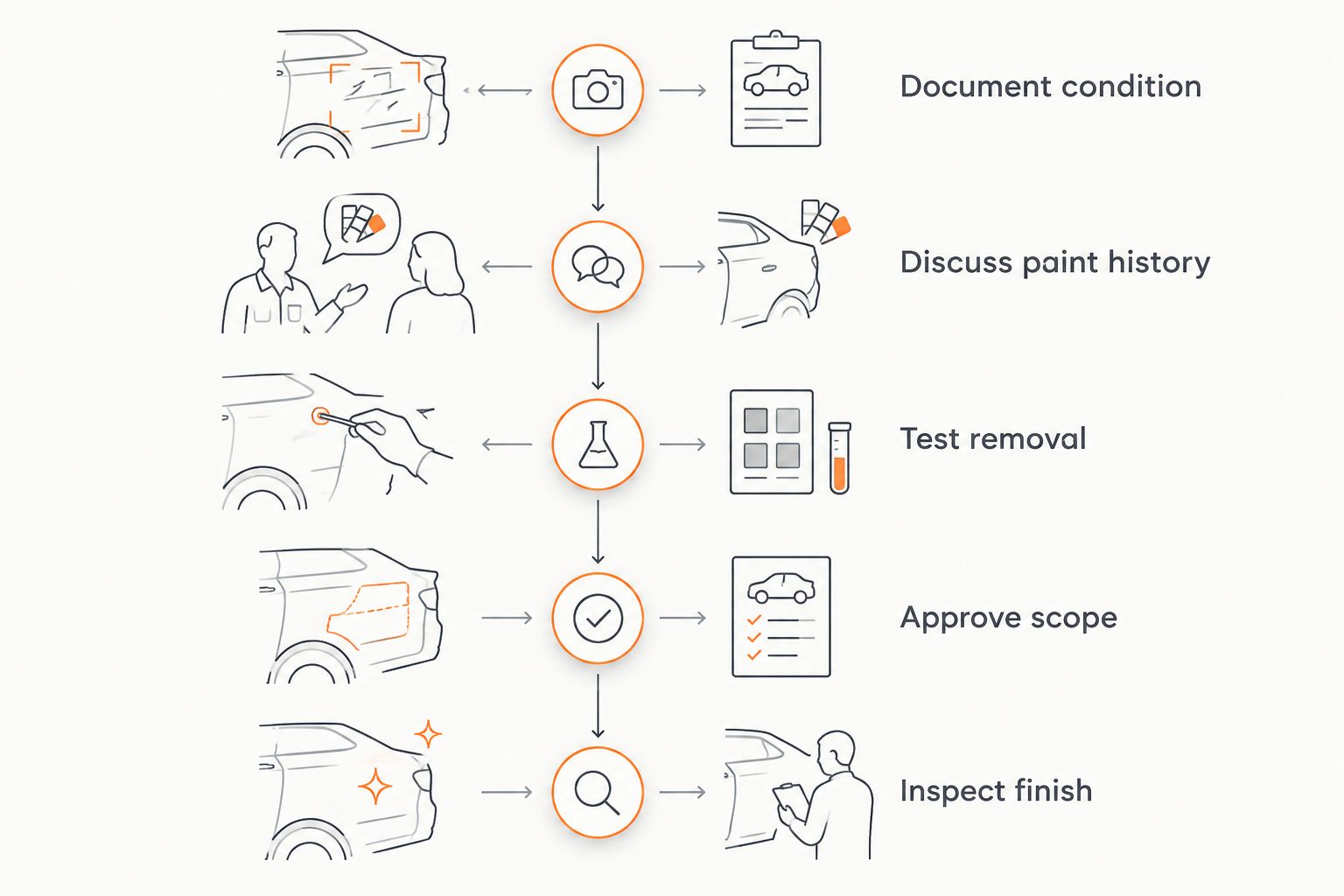
What should happen before removal starts?
A sound removal plan follows the condition of your vehicle, not a fixed promise about how quickly every wrap comes off. These steps help you establish expectations before authorizing work.
- Document condition. Photograph cracking, lifted edges, stone chips, clear-coat damage, and visible paint defects. Include close views and wider views that identify the panel.
- Discuss paint history. Identify known repainting, collision repairs, replacement panels, and previous film layers. Say when the history is unknown rather than treating it as factory paint.
- Test removal. Ask the installer to assess a suitable area and explain how the film, adhesive, and paint respond. A successful test does not guarantee identical behavior across every panel.
- Approve scope. Confirm included panels, adhesive cleanup, component handling, and the process for approving unexpected work.
- Inspect finish. Review the exposed surface before authorizing correction, another wrap, or a coating. Document remaining defects separately from remaining adhesive.
The purpose is to make decisions at the right stage. You should not have to approve polishing before anyone has seen the exposed paint.
Can removing a wrap damage the paint?
Yes. Removing a wrap can lift compromised paint or clear coat, particularly where adhesion was already weak. Repainting does not automatically mean failure, but it makes the repair history and finish condition important parts of the assessment.
A clean release also does not prove that the finish will look uniform. Existing scratches, discoloration, old repairs, and differences between exposed and covered areas can become apparent after removal.
Separate removal damage from pre-existing damage revealed by removal. Before-and-after photographs help establish what was visible initially and what appeared only after the film came off. They do not eliminate the need for a careful inspection.
The distinction between materials matters, too. Vinyl wrap changes appearance, while paint protection film is intended to provide a protective barrier against surface damage. The question of removing PPF without damaging paint likewise depends on the underlying finish and removal method; neither material creates a blanket guarantee of damage-free removal.
If the paint begins lifting, stop and reassess rather than treating faster removal as the solution. Continuing without understanding the failure risks extending the affected area.
Does wrap removal include adhesive removal and polishing?
Wrap removal includes adhesive removal and polishing only when the agreed scope says so. These are distinct operations, and you should confirm each rather than infer them from the phrase complete removal.
Adhesive cleanup addresses residue left by the film. Paint correction addresses suitable defects in the exposed finish through polishing; it does not replace missing paint or repair clear-coat failure.
For a 2026 quote, ask what the finished surface will be ready for: inspection, sale photographs, a replacement wrap, or a different protection service. That answer establishes the required preparation more clearly than a vague promise of a detailed finish.
Also ask how textured plastics and other unpainted surfaces will be handled. A process suitable for one body panel is not automatically appropriate for every adjacent component.
What should you do after the wrap is removed?
Choose the next treatment after the paint inspection, not before it. First establish whether the surface needs cleaning, repair, or suitable correction; then decide which protection addresses your driving and ownership goals.
For Florida Gulf Coast vehicles, explain the exposure you want to manage: outdoor parking, coastal use, frequent highway driving, or regular washing. Vinyl wraps, ceramic coatings, and paint protection film serve different purposes and should not be treated as interchangeable shields against sun, salt, and road wear.
CoaterZ offers vinyl wraps, ceramic coating, and paint protection film, but those services do not share identical preparation requirements or protection characteristics. Ask about the specific material, surface compatibility, maintenance instructions, and written terms rather than assuming a general protection claim applies to everything.
If another wrap is your goal, compare the removal scope separately from the full vehicle wrap cost in Tampa. Keeping those decisions separate makes it easier to see which preparation tasks are included and which require approval after inspection.
What should you send when requesting a removal quote?
Send clear photographs of the whole vehicle, each wrapped panel, damaged areas, and any lifting edges. Include the installation date if known, the film identity if documented, previous repair history, and whether the vehicle is normally parked outdoors.
Describe the desired handover condition in plain language. For example, specify whether you want the film removed and adhesive cleaned, or whether you also want an assessment for another wrap or protective treatment.
For your 2026 appointment request, ask whether the initial estimate is provisional pending inspection. A clearly bounded estimate is more useful than a firm-looking figure that leaves adhesive cleanup and paint condition undefined.
FAQ
How much does it cost to remove a vehicle wrap in 2026?
The cost to remove a vehicle wrap depends on coverage, film condition, adhesive cleanup, access, and underlying paint. Request an inspection-based quote that separates removal from correction and replacement protection.
Is removing a vehicle wrap cheaper than installing one?
Do not assume removal costs less than installation. Deteriorated film, adhesive residue, and access requirements make the removal scope vehicle-specific, so compare separate written quotes.
Can I remove my vehicle wrap myself?
DIY removal puts responsibility for surface compatibility and paint-damage prevention on you. Seek professional assessment if the vinyl is brittle, the paint history is uncertain, or the finish is already damaged.
Will removing a vinyl wrap ruin my paint?
Wrap removal does not inevitably ruin paint, but compromised paint or clear coat can lift. Inspect known repairs and existing damage before work, and stop if the finish begins separating.
Does a wrap removal quote include adhesive cleanup?
Adhesive cleanup is included only when the quote explicitly includes it. Confirm the intended handover condition and whether trim handling, polishing, or replacement preparation is separate.
How long does it take to remove a car wrap?
Removal time depends on how the film releases, the covered areas, and the residue left behind. Ask for a schedule after inspection rather than relying on vehicle size alone.
Can I put a new wrap on immediately after removal?
Install a new wrap only after the exposed surface has been assessed and prepared for the selected film. Adhesive residue, damaged paint, and compatibility issues need attention before installation.
One last thing
Do not use water beading or a quick visual check as proof that the surface is ready for another wrap. Ask the installer to confirm that residue, existing surface treatments, and paint defects have been addressed for the chosen material. The important handover is not simply vinyl off; it is a clearly documented surface condition.