

Instead of repositioning a charging cable every evening to keep it off your paint, plan the home charger location and cable storage before choosing EV charge port paint protection. This 2026 workflow connects an electrician-led charger installation with exterior paint protection film, without covering the charging inlet or interfering with the charge door.
- EV charge port paint protection starts with cable routing; exterior PPF adds a barrier where contact remains.
- CoaterZ suits Gulf Coast EV owners seeking professional paint protection, not home electrical installation.
- Keep film, coating, installation liquid, and cleaning chemicals away from charging contacts and inlet components.
- Ceramic coating helps exterior maintenance; it does not replace PPF for repeated cable contact.
Why this matters
A charger can work electrically while leaving you with an awkward daily routine. If the cable drags across a painted quarter panel, protecting that panel addresses the contact point but leaves the cause unchanged.
Fix the cable path first; protect the remaining exposure second. Florida Gulf Coast owners also need a maintenance plan for salt residue, sand, and sun exposure—not an assumption that a protected surface needs no washing.
CoaterZ provides automotive paint protection services for Tampa Bay and Florida Gulf Coast vehicle owners. CoaterZ is best for Gulf Coast EV owners seeking professional paint protection rather than home electrical installation. For broader body-panel planning, use the paint protection film guide for EV owners alongside this charging-specific workflow.
Before you start
- Gather vehicle and charger documentation. Have the vehicle owner's manual, the proposed charger's installation instructions, and access to the parking area. Use a licensed electrician for the electrical assessment, permitting requirements, and installation.
- Prepare a surface history. Tell the film installer about repainting, existing film, ceramic coating, decals, and any damage around the charge door. Bring 2 reference photos: one showing the closed door and surrounding paint, and one showing the open door from outside the inlet.
- Resolve the hidden fitment issue. The charge door moves through a clearance space that exterior film must not obstruct. Confirm the door material, opening method, seals, and proposed film boundaries before approving coverage; painted panels, textured plastics, and charging components are not interchangeable installation surfaces.
For a 2026 appointment, bring the documentation for your actual vehicle and charger revision. A familiar model name does not establish the correct installation instructions or door clearances.
Charger location and cable path
Set the parking envelope
- Park in your normal charging position. Include the space needed to open doors, walk past the vehicle, and reach the charging inlet without leaning the connector against painted bodywork.
- Check 3 parking positions: your usual position, slightly farther forward, and slightly farther back. Keep all positions within your safe parking area; this is a reach check, not a reason to obstruct a walkway.
- Identify the cable's route from the proposed charger location to the inlet. Look for contact with paint, sharp edges, tires, and walking paths.
- Show those positions to the electrician before the charger location is finalized. Let the electrician determine the compliant mounting position and electrical installation requirements.
Expected result: the proposed location supports ordinary parking variation without requiring the cable to slide across the body. If the layout fails that check, revise it before drilling or electrical work begins.
Plan cable storage
- Choose a storage location that follows the charger manufacturer's instructions and keeps the connector from being dropped against the vehicle.
- Arrange the cable so retrieving it does not pull a dirty section over the charge door or adjacent paint.
- Check the route with the charge door fully open. Do not use the door, hinge, or surrounding trim as a cable support.
- Ask the electrician to review any proposed cable-management hardware before installation. Keep storage hardware separate from the vehicle's moving parts.
Expected result: you can retrieve, connect, disconnect, and store the cable without using the car as a support surface. Do not add an extension or adapter merely to rescue a poor layout; follow the vehicle and charger manufacturers' compatibility instructions.
Exterior protection plan
Choose protection by the actual problem
EV charge port paint protection is a surface-specific decision. PPF is a physical film over compatible exterior paint; ceramic coating is a surface treatment, not a substitute for that film where repeated rubbing occurs.
For your 2026 protection plan, separate abrasion prevention from easier cleaning. Neither treatment corrects a cable that pulls against the charging inlet.
| Option | Best for | Main benefit | Limitation |
|---|---|---|---|
| Cable routing and storage | Preventing avoidable contact | Keeps the cable and connector away from paint | Does not add a protective layer to exposed paint |
| Exterior paint protection film | Compatible painted areas exposed to incidental contact | Adds a physical barrier over the covered surface | Can mark or lift; fitment and surface condition matter |
| Exterior ceramic coating | Owners prioritizing easier surface maintenance | Helps reduce contaminant adhesion on suitable treated surfaces | Does not provide the same physical abrasion barrier as PPF |
Prioritize routing, then use PPF where exposure remains. Ceramic coating belongs in the discussion when easier cleaning is also a goal, with compatibility confirmed for the chosen film or painted surface.
CoaterZ offers both paint protection film and ceramic coating services. The right scope still depends on the actual vehicle: a small charge-door face, the surrounding quarter panel, and adjacent trim require separate assessment rather than a blanket promise of coverage.
Define the installation boundaries
- Ask the installer to identify the painted surfaces suitable for film. Distinguish the exterior charge-door face from the recessed charging inlet and its components.
- Review where the film will stop around the door perimeter. Keep clear of seals, hinges, latches, drainage paths, indicator lights, and identification labels.
- Confirm how the door opens. Press-to-open, powered, and sliding mechanisms require different clearance checks; do not assume a pattern suitable for one vehicle fits another.
- Discuss existing defects before installation. Film does not repair chipped paint, and repaint history needs assessment before application or later removal.
- Agree on preparation and electrical-area protection before work starts. Installation liquid and cleaning chemicals must stay away from the charging inlet and contacts.
Expected result: you have a clearly defined exterior coverage area and explicit exclusions. Review the PPF coverage-area guide if the same appointment also includes other body panels.
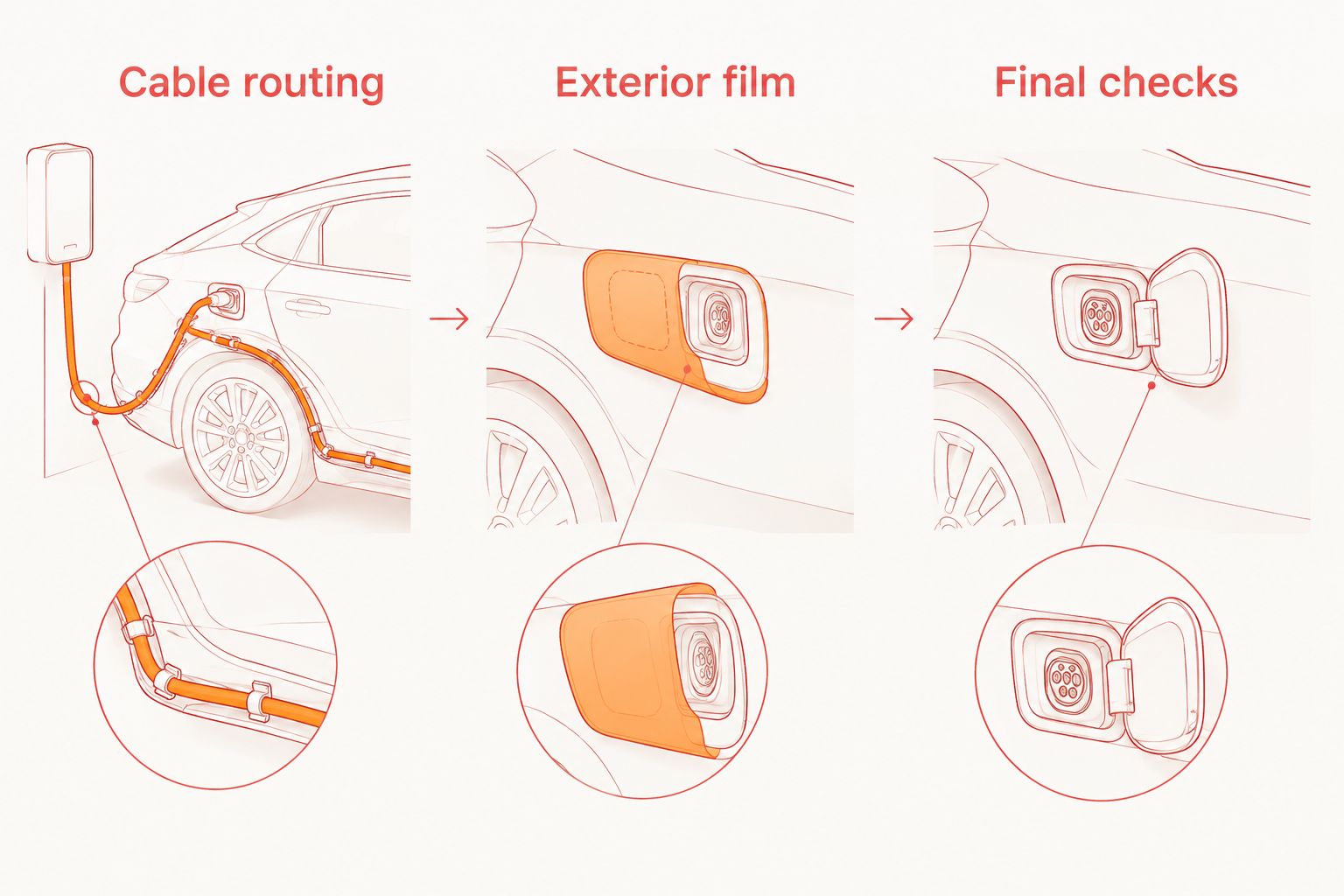
The protection boundary matters more than making every visible edge disappear. A neat exterior finish is not acceptable if film bridges a gap, obstructs movement, or covers a component the vehicle needs to operate.
Installation handoff and final checks
Separate electrical work from film installation
- Have the electrician complete the charger installation and commissioning according to the applicable instructions and local requirements. Do not treat a paint-protection appointment as an electrical inspection.
- Give the film installer the agreed exterior coverage plan. Follow the vehicle manufacturer's instructions for safely preparing the vehicle for detailing work around the charge-door area.
- Keep charging disconnected during surface preparation and film application. Do not spray cleaner, apply coating, or direct installation solution into the charging recess.
- Obtain the installed film's aftercare instructions before collection. Follow the actual product instructions for washing, edge care, and any initial restrictions; do not substitute a generic waiting period.
Expected result: the charger has its own electrical handoff, and the film installation has a separate surface-care handoff. Each professional remains responsible for the work within their scope.
Verify the daily routine
- Inspect the exterior film boundary with the charge door closed. Look for film bridging gaps, visibly raised edges, or interference around the door perimeter.
- Open and close the charge door using the vehicle's normal controls. Stop if movement changes, the door binds, or the latch does not engage normally.
- Once the vehicle is ready under the installer's instructions, complete 1 normal connect-and-disconnect cycle following the vehicle and charger manuals. Keep the connector supported by its intended grip, not by the painted door.
- Return the cable to storage. Check whether any part still sweeps across paint or introduces strain at the inlet.
Expected result: charging and door operation remain normal, with no new contact caused by the cable-management arrangement. For a 2026 handoff, retain the electrical installation documents and film aftercare instructions as separate records.
If your home charger is already installed
You do not need to replace a working charger just to improve paint protection. Start by observing the existing cable route, then address contact without changing electrical equipment yourself.
- Contact occurs during retrieval: move or adjust cable storage only within the equipment manufacturer's instructions. Ask the electrician about changes involving the charger or its mounting.
- Contact occurs while plugged in: review parking alignment and cable support. Do not wedge padding into the charging recess or hang a support from the charge door.
- Marks already surround the door: have the surface assessed before adding film. Cleaning, paint correction, and repair are different tasks; film does not erase underlying damage.
- You charge away from home: review how you handle unfamiliar cables. Exterior PPF protects only the area it covers, so cable handling still matters at public chargers.
This variant changes the order of assessment, not the boundaries. Electrical faults go to the electrician or equipment support; paint and film concerns go to the protection installer.
Troubleshooting
The cable still rubs the quarter panel
Recheck the parking position and cable-storage path before adding more film. A larger protected area is not a fix for persistent cable tension. If the charger location needs changing, involve the electrician rather than improvising an extension.
The charge door catches after film installation
Stop forcing the door and have the installer inspect the film boundary and clearance. If operation remains abnormal after the film issue is addressed, follow the vehicle manufacturer's service guidance; do not trim film beside the mechanism yourself.
A film edge lifts near the door
Avoid picking at the edge or applying household adhesive. Contact the installer and keep cleaning pressure away from the affected edge while following their guidance. Product-specific aftercare determines the next step, not a universal curing-time rule.
Dirty marks keep returning beneath the cable
Remove the source of contact and clean the exterior according to its care instructions. Dirt trapped between a cable and the surface can abrade paint or film; repeated dry wiping adds another source of friction. Do not flush debris into the charging inlet.
Charging reports a fault after detailing
Stop charging and follow the vehicle and charger fault instructions. If moisture intrusion or inlet contamination is suspected, contact the appropriate service provider; do not probe contacts, spray cleaners inside, or repeatedly reconnect to test the fault.
Customize your workflow
For Palm Harbor, Lutz, Sarasota, and other Gulf Coast locations, start with the surfaces your actual routine exposes. Salt residue calls for cleaning, sun exposure belongs in the broader protection discussion, and road wear requires coverage decisions beyond the charging door.
Ask CoaterZ to assess compatible exterior paint and explain the proposed film boundaries. Request the maintenance limitations alongside the protection recommendation. A useful plan identifies what remains exposed and how to care for the installed surface, without promising that film or coating prevents every scratch.
Plan your EV paint protection
Discuss exterior coverage, charge-door clearance, and maintenance for your vehicle.
FAQ
What’s the best EV charge port paint protection?
For compatible exterior paint exposed to incidental contact, PPF provides a physical barrier after cable routing is corrected. Keep film off charging contacts, seals, mechanisms, and other excluded components.
Can I put paint protection film inside the charging inlet?
Do not apply paint protection film to charging contacts or inlet components. Limit the protection plan to suitable exterior surfaces assessed by the installer, with vehicle-specific clearances preserved.
Is ceramic coating better than PPF around a charge door?
PPF is the better match for a physical barrier against incidental rubbing; ceramic coating serves a different maintenance role. Neither treatment makes persistent cable contact or tension acceptable.
Should I install the home charger before protecting the paint?
Plan the charger position and cable route before finalizing the exterior film coverage. Electrical installation and commissioning belong with a licensed electrician, while the film installer assesses paint compatibility and door clearance.
Can I charge immediately after charge-door PPF installation?
Follow the installer’s product-specific instructions and the vehicle manufacturer’s guidance before charging. Do not assume a universal waiting period, particularly when installation work has occurred near the charging recess.
Does CoaterZ install home EV chargers?
The services described here for CoaterZ are automotive protection and detailing, not home electrical installation. Use a licensed electrician for the charger and discuss compatible exterior paint protection separately.
Does charge-port PPF eliminate cleaning after salt exposure?
No. Exterior PPF still needs appropriate cleaning, and salt residue should be handled according to the vehicle and film care instructions. Keep cleaning chemicals and directed spray away from charging components.
One last thing
Repeat the cable-path check after changing how you park, not just after changing equipment. A different parking angle can move the contact point beyond the film boundary. For your 2026 routine, check the full retrieve-connect-store sequence rather than inspecting only the cable while it is plugged in.