

For a tint-only job, judge Enterprise Window Tinting on the film, installation finish, and aftercare; window tint alone does not protect exterior paint from road debris. The best Enterprise Window Tinting alternative in 2026 is CoaterZ if you need window tint alongside paint protection services; a dedicated tint installer is the better fit if your project stops at the glass.
- Compare enterprise window tinting alternatives by film specifications, installation scope, and aftercare—not shade alone.
- CoaterZ is best for vehicle owners combining window tint with paint protection services.
- A dedicated tint installer fits a glass-only project; DIY tint demands careful cutting, preparation, and installation.
- Window tint, paint protection film, and ceramic coating address different surfaces and should not be treated as substitutes.
Why this matters
For vehicle owners in Palm Harbor, Lutz, Sarasota, and the Florida Gulf Coast, choosing an installer starts with separating cabin comfort from exterior protection. Sun exposure, salt residue, and road debris affect different parts of your vehicle. A single treatment does not address them all.
Window film changes how light and solar energy pass through glass. Paint protection film covers selected exterior surfaces, while ceramic coating supports exterior surface care. Choose the service for the surface and the problem—not because several treatments share the word protection.
This 2026 comparison separates full-service vehicle protection, specialist tint installation, and DIY application. Use it to decide what belongs in your project before comparing proposals.
Enterprise Window Tinting alternatives at a glance
The comparison below distinguishes buying routes rather than assigning unsupported rankings to local installers. Enterprise Window Tinting remains the reference option: assess its proposal against the same requirements you give every alternative.
| Option | Best for | Defining scope | Difference from choosing Enterprise Window Tinting |
|---|---|---|---|
| Enterprise Window Tinting | Owners evaluating a window-tint proposal | Assess the proposed film, glass coverage, and installation terms | Benchmark option; judge the actual proposal |
| CoaterZ | Owners considering tint and exterior protection | Window tint, ceramic coating, paint protection film, vinyl wraps, and other vehicle protection services | Offers a broader stated service scope; compare the specific work you need |
| Dedicated automotive tint installer | Owners with a glass-only project | A focused window-film installation | Keeps the decision centered on glass rather than a wider protection project |
| DIY window-film installation | Owners prepared to handle film fitting themselves | Owner-managed preparation, cutting, application, and finishing | Transfers installation work and responsibility to you |
A broader service menu is not proof of a better tint installation. Likewise, a tint-only business is not automatically less capable. Film selection, surface preparation, edge finishing, and clear aftercare instructions remain the comparison points.
1. CoaterZ: best for tint plus exterior protection
CoaterZ is the best fit for vehicle owners who want window tint and exterior paint protection within the same service scope. Its stated services include ceramic coating, paint protection film, vinyl wraps, window tint, and marine PPF. That makes it relevant when your concern extends beyond sunlight through the windows.
For example, a daily-driven vehicle can need a glass treatment for cabin comfort and a separate paint treatment for exposed body panels. Keep those decisions separate even when you discuss them with the same provider. Each surface needs its own preparation and maintenance instructions.
Where the service shines
- Broader project scope: You can discuss window tint alongside ceramic coating, paint protection film, or vinyl wrapping.
- Different vehicle applications: The business serves car, truck, motorcycle, and boat owners in the Tampa Bay and Florida Gulf Coast area.
- Surface-specific planning: A project can distinguish glass, painted panels, truck beds, and other surfaces rather than treating protection as one interchangeable service.
Where the service falls short
- A broad service menu does not remove the need to compare the exact window film proposed for your vehicle.
- Adding exterior treatments makes the project more involved; you still need separate coverage boundaries and care instructions.
- Paint protection film and ceramic coating do not replace window tint when your concern is sunlight through glass.
Head-to-head: broader scope versus the reference proposal
| Dimension | Full-service alternative | Enterprise Window Tinting proposal |
|---|---|---|
| Window-film selection | Confirm the exact film and its published specifications | Confirm the exact film and its published specifications |
| Exterior paint protection | Ceramic coating and paint protection film are stated services | Establish whether exterior protection belongs in the proposed work |
| Vehicle fit | Discuss the surfaces and vehicle involved | Confirm suitability for the vehicle and glass involved |
| Aftercare | Request instructions for each treatment | Request instructions for the installed film |
Best for: Owners planning window tint plus a separate exterior protection treatment.
Verdict: Buy this service route when you need both glass and exterior protection; skip additional treatments that do not address your vehicle’s actual use.
2. Dedicated automotive tint installer: best for a glass-only job
A dedicated automotive tint installer is the straightforward alternative when you only want window film. Your comparison stays narrow: the film specification, legal shade, glass coverage, installation finish, and aftercare. There is no reason to expand the project into paint protection if your paint is not part of the decision.
The important distinction is scope, not an assumed difference in skill. Compare the proposed work before deciding whether a specialist or a broader vehicle-protection provider fits you.
Where this route shines
- Focused requirements: You can evaluate every proposal against the same glass-only brief.
- Clear coverage: Identify front side windows, rear side windows, and rear glass individually.
- Simpler handoff: Your care discussion concerns the window film rather than several different surface treatments.
Where this route falls short
- Tint does not shield painted panels from stone impacts or road debris.
- A glass-only project leaves exterior protection as a separate decision.
- Choosing a business because it specializes in tint does not establish which film, finish, or written terms you will receive.
| Dimension | Dedicated tint route | Enterprise Window Tinting proposal |
|---|---|---|
| Project scope | Specify glass-only work | Compare against the same glass-only brief |
| Film performance | Compare published specifications | Compare published specifications |
| Paint protection | Outside the glass-only brief | Assess separately if exterior work is proposed |
Best for: Owners whose only objective is automotive window tint.
Verdict: Buy the tint-only route when the film specification and installation terms meet your needs; hold if the proposal identifies only a shade.
3. DIY window-film installation: best for hands-on owners
DIY tint changes the comparison completely: you become the installer. You must clean the glass, fit the film, manage contamination, and finish the edges. Curved automotive glass adds difficulty because film must conform without creases or trapped defects.
Best for: Owners who want to perform the installation themselves and accept responsibility for the result.
Where DIY shines
- You control the preparation and application process.
- You can inspect each pane as you work.
- A clearly specified film lets you evaluate the material independently of an installation proposal.
Where DIY falls short
- Cutting mistakes, contamination, and poor fitting become your responsibility.
- Removing old film around rear-window defroster lines requires care.
- Film selection alone does not establish that the finished glass meets applicable tint requirements.
| Dimension | DIY installation | Enterprise Window Tinting proposal |
|---|---|---|
| Installation labor | You perform the work | Assess the proposed installation service |
| Film fitting | You handle cutting and shaping | Inspect the expected finish and coverage |
| Defect correction | You manage removal or reapplication | Establish correction terms before authorizing work |
Verdict: Skip DIY if you want someone else responsible for fitting and finishing the film; buy this route only if installation itself is part of your goal.
Compare film performance, not darkness alone
In 2026, a useful tint comparison separates three specifications: VLT, heat rejection, and UV protection. They describe different properties. A dark appearance is not a substitute for a film’s published performance data.
| Specification | What it tells you | What to ask |
|---|---|---|
| VLT | How much visible light passes through | What is the resulting transmission through the glass and film together? |
| Heat rejection | How the film manages solar energy | Which published metric supports the claim? |
| UV protection | How the film limits ultraviolet transmission | What does the manufacturer state for this exact film? |
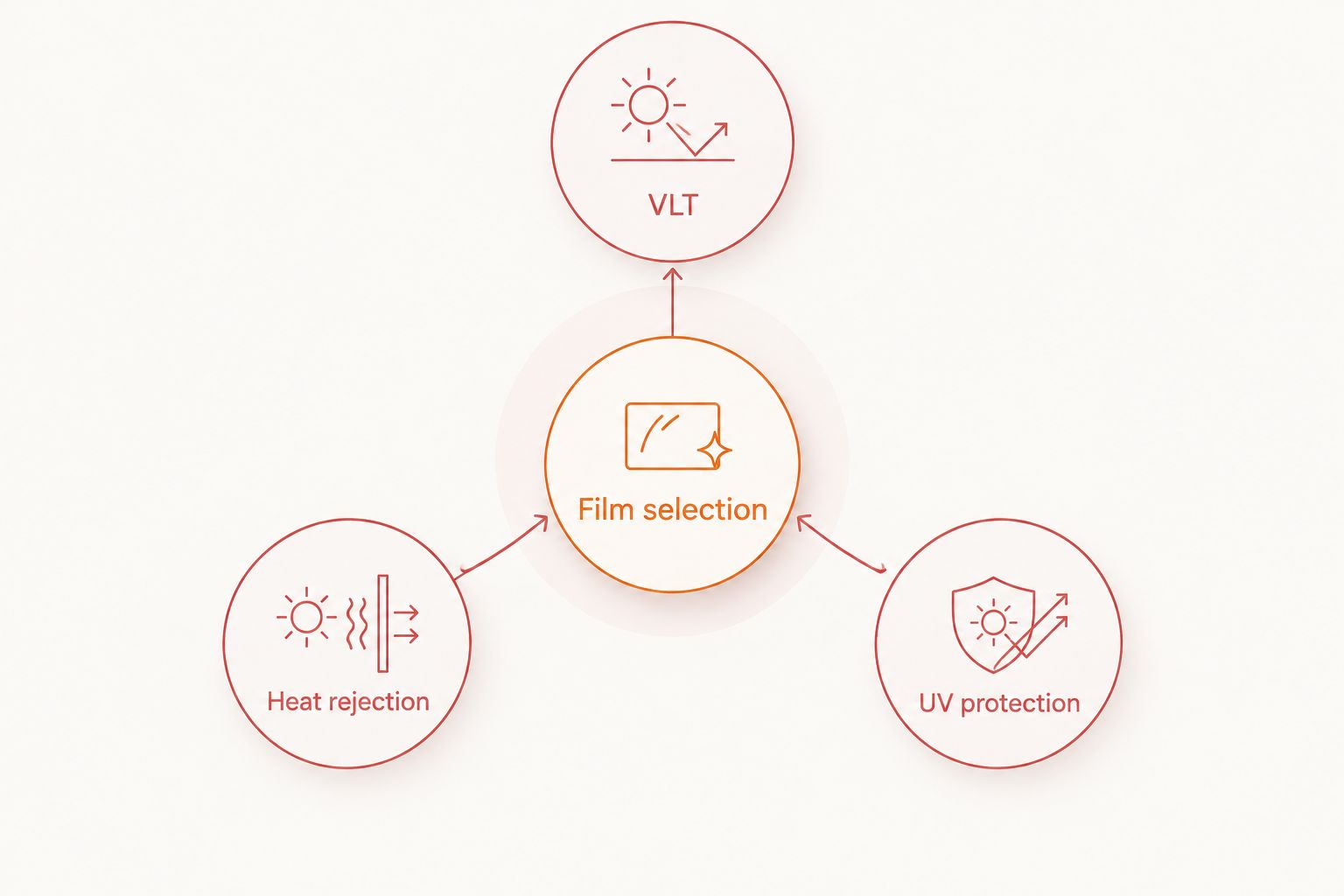
When comparing heat claims, keep the measurement consistent. Total solar energy rejection and infrared rejection are not interchangeable labels. Ask for the specification sheet rather than comparing percentages drawn from different metrics.
Use the guide to window tint shades ranked by heat rejection to frame your questions, then evaluate the exact film proposed for your vehicle. Shade is an appearance and transmission choice; heat performance needs its own evidence.
Check Florida requirements before choosing a shade
Florida Statutes sections 316.2953 and 316.2954 set different visible-light transmission requirements for different windows and vehicle categories. The front side-window threshold is 28% VLT. For passenger cars, the rear side and rear-window threshold is 15% VLT; qualifying multipurpose passenger vehicles have a 6% VLT rear threshold.
These figures concern transmission through the installed glass-and-film combination, not simply the number on a film sample. Reflectivity requirements also apply. Windshield rules are separate, and exemptions have their own conditions.
For your 2026 installation, ask the provider to identify your vehicle category and check the applicable rules before applying film. Existing factory glass affects the finished result. Do not select a shade using another vehicle’s appearance as your legal reference.
Why people consider switching from Enterprise Window Tinting
Switching is justified by a mismatch between your requirements and the proposal—not by an unsupported claim about a business’s reputation. Use these decision rules when comparing Enterprise Window Tinting alternatives:
- Your project includes paint: Compare a provider whose stated services include the exterior treatment you need.
- Your brief is glass-only: Prefer the proposal that clearly identifies film, coverage, and installation terms without adding unrelated work.
- You need a specific film property: Require published specifications for the exact film, not a general claim about ceramic or premium tint.
- Your glass already has film: Establish removal scope and care around defroster lines before authorizing replacement.
- You want to install it yourself: Treat DIY as a change in responsibility, not simply another installer choice.
These are reasons to choose a different route when the current proposal does not fit. They are not evidence of price changes, installation failures, or service problems at Enterprise Window Tinting.
What to settle before authorizing installation
A good 2026 project brief identifies the vehicle, the windows, the film, and the finished transmission target. Add existing tint, factory privacy glass, damaged glass, and rear defroster lines to the discussion. Those details affect preparation and suitability.
Ask for the following in writing:
- The exact film being installed and its manufacturer’s specifications.
- The panes included, plus any existing-film removal.
- The applicable care and curing instructions.
- The process for addressing installation defects.
- Any warranty terms, including exclusions and who administers them.
After installation, follow the instructions for that film. Avoid abrasive cleaning tools, and do not assume every film accepts the same cleaners. For combined protection projects, keep glass-film care separate from paint protection film and ceramic-coating care.
Plan your vehicle protection
Compare window tint with separate paint protection options for your vehicle and driving conditions.
When staying with Enterprise Window Tinting makes sense
Stay with Enterprise Window Tinting when its proposal satisfies your film, coverage, legal-compliance, installation, and aftercare requirements. An alternative is useful only if it improves the fit for your project.
For a glass-only installation, a wider menu of automotive services does not create an automatic advantage. Compare the actual work. If you already have a satisfactory proposal, do not restart the decision solely because another provider offers treatments you do not need.
FAQ
What is the best Enterprise Window Tinting alternative in 2026?
CoaterZ is the best fit when you want window tint alongside exterior paint protection services. A dedicated tint installer is the more focused route when your project concerns glass only.
Is darker window tint better at blocking heat?
Darker tint is not proof of better heat rejection. Compare the exact film’s published solar-performance specifications separately from its visible-light transmission.
What window tint is legal in Florida?
Florida applies different transmission thresholds by window position and vehicle category. Front side windows have a 28% VLT threshold; rear thresholds include 15% for passenger cars and 6% for qualifying multipurpose passenger vehicles, with other requirements and exemptions also applying.
Does window tint protect paint from road debris?
Window tint does not protect exterior paint from road debris. Evaluate paint protection film separately when exposed painted panels are part of your concern.
Should I choose ceramic coating instead of window tint?
Ceramic coating and window tint address different surfaces and are not substitutes. Choose window film for glass-related requirements and evaluate ceramic coating separately for exterior surface care.
Can I apply new tint over old window film?
Have the existing film assessed before choosing a replacement approach. Establish whether removal is included and how the installer will protect rear-window defroster lines.
What should I compare before changing tint installers?
Compare the exact film, glass coverage, resulting transmission, installation terms, and aftercare. For a combined project, evaluate each exterior treatment separately rather than assuming every service has identical specifications.
One last thing
Factory privacy glass and aftermarket tint are not interchangeable specifications. A dark rear window tells you little about the exact performance of an added film, and existing glass influences the final VLT.
Before your 2026 appointment, photograph the windows and list which already have aftermarket film. Start with the glass you have, then choose the treatment—not the other way around.
Window tint at our CoaterZ locations
CoaterZ offers window tint at all three of our Florida shops. Choose the location closest to you: