

No—undercoating does not attract rust, but applying it over moisture, salt, loose corrosion, or poorly prepared metal can trap the conditions that let rust continue underneath. A compatible coating on a properly prepared surface helps separate metal from corrosive exposure. Undercoating is a protective barrier, not a repair for rusted metal.
- Does undercoating attract rust? No; trapped moisture, salt contamination, and damaged barriers explain rust beneath coatings.
- CoaterZ offers professional undercoating for Florida Gulf Coast vehicle owners; surface condition must guide treatment.
- Rustproofing starts with inspection, cleaning, drying, and compatible preparation—not hiding corrosion beneath a fresh finish.
- Keep drains open and inspect damaged coating; no underbody treatment eliminates maintenance.
Does undercoating attract rust instead of preventing it?
Undercoating does not draw rust toward your vehicle. Rust forms when iron-containing metal corrodes in the presence of moisture and oxygen; dissolved salts help that corrosion process. Trouble starts when a coating conceals contamination, separates from its substrate, or covers damage that needed repair.
The distinction matters when choosing CoaterZ undercoating services in 2026: assess the metal beneath the proposed finish, not just how uniform the finished underside will look.
| Underbody condition | What undercoating does | Best next move |
|---|---|---|
| Clean, dry, sound, compatible surface | Adds a barrier against exposure | Follow the specified preparation and application process |
| Loose rust or flaking scale | Covers an unstable surface rather than repairing it | Remove unstable material and assess the remaining metal |
| Moisture or salt residue beneath a coating | Conceals contamination that supports corrosion | Clean, dry, and prepare before applying a compatible system |
| Cracked or lifting existing coating | Leaves paths for contamination beneath the finish | Inspect affected areas before choosing a repair method |
| Perforated or structurally weakened metal | Does not restore lost strength | Obtain a qualified repair assessment before coating |
A dark, tidy underside proves that a surface has been covered. It does not prove that corrosion has stopped.
Why this matters on Florida’s Gulf Coast
For owners in Palm Harbor, Lutz, and Sarasota, the useful question is not whether every vehicle needs the same treatment. It is which surfaces encounter salt, moisture, debris, and repeated abrasion—and whether those surfaces can be prepared correctly.
Boat-ramp use, coastal exposure, wet roads, and accumulated mud create different inspection priorities. A truck used around saltwater deserves attention to splash zones and areas that hold contamination. A vehicle with previous corrosion or unknown underbody repairs needs a condition assessment before another layer goes on.
Florida sun also affects vehicle-protection decisions, but an underbody coating is not a substitute for exterior paint protection. Match the treatment to the surface and exposure. Paint protection film, ceramic coating, bedliner, and undercoating serve different purposes; their specifications are not interchangeable.
How can undercoating make an existing rust problem worse?
The problem is concealment and entrapment, not attraction. A coating that looks intact from below can hide corrosion at its edges, beneath loose material, or around an unprepared seam.
Moisture remains beneath the finish
Applying a barrier before the substrate and accessible seams are properly dry risks leaving moisture underneath. Dry-looking exposed metal does not establish that overlapping panels, recesses, and other concealed areas are ready.
Ask how drying is confirmed for the selected system. Do not substitute an arbitrary waiting period for the manufacturer’s preparation requirements.
Salt and dirt remain on the surface
Coating over contamination leaves the underlying problem in place. Salt residue supports corrosion when moisture is present, while dirt and grease interfere with adhesion.
Cleaning must address the material on the surface, not simply improve its appearance. Loose debris removal and appropriate cleaning are preparation steps, not optional finishing details.
The coating separates from the metal
A lifting edge or crack creates an entry point. Water and contamination can reach the substrate, while the remaining coating makes the affected area harder to see and clean.
Adding another layer over that defect does not restore adhesion beneath it. The damaged area needs inspection and preparation before a compatible repair.
Which undercoating approach fits the surface?
Treatment categories differ in how they behave and where they belong. This 2026 comparison is a selection guide, not a claim that every formulation within a category performs identically.
| Treatment approach | Best for | Useful characteristic | Limitation or maintenance caveat |
|---|---|---|---|
| Hard-setting barrier coating | Compatible, sound surfaces needing a durable barrier | Separates prepared metal from direct exposure | Chips, cracks, and lifting edges need inspection; removal can complicate later assessment |
| Wax-based corrosion protection | Approved seams, cavities, and surfaces specified by the manufacturer | Provides a protective film in suitable locations | Suitability for exposed abrasion zones depends on the formulation; condition needs checking |
| Oil-based corrosion protection | Approved areas requiring a non-hardening protective film | Does not rely on a rigid shell | Residue, wash-off, material compatibility, and repeat treatment depend on the product |
| Rust repair before protection | Flaking, perforated, or weakened metal | Addresses the damaged substrate before concealment | Requires repair assessment; coating alone cannot replace lost metal |
Choose the system for the substrate, not the thickest-looking finish. A material intended for a cavity is not automatically suitable for an exposed impact area. Likewise, a coating designed for steel should not be assumed compatible with aluminum, plastics, rubber, sealants, or an existing finish.
The undercoating and rustproofing product guide provides a starting point for comparing treatment categories. Before approving any product, establish its intended surfaces, preparation requirements, exclusions, and maintenance instructions.
Why undercoating results vary
Two vehicles receiving the same general treatment category can present very different preparation problems. These factors determine whether the application creates a useful barrier or covers a problem that remains unresolved:
- Existing corrosion: Light surface oxidation, flaking scale, and structural metal loss require different responses. Do not treat them as equivalent.
- Surface cleanliness: Grease, salt residue, mud, and loose material affect the condition beneath the coating and its adhesion.
- Dryness: Accessible panels and concealed seams do not necessarily dry together. Follow the selected system’s requirements.
- Material compatibility: Existing factory finishes, repair coatings, metals, plastics, and rubber need product-specific consideration.
- Application access: Obstructions, cavities, and overlapping panels influence what can be inspected and treated correctly.
- Later damage and exposure: Abrasion, impacts, saltwater contact, and blocked drainage change what needs attention after application.
There is no universal service interval or lifespan that applies to all those combinations. For a 2026 application, request instructions for the actual treatment installed rather than borrowing maintenance advice from another product category.
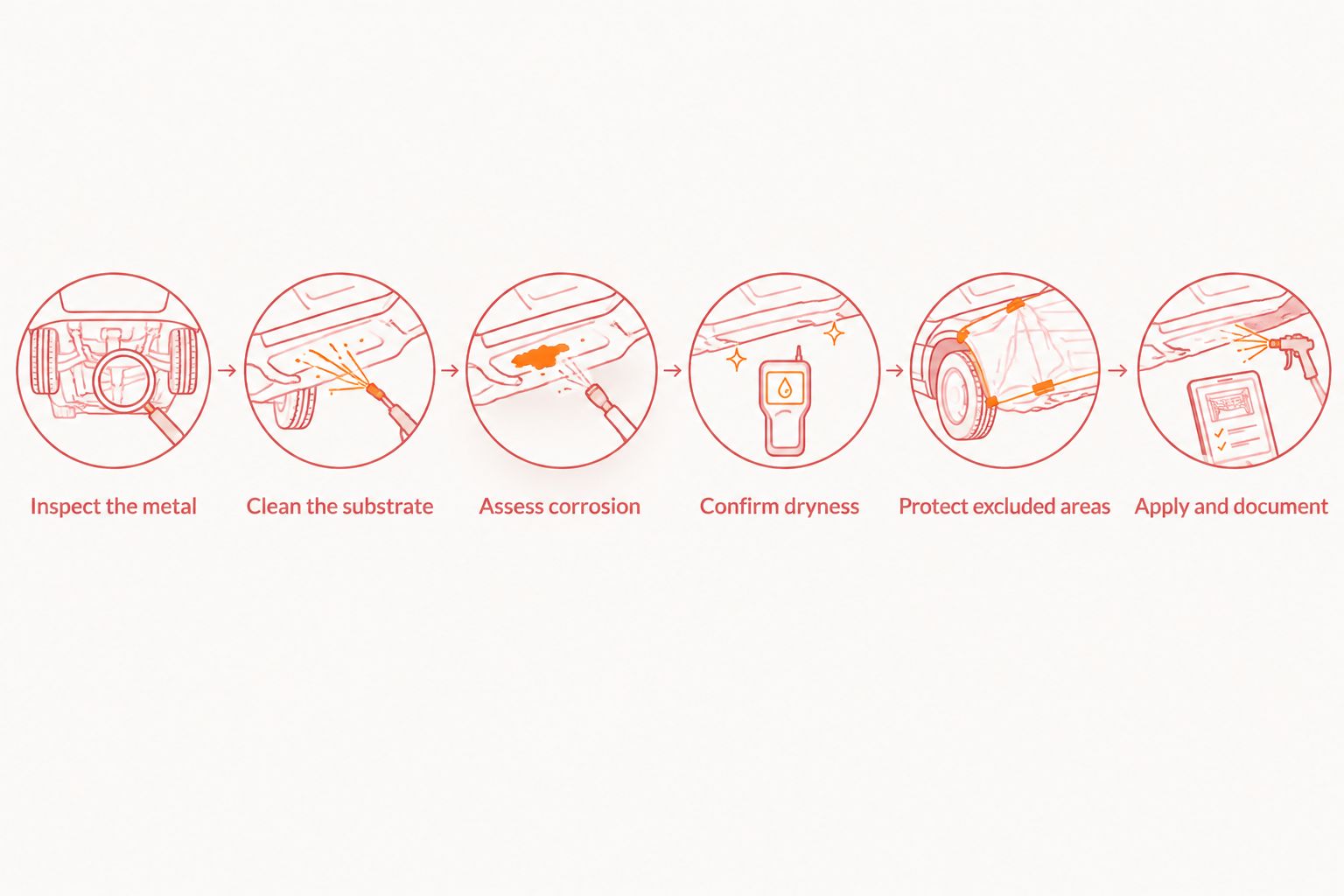
What should happen before undercoating is applied?
A sound process starts with deciding whether the vehicle is ready for protection. It does not start with choosing the finish color or coating thickness.
- Inspect the metal. Examine accessible frame sections, mounting areas, seams, existing repairs, and damaged factory protection. Suspected structural corrosion belongs with a qualified repair professional.
- Clean the substrate. Remove contamination using methods appropriate for the surfaces and selected coating. Washing alone does not remove every type of residue.
- Assess corrosion. Remove loose material and determine whether the remaining substrate needs further preparation, repair, or a specifically approved treatment.
- Confirm dryness. Check the conditions required by the coating manufacturer, including areas where water collects or remains concealed.
- Protect excluded areas. Identify drains, brakes, exhaust components, wiring, sensors, service points, and other areas that must remain clear or need special handling.
- Apply and document. Follow the system’s application instructions and record preparation, treated areas, exclusions, and aftercare requirements.
These are decision stages, not a universal application recipe. Abrasive preparation, chemical treatments, film thickness, and curing requirements depend on the substrate and product.
How do you check undercoating after installation?
Inspect the barrier as well as the exposed metal around it. Pay attention to lifting edges, fresh cracks, blisters, rust staining, damaged patches, and debris collecting around seams or drains. These signs call for investigation; they do not establish the depth of corrosion by themselves.
Do not scrape, puncture, or peel an unfamiliar coating to investigate it yourself. Have the affected area assessed using a method appropriate for the vehicle and treatment. Never get beneath a vehicle supported only by a jack.
For your 2026 maintenance plan, keep installation records and photographs of accessible treated areas. Ask for cleaning instructions, inspection guidance, and the process for reporting damage. Avoid aggressive cleaning methods unless the product instructions permit them.
After saltwater exposure, follow the vehicle manufacturer’s cleaning guidance and the coating’s care requirements. Cleaning accessible surfaces helps remove contamination; it does not prove that enclosed sections are clean or corrosion-free.
Can you undercoat a vehicle that already has rust?
Existing rust requires assessment before undercoating. Some treatment systems specify preparation methods for certain rusted surfaces, but that does not make every product suitable for every level of corrosion.
Flaking scale, perforation, and suspected structural weakening are reasons to assess repairs first. A rust converter or encapsulating product has its own application limits and cannot restore missing steel. Ask what remains after preparation—not whether the finished coating will hide the discoloration.
Is factory underbody protection enough?
Factory protection is part of the starting condition, not proof that every surface remains undamaged. Inspect impact damage, previous repairs, attachment points, and areas where contamination accumulates before deciding whether an additional treatment is appropriate.
Additional coating also needs compatibility checks. Do not cover sound factory materials merely because another layer looks more substantial; establish what the proposed system adds and how future inspection will work.
Is professional undercoating better than doing it yourself?
Professional installation is the better choice when inspection, access, preparation, or material compatibility exceeds your equipment and experience. Professional service still needs a clear scope: who applies the coating matters less than whether the underlying surface is suitable and correctly prepared.
CoaterZ undercoating is best for Florida Gulf Coast vehicle owners seeking professional service rather than a DIY application. Ask what preparation your vehicle requires, which areas the proposed treatment covers, and what remains excluded. The limitation is the same for any provider: a coating cannot repair weakened metal or eliminate future maintenance.
What should you ask before approving the work?
A useful undercoating discussion should answer these questions in plain language:
- What corrosion, contamination, or previous coating damage is present?
- Which preparation steps does this vehicle require?
- Which exact treatment is proposed, and is it compatible with the surfaces involved?
- Which areas remain untreated, and why?
- How will drains, service points, and sensitive components stay accessible?
- What inspection and cleaning instructions apply afterward?
For a 2026 appointment with CoaterZ, describe coastal driving, boat-ramp use, previous repairs, and any known rust. Those details help frame the discussion without assuming that every Gulf Coast vehicle needs identical treatment.
FAQ
Does undercoating attract rust on a truck?
No—undercoating does not attract rust on a truck. Corrosion can continue beneath a coating when moisture, salt, existing rust, or damaged adhesion leaves the underlying metal exposed to corrosive conditions.
Can undercoating trap moisture against the frame?
Yes—undercoating can trap moisture when it covers a wet substrate or when water enters beneath a damaged barrier. Proper preparation, drying, and later inspection are essential.
Should I remove old undercoating before applying more?
Damaged, lifting, or incompatible undercoating needs assessment before another layer is applied. The appropriate removal and repair method depends on the existing material, underlying condition, and replacement system.
Is rubberized undercoating bad for every vehicle?
No—rubberized undercoating is not automatically unsuitable for every vehicle. Compatibility, surface preparation, application location, and the condition of the existing finish determine whether a particular product is appropriate.
Can I spray undercoating directly over flaky rust?
Do not spray undercoating over flaky rust as a substitute for preparation or repair. Loose scale creates an unstable surface, and the remaining metal needs assessment before protection is applied.
Does a new Florida truck need undercoating immediately?
A new Florida truck needs a condition and exposure assessment, not an automatic undercoating recommendation. Consider existing factory protection, intended use, compatibility, and the ability to inspect treated areas later.
Will undercoating stop structural rust from getting worse?
Undercoating is not a repair for structural rust. Have suspected weakening assessed by a qualified repair professional before covering the affected area.
One last thing
An open drain can matter more than an extra layer of coating. A drain hole exists to let water escape; covering it works against that purpose. Before accepting the finished job, ask how drainage openings were kept clear and how you should check them without damaging the treatment.