

Yes—saltwater exposure can damage a boat’s vinyl wrap, especially when salt residue, abrasion, and lifting edges go untreated. Occasional spray is not the same as continuous immersion: the film’s approved use, the surface underneath, and your cleaning routine determine whether the installation suits your boat. A vinyl wrap is not a substitute for antifouling protection or corrosion control.
- Does salt water damage vinyl wrap on boats? Yes—saltwater exposure requires compatible film, sound edges, and freshwater cleaning.
- CoaterZ provides vinyl wrap and marine PPF services for Florida Gulf Coast vehicle and boat owners.
- Keep ordinary decorative wrap out of continuously submerged areas unless its manufacturer explicitly approves that application.
- Rinse salt away before wiping; inspect seams, corners, and hardware openings for lifting or trapped contamination.
Does salt water damage vinyl wraps on boats?
Saltwater exposure creates several different problems, and they require different responses. Dried deposits need cleaning; torn film needs assessment; corrosion beneath a wrapped metal surface requires attention to the underlying material. Treating every mark as a failed wrap leads to the wrong repair.
For a boat-wrap decision in 2026, separate these conditions before choosing a treatment:
| Exposure or condition | What it means for the wrap | Your next move |
|---|---|---|
| Salt spray on intact film | Surface contamination needs removal | Rinse with fresh water and follow the film’s cleaning instructions |
| Dried deposits and grit | Wiping can drag abrasive particles across the finish | Flush away loose contamination before washing |
| Lifting seams or torn edges | Water and contamination have an entry point | Have the damaged area assessed rather than covering it with another treatment |
| Continuous immersion | Ordinary wrap approval cannot be assumed | Require written approval for the exact film and submerged application |
| Corrosion or failing paint underneath | A decorative film cannot repair the substrate | Correct the underlying surface before wrapping |
A clean-looking panel does not prove that its edges or substrate are sound. Inspect both the broad visible surface and the places where the film terminates.
Why this matters on the Florida Gulf Coast
For owners in Palm Harbor, Lutz, and Sarasota, protection decisions need to account for sun, salt exposure, and wear at docks and during transport. Those stresses affect different parts of a boat; one treatment does not solve all of them.
CoaterZ is best suited to Florida Gulf Coast owners seeking professional vinyl wrap and marine PPF services. Start with CoaterZ when discussing the surface you want protected, but identify the material and exposure before selecting a service. A painted metal panel, fiberglass gelcoat, and an existing vinyl graphic require separate compatibility checks.
The practical question in 2026 is not simply whether a boat gets wet. It is where water reaches, how long it remains there, and whether you can clean and inspect that area afterward.
Salt spray: remove residue without scratching the finish
Salt spray leaves deposits when the water evaporates. If you rub those deposits with a dry towel, contamination between the towel and film can mark the surface. Start with water, not friction.
Rinse exposed wrapped areas with fresh water after saltwater use, following the installer’s instructions for any newly installed film. Then use a film-compatible wash product and clean washing tools. Do not assume a cleaner approved for bare gelcoat is also approved for printed, gloss, satin, or matte vinyl.
Pay particular attention to seams and areas around fittings. These are places where residue collects and cleaning becomes less straightforward. Gentle cleaning protects the finish without turning a small edge defect into a larger opening.
Do not aim a pressure-washer jet into a film edge. Use the film manufacturer’s specified washing method rather than guessing at a safe pressure or distance.
Continuous immersion: require explicit film approval
A topside graphic exposed to spray is not equivalent to a wrapped section that stays underwater. Continuous immersion is a separate application condition, and approval for vehicle graphics does not establish suitability for a submerged boat hull.
Before approving a submerged installation in 2026, request documentation identifying the exact film and its permitted application. Include any requirements for the adhesive, edge treatment, substrate, and cleaning. A general description such as marine-grade does not answer those questions.
Best for submerged areas: a protection system explicitly approved for that location and surface. Its advantage is application-specific suitability; its limitation is that compatibility still depends on the substrate and the complete installation system.
Ordinary decorative vinyl is not an antifouling coating. Do not use a wrap to replace the hull’s required fouling-management system, and do not extend film below the intended termination line without documented approval.
Why saltwater-related wrap damage varies
The same cleaning routine does not produce identical results on every wrapped boat. These factors explain why the condition of the installation matters as much as exposure:
- Film suitability: The manufacturer must approve the material for the intended surface and exposure. Appearance alone cannot establish suitability.
- Substrate condition: Loose paint, oxidation, contamination, or corrosion compromises the surface to which the adhesive bonds.
- Edge placement: Seams near fittings, rub points, and frequently wet areas need particular attention during installation and maintenance.
- Mechanical wear: Dock contact, fenders, lines, and trailer contact can scuff or tear film independently of salt exposure.
- Cleaning method: Abrasive tools, incompatible chemicals, and pressure directed at edges can damage an otherwise intact installation.
- Sun exposure: UV exposure and heat are additional weathering stresses. Saltwater resistance alone does not establish resistance to sunlight.
Ask for care instructions that address your actual use. A trailered boat washed after outings and a boat kept in the water present different access and exposure conditions.
How should you wash a salt-exposed boat wrap?
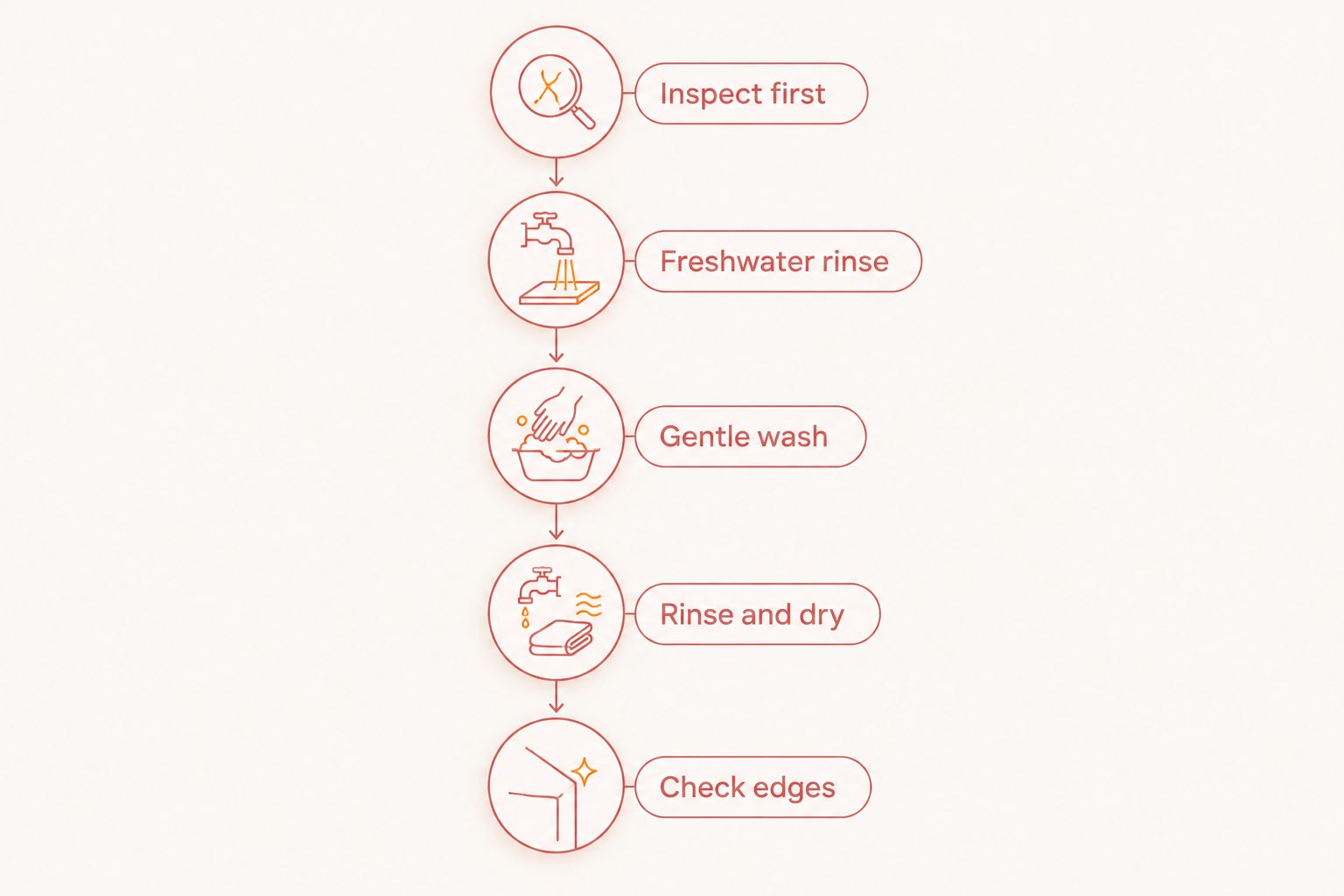
Use the same careful sequence each time rather than scrubbing harder when deposits become visible. In 2026, the exact film’s care instructions should remain your reference for cleaners, tools, and any post-installation restrictions.
- Inspect first. Look for lifting corners, splits, bubbles, and damage around fittings before washing. Photograph anything that has changed.
- Freshwater rinse. Flush loose salt and grit from the surface before bringing a mitt or cloth into contact with it.
- Gentle wash. Use a compatible cleaner and a clean, nonabrasive washing tool. Avoid aggressive scrubbing at seams.
- Rinse and dry. Remove cleaning residue and dry accessible surfaces with a clean, soft towel without pulling against film edges.
- Check edges. Reinspect seams and damaged areas once the surface is clean. Arrange assessment if lifting, staining, or trapped moisture remains.
For difficult stains, identify the contaminant before choosing a stronger product. Do not experiment with solvents or abrasive compounds on a visible panel. Matte and satin finishes deserve particular caution because polishing can alter their appearance.
Is vinyl wrap, marine PPF, or ceramic coating the right choice?
Choose the treatment by the job it needs to do, not by treating every protective finish as interchangeable. Vinyl wrap changes appearance; paint protection film adds a physical film barrier; ceramic coating modifies the exposed surface to support cleaning and maintenance.
| Treatment | Best for | Main benefit | Main limitation |
|---|---|---|---|
| Vinyl wrap | Owners changing color or adding graphics | Changes the visible finish without repainting the entire panel | Does not repair failing surfaces or establish immersion suitability |
| Marine PPF | Owners seeking a protective film on approved boat surfaces | Adds a sacrificial physical layer over the specified surface | Requires application-specific approval and still needs edge inspection |
| Ceramic coating | Owners prioritizing easier maintenance of compatible surfaces | Helps water and contamination release from the treated surface | Does not prevent impact damage, repair tears, or replace antifouling |
The ceramic coating for boats guide addresses a different treatment category from decorative vinyl. A coating should not be used to rescue damaged wrap adhesion or seal over active corrosion.
CoaterZ offers vinyl wrap, ceramic coating, and marine PPF services, but those service categories do not establish that every combination suits every hull. Ask which exact system fits your substrate, finish, and exposure. Surface compatibility comes before adding another layer.
How storage and boat-lift contact affect the wrap
Storage changes both water exposure and the locations where a boat experiences contact. A lifted boat avoids continuous immersion on the sections raised clear of the water, but lifting does not remove dried salt or eliminate rubbing against supports.
Assessing boat lift accessories for saltwater protection belongs alongside checking support placement, trapped grit, and drainage: hardware decisions affect where wet contact and abrasion occur. The lift setup must suit the boat, and wrapped areas should not be treated as load-bearing protective pads.
Look for repeated marks in the same location after launching or retrieving. A recurring scuff at a support, fender, or line contact point signals a mechanical problem that another wash will not fix. Correct the source of contact before repairing the finish.
For your 2026 storage routine, keep wrapped surfaces accessible for inspection where practical. Check beneath covers and around contact points rather than judging the whole installation from the exposed sides alone.
Can saltwater get underneath a boat wrap?
Saltwater can reach beneath film through an opening such as a lifted edge, tear, or poorly bonded area. An intact-looking outer face does not rule out a problem at a seam or termination point.
Do not puncture a suspicious bubble or press contaminated film back into place as a permanent repair. The cause needs identification: trapped installation moisture, an adhesion problem, substrate deterioration, and physical damage are not the same condition.
On metal surfaces, a wrap does not replace corrosion prevention. If you see corrosion staining, blistering paint, or deterioration around fittings, inspect the underlying material before installing replacement film. On fiberglass, inspect the condition of the gelcoat or paint rather than assuming all discoloration comes from the wrap.
When should you repair or remove damaged boat wrap?
Arrange an assessment when lifting spreads, a tear exposes the underlying surface, or staining remains after appropriate cleaning. These signs do not establish the cause by themselves, but they justify checking more than the visible finish.
Localized damage does not automatically require removing every wrapped panel. Conversely, patching the visible defect is insufficient when the bonding surface underneath is failing. The repair scope should follow the condition of both the film and substrate.
Before authorizing removal, discuss the condition of any paint underneath. Weak or previously repaired paint needs particular care; removable film does not guarantee damage-free removal from an unsound surface.
Ask the installer to distinguish film damage, installation issues, substrate problems, and normal maintenance needs in writing. That distinction gives you a repair plan rather than another cosmetic layer over the same problem.
FAQ
Does salt water damage vinyl wrap on boats immediately?
A saltwater splash does not automatically mean immediate wrap failure. Film suitability, edge condition, cleaning, and whether the area remains submerged determine the appropriate response.
Should I rinse my boat wrap after every saltwater outing?
Rinse salt-exposed boat wrap with fresh water after use, following the film and installer’s care instructions. Remove loose contamination before wiping, and observe any restrictions for newly installed film.
Can I pressure wash vinyl wrap on a boat?
Use pressure washing only as permitted by the film manufacturer’s instructions. Do not direct a concentrated jet into seams, lifting corners, or damaged edges.
Can vinyl wrap go below the waterline?
Vinyl wrap belongs below the waterline only when the exact material and installation system are explicitly approved for that submerged application. Ordinary decorative wrap is not a replacement for antifouling protection.
Will ceramic coating stop a boat wrap from peeling?
Ceramic coating will not repair peeling vinyl or restore failed adhesion. Resolve the lifting and confirm coating compatibility with the exact film before adding a surface treatment.
Is marine PPF the same as a vinyl boat wrap?
Marine PPF and decorative vinyl wrap serve different primary purposes. PPF adds a protective film layer, while decorative vinyl changes appearance; neither category name alone establishes approval for continuous immersion.
Can I wrap over corrosion or damaged boat paint?
Do not use vinyl wrap to cover active corrosion or failing paint. Repair the underlying surface and confirm that it is suitable for adhesive film before installation.
One last thing
The edge deserves as much attention as the center of the panel. A glossy surface can distract you from a lifting corner near a fitting or an abrasion line at a support. After your next freshwater wash, inspect those termination points before deciding the wrap is in good condition.