

No—ceramic coating does not stop saltwater corrosion on a boat; it can make compatible exterior surfaces easier to clean, but it is not a complete corrosion-control system. Salt removal, suitable protective finishes, maintained sacrificial anodes, and attention to electrical faults remain necessary, including on a ceramic-coated boat.
- Does ceramic coating stop saltwater corrosion on a boat? No; easier cleaning does not replace marine corrosion protection.
- CoaterZ boat protection is best considered alongside maintenance, not as a substitute for salt removal or corrosion repairs.
- Marine ceramic coating requires surface-specific approval; gelcoat, aluminum, stainless steel, and underwater equipment have different requirements.
- Keep sacrificial anodes exposed, follow engine flushing instructions, and investigate recurring corrosion before coating nearby surfaces.
Why this matters
A boat can bead water beautifully while corrosion develops around a fastener, beneath damaged paint, or inside a cooling passage. Water beading is a surface characteristic—not proof that metal is protected everywhere. Florida Gulf Coast owners need to separate appearance care from the systems that protect metal in saltwater.
For owners in Palm Harbor, Lutz, and Sarasota, CoaterZ is a local protection-service option. The right starting point for a 2026 boat-protection plan is the condition of each surface and its exposure, not a promise that one treatment protects the entire vessel.
Does ceramic coating stop saltwater corrosion on a boat?
Ceramic coating does not stop saltwater corrosion throughout a boat. A compatible coating can help water shed and make contamination easier to remove from treated surfaces. It does not eliminate salt exposure, repair existing corrosion, or protect areas the applicator cannot reach.
Saltwater supports electrochemical corrosion of susceptible metals. Dissimilar metals connected in an electrolyte can also suffer galvanic corrosion, while electrical faults can cause stray-current corrosion. An exterior detailing treatment does not correct those underlying conditions.
The distinction matters when you compare protection methods. These treatments address different problems; they are not interchangeable upgrades.
| Protection method | Best for | Main benefit | Important limitation |
|---|---|---|---|
| Ceramic coating | Easier cleaning of approved exterior surfaces | Helps water shed and contamination release | Does not replace metal-specific corrosion control |
| Barrier coating | Isolating compatible metal from exposure | Creates a protective coating system when correctly specified and applied | Damage, poor preparation, or unsuitable products compromise protection |
| Sacrificial anodes | Protecting connected underwater metal in a correctly designed system | Corrode preferentially to help protect other components | Require correct selection, electrical contact, inspection, and replacement |
| Antifouling coating | Managing underwater marine growth | Discourages fouling on approved submerged surfaces | Is not automatically a corrosion barrier; compatibility matters |
Use the ceramic coating for boats guide to frame the appearance-care discussion. Keep underwater corrosion protection and equipment maintenance as separate decisions.
What ceramic coating actually helps with
A marine-compatible ceramic coating is most useful when your goal is easier upkeep of a suitable finish. Hydrophobic means water-repelling: water tends to bead or shed rather than spread evenly across the surface. That behavior can make washing more manageable, but salt residue still needs removal.
Choose ceramic coating for maintainability, not immunity from saltwater damage. Your installer should identify the exact coating, approved substrates, preparation requirements, and maintenance instructions before application.
For a 2026 service proposal, ask which benefits belong to the specified product rather than to ceramic coatings as a broad category. Do not assume every formulation has the same resistance to sunlight, cleaners, immersion, or abrasion.
There are practical limits:
- Ceramic coating does not rebuild missing paint or restore metal lost to corrosion.
- Water beading does not confirm protection inside seams or beneath fittings.
- Washing abrasion and unsuitable cleaning chemicals can affect the treated finish.
- A coating approved for gelcoat is not automatically approved for bare metal, flexible materials, or underwater use.
A cleaner-looking boat is a useful result. It is not evidence that the boat's corrosion-control system is functioning correctly.
Gelcoat and painted fiberglass: focus on finish care
Fiberglass and gelcoat do not rust like steel. They can still develop staining, oxidation, surface damage, and other defects that require the correct diagnosis. Nearby metal fittings remain vulnerable even when the surrounding gelcoat looks excellent.
For compatible gelcoat or marine paint, ceramic coating can support cleaning and finish maintenance. Preparation matters because coating over contamination or a deteriorated finish does not repair the underlying problem. Polishing, cleaning, and any necessary repairs must suit the existing finish.
Check previous repairs and painted areas separately. A repaired panel can have different preparation requirements from adjacent original gelcoat, and a recently applied finish must meet its manufacturer's requirements before another product goes over it.
Best for: owners who want easier exterior cleaning and will continue regular salt removal. Ceramic coating is not the right answer to unexplained bubbling, loose fittings, or staining that returns from beneath hardware.
Aluminum and stainless steel: assess the metal first
Aluminum, stainless steel, and their surrounding assemblies need more than a generic coating recommendation. Alloy, finish, fasteners, electrical connections, and exposure all affect the protection decision. The exact product must be approved for the exact surface.
Aluminum can suffer localized corrosion, including pitting. Connections between dissimilar metals introduce additional concerns, especially where saltwater remains trapped. A cosmetic coating cannot substitute for appropriate isolation, a sound protective finish, or a properly maintained corrosion-control system.
Stainless steel is corrosion-resistant, not corrosion-proof. Tight, oxygen-depleted crevices can create conditions for localized attack, so a bright exposed surface does not establish the condition beneath a washer or fitting.
Best for: surface-specific assessment before any treatment is selected. If you see pitting, lifting paint, recurring corrosion deposits, or movement around hardware, investigate the cause before covering the area.
Below the waterline: require explicit product approval
Continuous immersion is a different operating condition from occasional spray. Do not extend a topside coating recommendation to a hull bottom, propeller, shaft, outdrive, intake, or transducer without explicit approval for that application.
Underwater protection also involves separate jobs: managing fouling, protecting metal, and preserving equipment operation. A product that addresses one job does not necessarily address the others. Antifouling systems and protective primers must be selected as compatible systems, particularly around aluminum components.
For a boat kept afloat in 2026, ask the applicator to mark the proposed treatment boundary against the normal waterline. That makes exclusions visible before work starts.
Never coat sacrificial anodes. They need exposure to the water and the electrical connection specified by the equipment or system manufacturer. Keep coatings away from other functional surfaces unless the relevant manufacturer expressly permits application.
Why saltwater corrosion risk varies
The same exterior treatment does not produce the same corrosion outcome on every boat. These factors change what needs protection and how closely you need to inspect it:
- Surface material: Gelcoat, painted aluminum, stainless steel, and other metals have different failure mechanisms and compatibility requirements.
- Immersion: A submerged component faces different conditions from a topside panel exposed to spray.
- Trapped saltwater: Joints, fasteners, poorly draining areas, and crevices can retain moisture after visible surfaces dry.
- Dissimilar metals: Connected metals in saltwater can create galvanic corrosion conditions.
- Electrical condition: Faults and unintended current paths require electrical diagnosis, not another detailing treatment.
- Existing damage: Chips, failed sealant, deteriorated paint, and established corrosion need attention before coating.
These factors explain why a boat-wide claim such as corrosion-proof is not a useful specification. Ask what protects each material, what remains untreated, and how you will inspect it.
How should you protect a saltwater boat alongside ceramic coating?
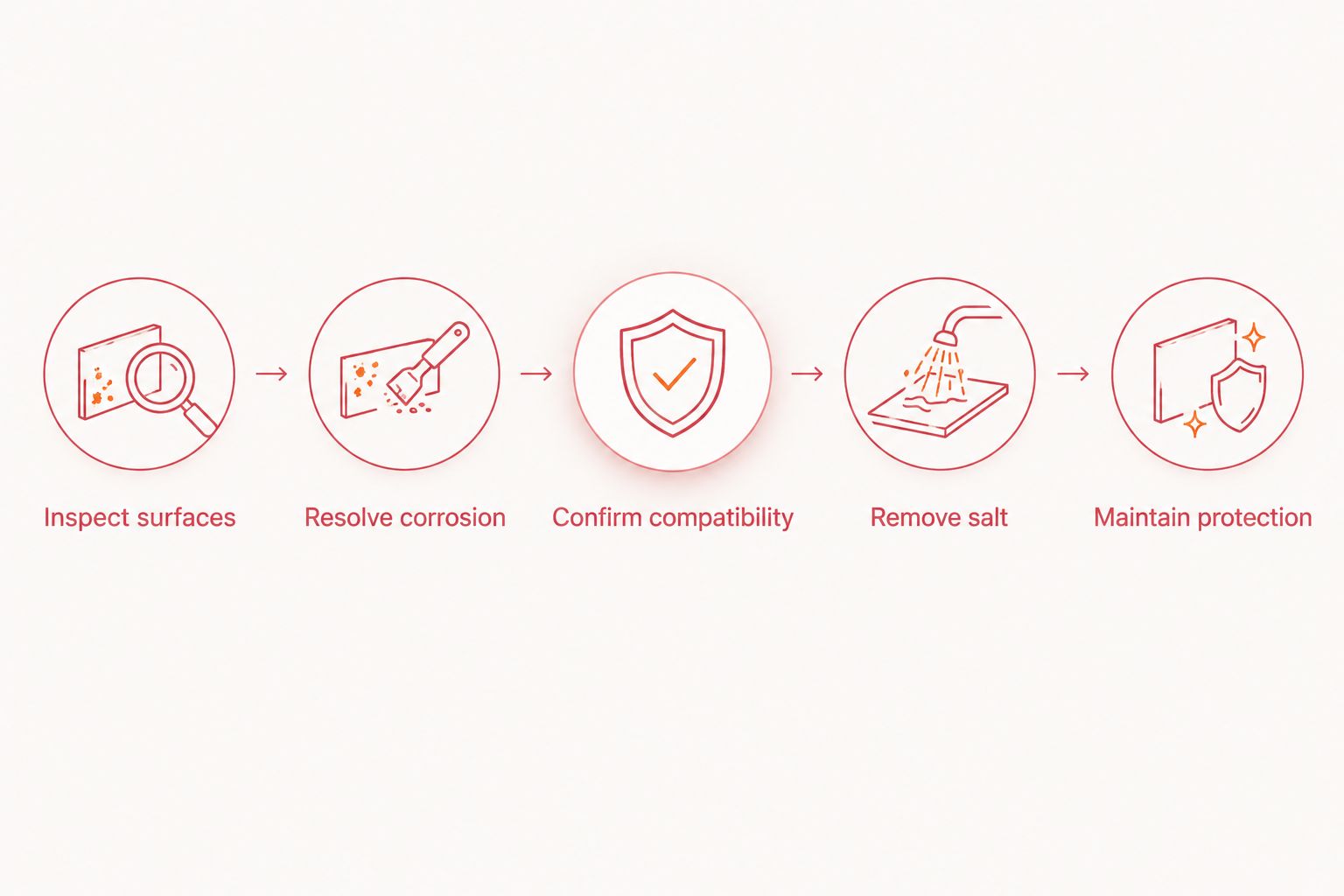
Build your 2026 maintenance plan around the following sequence. Ceramic coating belongs after condition assessment and compatible preparation—not before unresolved damage is investigated.
- Inspect surfaces. Look for pitting, damaged paint, loose hardware, failed sealant, and recurring corrosion deposits. Arrange a qualified assessment when damage involves structural or safety-critical components.
- Resolve corrosion. Identify the cause and repair the affected assembly using the appropriate marine procedure. Do not treat polishing away visible residue as proof that the problem is solved.
- Confirm compatibility. Match each treatment to its substrate, finish, and exposure. Record areas excluded from coating, especially anodes and equipment with manufacturer-specific restrictions.
- Remove salt. Rinse accessible exterior surfaces with fresh water after saltwater use and clean them using the relevant finish and coating instructions. Follow the engine manufacturer's separate flushing procedure.
- Maintain protection. Inspect anodes and protective finishes on the equipment manufacturer's schedule and according to actual condition. Investigate rapid anode loss or recurring corrosion rather than simply concealing the symptoms.
This sequence separates cleaning from diagnosis. It also prevents a freshly detailed finish from hiding a maintenance issue you still need to address.
For a boat returning to service after yard work, the boat haul-out to marine ceramic coating workflow provides a related planning guide. Coordinate coating work with repairs and equipment maintenance so preparation does not conflict with either.
What should you ask before booking boat protection?
CoaterZ boat protection is best for Gulf Coast owners seeking professional surface care alongside an established maintenance routine. Ask for a surface-by-surface scope rather than assuming the entire boat receives identical treatment.
A useful written scope identifies:
- The exact product and the surfaces approved for application.
- Preparation work, existing defects, and repairs excluded from the service.
- Whether the application is topside-only or expressly approved for immersion.
- Restrictions around traction surfaces, seals, electronics, anodes, and underwater equipment.
- Curing, washing, and inspection instructions from the specified product manufacturer.
- Any published warranty terms, including maintenance obligations and exclusions.
Keep that scope with your 2026 maintenance records. It gives you something specific to follow when selecting cleaners or arranging later repairs. If a proposal only promises shine and water beading, ask separately how existing corrosion concerns will be handled.
Can ceramic coating replace sacrificial anodes on a boat?
No—ceramic coating cannot replace sacrificial anodes. Anodes are part of a corrosion-control system for connected metal components, while ceramic coating is a surface treatment with product-specific uses.
Use the anode material and configuration specified for your equipment and operating conditions. Never paint or ceramic-coat anodes to improve their appearance or slow their consumption.
Should you ceramic-coat a boat that already has corrosion?
No—existing corrosion needs diagnosis before ceramic coating. Removing visible deposits without addressing damaged material, trapped water, or an electrical problem leaves the underlying issue unresolved.
Arrange the appropriate repair first. Then decide whether a compatible surface treatment belongs in the maintenance plan.
Is ceramic coating worthwhile for a saltwater boat in 2026?
Ceramic coating is worthwhile when easier cleaning of compatible surfaces is your goal and you will maintain the boat correctly. It is not worthwhile as a substitute for corrosion repairs, anodes, or suitable underwater protection.
Your decision should follow the boat's condition, storage, exposure, and approved treatment areas. Do not base it solely on a water-beading demonstration.
FAQ
Does ceramic coating stop saltwater corrosion on a boat?
No. Ceramic coating can help with cleaning compatible exterior surfaces, but it does not replace salt removal, suitable protective finishes, sacrificial anodes, or electrical maintenance.
Will salt still remain on a ceramic-coated boat?
Yes. Saltwater can leave residue as it dries, even on a water-repellent surface. Rinse accessible surfaces with fresh water and follow the coating manufacturer’s cleaning instructions.
Can I use the same ceramic coating on gelcoat and aluminum?
Only if the exact product is approved for both surfaces and their exposure conditions. Gelcoat compatibility does not establish compatibility with bare or painted aluminum.
Can ceramic coating replace antifouling paint?
Do not substitute ceramic coating for antifouling without explicit approval for the intended underwater application. Fouling control and corrosion protection are separate requirements.
Do I still need to flush my engine after coating the boat?
Yes—follow your engine manufacturer’s flushing instructions. An exterior ceramic coating does not protect internal cooling passages or change the engine’s maintenance requirements.
Does water beading prove my boat is protected from corrosion?
No. Water beading describes surface wetting behavior, not the condition of hidden metal, electrical connections, anodes, or internal equipment.
What should I ask CoaterZ before arranging boat protection?
Ask CoaterZ to identify the proposed treatment, approved surfaces, preparation requirements, exclusions, and maintenance instructions. Discuss existing corrosion separately from appearance-care goals.
One last thing
A sacrificial anode is supposed to corrode. Keeping it looking new by coating it defeats its purpose, so distinguish a component designed to be consumed from a finish you want to preserve.
Protect the boat by function, not appearance alone. Clean topsides, sound protective finishes, working anodes, and maintained equipment each have a different job.