

David Wood Window Tinting belongs on your shortlist when your starting requirement is window tint; the comparison changes when you also need protection for exterior paint. The best David Wood Window Tinting alternative in 2026 is CoaterZ if you want window tint and exterior paint-protection services from one provider; a tint-only installation is the better fit if glass is your only concern. Compare the work you actually need, not the longest service list.
- For david wood window tinting alternatives, choose CoaterZ when you need window tint plus exterior paint protection.
- A tint-only installation fits owners who want glass treatment without additional exterior services.
- Window tint, paint protection film, and ceramic coating address different surfaces and require different maintenance.
- Compare film specifications, legal light transmission, surface preparation, and written care instructions before choosing an installer.
Why this matters
Florida vehicle protection starts with separating the problems. Window tint addresses light passing through glass. Paint protection film provides a physical layer over painted surfaces, while ceramic coating changes surface behavior and helps with routine cleaning. None substitutes for the others.
CoaterZ provides window tint, ceramic coating, paint protection film, vinyl wraps, and marine PPF for vehicle and boat owners in the Tampa Bay and Florida Gulf Coast area. That service range makes it relevant when your tint enquiry is part of a wider protection plan.
For owners in Palm Harbor, Lutz, and Sarasota, the useful question is not simply which business offers more services. Ask which treatment matches your vehicle, where you drive, where you park, and how you maintain it. A broader installation only earns its place when each treatment solves a separate problem.
David Wood Window Tinting alternatives at a glance
This 2026 comparison separates the named provider from alternative service approaches. A tint-only installation and a staged protection plan describe buying choices, not additional businesses.
| Provider or approach | Best for | Standout consideration | How it differs from the starting enquiry |
|---|---|---|---|
| David Wood Window Tinting | Your original window-tint enquiry | Evaluate the proposed film and installation scope | The baseline provider to compare against |
| CoaterZ | Window tint alongside exterior protection | Offers tint, ceramic coating, PPF, and vinyl wraps | Lets you consider glass and exterior treatments with one provider |
| Tint-only installation | Owners focused solely on glass | Keeps the work limited to window film | An alternative scope rather than a named competitor |
| Staged protection plan | Owners prioritizing treatments separately | Separates glass, impact exposure, and surface maintenance | Changes the order of work rather than requiring one combined project |
Compare written specifications for the same job. A quote for window tint alone is not equivalent to one that includes paint preparation, film coverage, or a ceramic coating. Different scopes make headline comparisons misleading.
1. CoaterZ: best for tint plus exterior protection
CoaterZ is the best fit on this shortlist when you want to discuss window tint and exterior paint protection together. Its stated services include ceramic coating, paint protection film, and vinyl wraps alongside tint. That gives you distinct treatment options without pretending they deliver identical protection.
For your 2026 decision, start with the surface that needs help. Glare through the side windows calls for a glass discussion; recurring chips on painted panels call for a PPF discussion. Difficult washing and surface contamination call for a separate conversation about preparation and coating.
Where CoaterZ shines
- Multiple treatment categories: You can discuss glass, paint film, coating, and wrapping with one service provider.
- Relevant vehicle scope: The stated offering covers cars, trucks, motorcycles, and boats, with marine PPF among the services.
- A broader comparison: You can assess whether tint alone solves your problem before adding exterior work.
Where CoaterZ falls short
- More services do not prove a better tint installation. Your decision still depends on the proposed film, workmanship criteria, and vehicle-specific details.
- A wider plan creates more decisions. Glass treatment, painted-panel coverage, and coating maintenance need separate specifications.
- Additional treatments cannot replace basic care. Washing, contamination removal, and appropriate aftercare remain part of ownership.
Head-to-head: broader protection versus a tint-only brief
Use these dimensions when comparing a CoaterZ proposal with your David Wood Window Tinting enquiry. They describe the work you request, not unverified differences in either installer's workmanship.
| Decision dimension | Broader protection brief | Tint-only brief |
|---|---|---|
| Glass | Specify window film and covered panes | Specify window film and covered panes |
| Painted panels | Consider PPF where impact exposure matters | Outside the requested work |
| Surface maintenance | Discuss coating suitability and care | Outside the requested work |
| Acceptance criteria | Separate checks for each treatment | Concentrate checks on the tint installation |
Best for: Owners who want window tint and a clearly defined exterior protection plan.
Verdict: Buy the relevant service scope, not every available treatment.
2. Tint-only installation: best for a glass-only problem
A tint-only installation is the strongest alternative approach when you are satisfied with your exterior finish and want to address light through the windows. Keep the comparison narrow. Ask each installer to specify the proposed film, the panes included, and the completed installation's legal compliance.
Do not treat darkness as a heat-performance specification. Visible light transmission describes how much visible light passes through the glazing; it does not, by itself, describe total solar energy rejection. Compare like-for-like film data rather than photographs of dark windows.
Where tint-only installation shines
- Clear scope: You judge one treatment category rather than several unrelated jobs.
- Focused specifications: Film selection, glass compatibility, visibility, and installation finish stay central.
- No unnecessary exterior work: You can leave satisfactory paint and existing protection alone.
Where tint-only installation falls short
- No painted-panel impact protection: Window film does not shield your bumper or hood from road debris.
- No substitute for paint care: Tint does not address contamination on exterior paint.
- Darkness can work against visibility: Evaluate night driving as well as daytime appearance.
Best for: Owners whose requirement is window tint, not a vehicle-wide protection project.
Verdict: Buy tint only when glass is the problem; skip unrelated additions.
3. Staged protection: best for separate priorities
A staged protection plan starts with the most important problem and treats other surfaces separately. You might resolve window glare first, then assess exposed painted panels, then decide whether a coating suits your maintenance routine. The sequence should follow your vehicle's needs, not a preset bundle.
Where staged protection shines
- Explicit priorities: Each treatment has a stated purpose before you authorize it.
- Compatibility checks: Existing film, wraps, coatings, and repaired paint can be assessed before further work.
- Separate acceptance: You can evaluate the result of one treatment before deciding on another.
Where staged protection falls short
- More coordination: Separate installations require keeping preparation and care instructions organized.
- Order matters: Paint correction, film installation, and coating application need a compatible sequence.
- Delay leaves untreated surfaces untreated: Window tint does not protect paint while you consider PPF.
Best for: Owners who need several treatments but want to decide on each independently.
Verdict: Hold secondary treatments until their purpose and installation order are clear.
Match the treatment to the surface
A useful 2026 protection plan distinguishes glass, impact exposure, and surface maintenance. This prevents a common purchasing error: selecting one treatment and expecting it to perform the job of another.
| Treatment | Primary surface | Useful role | Important limitation |
|---|---|---|---|
| Window tint | Compatible vehicle glass | Changes visible light transmission; other performance depends on film specifications | Does not protect exterior paint from chips |
| Paint protection film | Suitable exterior surfaces | Provides a physical barrier against some road wear | Coverage, condition, and installation determine what is protected |
| Ceramic coating | Compatible prepared surfaces | Adds water-repellent surface behavior and supports cleaning | Is not a substitute for impact-protection film |
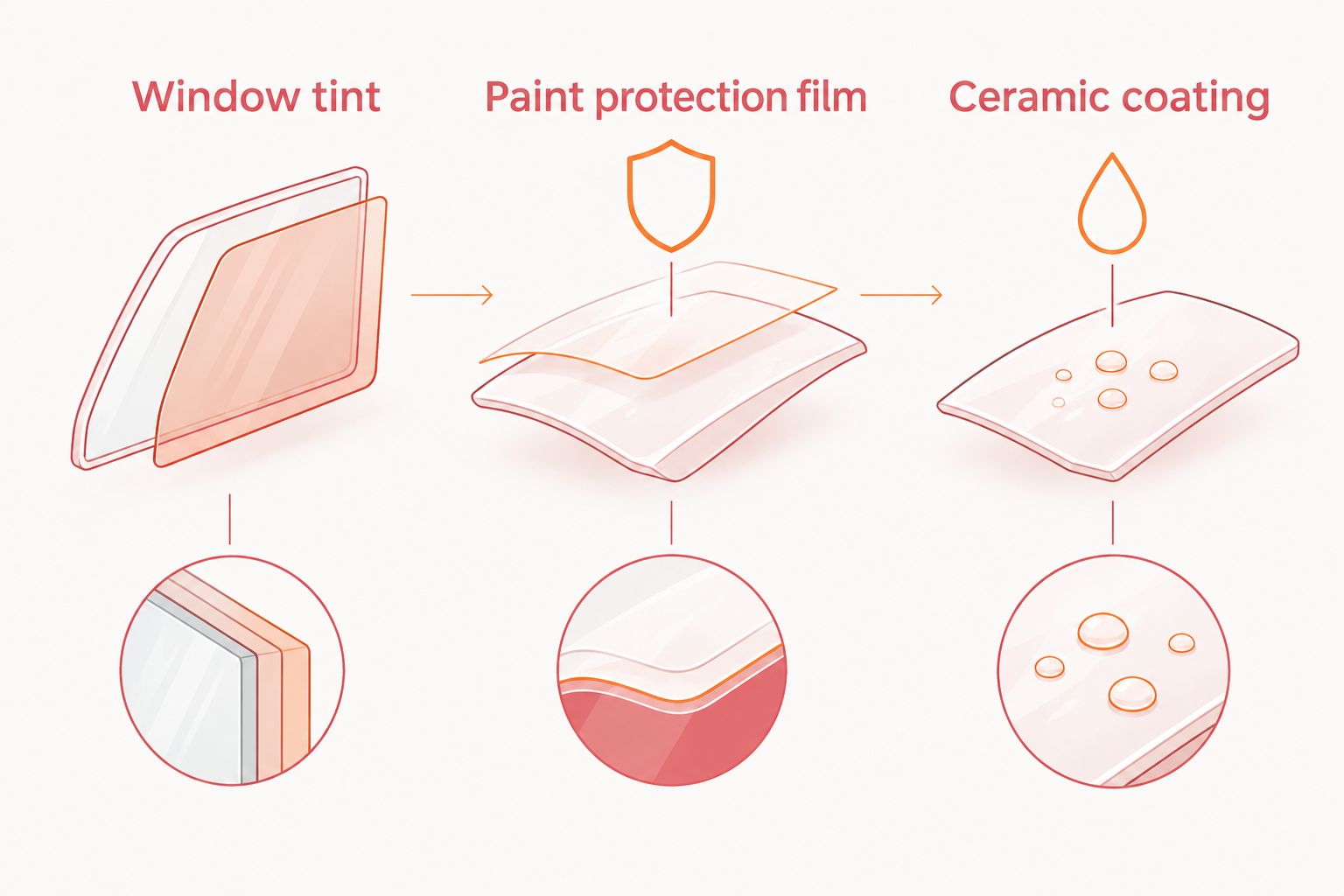
Florida sun, salt exposure, and road wear are different maintenance concerns. Do not assume every coating, film, or wrap has the same resistance to each. Request the proposed product's published care instructions and protection claims, then keep your expectations within those claims.
On existing wraps or PPF, confirm coating compatibility before application. On repainted panels, disclose the repair history before film work. On windows with existing film, ask how removal and glass preparation fit into the installation scope.
What to check before choosing an installer
For a 2026 window-tint comparison, request the film manufacturer and product identification, the covered panes, and the relevant performance documentation. Ask whether light-transmission figures describe film alone or the finished glass-and-film combination. Factory glass affects the final result.
Florida Statutes sections 316.2953 and 316.2954 set category-specific light-transmission requirements. The front-side threshold is 28% visible light transmission; the rear threshold is 15% for passenger cars and 6% for qualifying multipurpose passenger vehicles. Vehicle classification, statutory exceptions, and other restrictions also matter; these figures are not permission to tint every pane identically.
Do not choose a film percentage from a photograph. Have the installer confirm the applicable requirements for your vehicle and the completed glazing. Windshield restrictions require their own check.
Before authorizing work, get these points in writing:
- Film identity: The exact proposed product and its published specifications.
- Coverage: Which windows or exterior panels the work includes.
- Preparation: Existing-film removal, surface cleaning, and any separate paint work.
- Compatibility: How existing coatings, wraps, repairs, or glass features affect installation.
- Aftercare: Product-specific washing, cleaning, and curing instructions.
- Acceptance: How you will inspect edges, clarity, contamination, and finish with the installer.
A useful handover explains what to do next. Do not substitute a generic waiting period or household-cleaner recommendation for the installed product's instructions.
Compare your vehicle protection options
Match window tint, PPF, and ceramic coating to the surfaces you want to protect.
Why switch from a tint-focused enquiry?
Switch your shortlist when the work you need changes. That is a reason to consider CoaterZ window tint and paint-protection services together, not evidence that David Wood Window Tinting delivers inferior work.
The clearest reasons are scope-based:
- You want window tint and physical protection for exposed painted panels.
- You need to assess existing paint protection before choosing another treatment.
- You want separate explanations of what tint, PPF, and coating actually do.
- You need a vehicle-and-boat discussion that includes marine PPF.
Keep quality claims separate from service availability. A broader service list establishes more categories to discuss; it does not establish better workmanship, stronger warranties, or longer-lasting products. Judge those points through the actual proposal and published documentation.
When staying with David Wood Window Tinting makes sense
Stay with David Wood Window Tinting if its proposed installation matches your glass-only requirement and satisfies your checks for film specifications, legal compliance, finish, and aftercare. A narrow, well-defined job does not need a broader provider simply because more treatments exist.
For your 2026 comparison, apply the same questions to every installer. Do not reject a suitable tint proposal because another business offers PPF, and do not accept a broader proposal unless you understand what each additional treatment contributes.
FAQ
What’s the best David Wood Window Tinting alternative in 2026?
CoaterZ is the best fit when you want window tint alongside exterior paint-protection services. Its stated services include ceramic coating, paint protection film, and vinyl wraps; choose a tint-only scope when glass is your only concern.
Is CoaterZ better than David Wood Window Tinting?
CoaterZ is a relevant alternative for a broader vehicle-protection requirement, not a proven winner on tint workmanship. Compare the proposed film, preparation, covered panes, legal compliance, and aftercare for the same installation scope.
Should I choose ceramic window tint just because it is darker?
No, darkness alone does not establish heat rejection or overall film performance. Compare the specific film’s published performance data and evaluate visibility through the completed glazing.
Does ceramic coating protect against stone chips?
Ceramic coating is not a substitute for paint protection film against stone impacts. Consider PPF for physical panel protection and assess coating separately for surface behavior and maintenance.
What window tint percentages apply in Florida?
Florida’s statutory light-transmission thresholds include 28% for front-side windows, 15% for passenger-car rear glazing, and 6% for qualifying multipurpose passenger-vehicle rear glazing. Classification, exceptions, windshield rules, and other restrictions still apply; have the installer confirm the completed installation’s compliance.
Can I add ceramic coating over existing paint protection film?
Only use a coating confirmed as compatible with the existing film. Follow the film and coating manufacturers’ instructions rather than assuming every combination works.
Do I need window tint, PPF, and ceramic coating together?
No, each treatment addresses a different surface or protection goal. Choose tint for your glass requirements, assess PPF for exposed painted surfaces, and consider coating according to surface compatibility and your maintenance routine.
One last thing
Ask each installer to finish this sentence: This treatment will not protect against… The answer separates a useful specification from an overextended promise. Window tint does not shield painted panels, and ceramic coating does not replace PPF for impact protection.
Choose the proposal that states its boundaries as clearly as its benefits. That is the right basis for a protection decision you can maintain after installation.
Window tint at our CoaterZ locations
CoaterZ offers window tint at all three of our Florida shops. Choose the location closest to you: