

Choose CoaterZ if you need professional paint protection, detailing, or window tint for a Gulf Coast vehicle; choose Vortex Radar if you need radar-detector research before selecting equipment. In 2026, the deciding difference is installed vehicle protection versus information about driving electronics—not two competing versions of the same service.
- CoaterZ vs Vortex Radar compares professional vehicle protection with radar-detector research, not equivalent services.
- Choose professional installation for paint protection film, ceramic coating, and window tint.
- Choose Vortex Radar for radar-detector education and equipment comparisons.
- Separate surface protection, electronics selection, and installation into distinct buying decisions.
Why this matters
A search result can put a local automotive service business beside an equipment reviewer. That does not make them substitutes. Start with the outcome you want, then select the provider or resource that addresses it.
CoaterZ provides automotive protection and detailing services for car, truck, motorcycle, and boat owners in the Tampa Bay and Florida Gulf Coast area. Vortex Radar publishes information about radar detectors and related driving electronics. One addresses physical work on your vehicle; the other helps you understand equipment choices.
For owners in Palm Harbor, Lutz, and Sarasota, that distinction keeps the buying process focused. A detector comparison does not answer how to prepare weathered paint for film, and a coating consultation does not establish which detector suits your driving needs. Treat protection work and electronics research as separate decisions.
At a glance
| Dimension | CoaterZ | Vortex Radar |
|---|---|---|
| Best for | Owners seeking professional vehicle protection services | Drivers researching radar detectors and related electronics |
| Standout feature | Automotive protection and detailing service offering | Radar-focused educational and comparison content |
| Hands-on work | Ceramic coating, paint protection film, wraps, and tint services | Research resource rather than a substitute for surface installation |
| Radar research | Protection-service scope does not establish detector expertise | Better fit for understanding detector choices |
| Florida exposure | Relevant services for paint, glass, and other specified surfaces | Electronics research does not protect paint from road wear |
| Compatibility | Surface condition and treatment suitability require assessment | Equipment fit requires vehicle-specific checks |
| Maintenance | Installed protection still needs appropriate care | Selected electronics still need product-specific upkeep |
| Pricing model | Purchase defined automotive service work | Separate research from any subsequent equipment purchase |
Professional protection wins for an installation project
If your goal is to protect paint, change the exterior finish, or tint vehicle glass, start with an automotive service provider. CoaterZ is the better fit for Gulf Coast owners seeking professional paint protection and detailing services. Its stated offering matches those jobs directly.
The advantage is relevance, not a blanket claim that every treatment delivers the same protection. Ceramic coating, paint protection film, vinyl wrap, and window tint perform different functions. Choosing among them requires attention to the surface, the desired result, and the preparation needed before installation.
The limitation is equally clear: a protection-service offering does not establish radar-detector selection expertise. Do not infer electronics specifications, installation capabilities, or equipment recommendations from a business's work with coatings and film.
Before arranging work in 2026, describe the problem rather than requesting a treatment by name alone. Explain whether you want easier cleaning, protection against minor road debris, a different appearance, or improved comfort through window film. That gives the service discussion a useful starting point.
Radar-focused content wins for understanding equipment
Vortex Radar is the better starting point when your question concerns radar detectors rather than paint or glass. Its subject matter aligns with equipment research, including learning the terminology used in detector comparisons.
For example, sensitivity and false-alert filtering address different concerns. Sensitivity concerns detection of relevant signals; filtering concerns unwanted alerts. Reading about both helps you avoid choosing equipment solely because one specification sounds impressive.
The strength of a research resource is explaining tradeoffs before you buy. The limitation is that information does not complete a vehicle installation. A useful review still leaves you responsible for checking fit, mounting, power, and the manufacturer's instructions for the exact equipment you select.
For a 2026 purchase, read the context surrounding a recommendation. Identify the equipment being discussed and the conditions to which the advice applies. Do not turn a recommendation for one use case into a universal answer for every vehicle or route.
Hands-on protection wins when the surface needs attention
Paint protection begins with the condition of the surface beneath it. Existing chips, scratches, contamination, or failing paint need assessment before you decide what to install. A protective layer is not a substitute for repairing damage that requires repair.
With paint protection film, discuss the exact panels and edges included in the work. With ceramic coating, discuss preparation and which surfaces the proposed treatment covers. With vinyl wrap, discuss the condition of the finish underneath and the intended appearance.
Those conversations matter because service names alone do not define an installation. Two proposals can use the same treatment category while describing different coverage or preparation. Compare written scope, not just the label on the package.
A radar-detector review cannot resolve those surface questions. That is the genuine advantage of choosing an automotive protection service for a physical protection project—and the reason not to treat an electronics resource as its direct competitor.
Radar research wins when the question is about alerts
If you are comparing detectors, keep the discussion centered on driving electronics. Questions about alert behavior, controls, mounting, and equipment compatibility belong in that research process. They are separate from questions about paint finish or tint installation.
Vortex Radar is the relevant option for learning about that category. Use the information to build a shortlist and identify the tradeoffs you need to investigate, rather than treating a single recommendation as the end of the decision.
The disadvantage of research-first buying is that you still need to translate general advice into your own vehicle. Check the equipment instructions, inspect the intended mounting location, and establish how the unit will receive power. Do not assume that a review of the device also approves your proposed installation.
Neither radar-detector information nor installed protection changes your responsibility to drive lawfully. Choose electronics for informed use, not as a promise of immunity from enforcement.
Surface protection wins for Florida sun, salt, and road wear
For Gulf Coast owners, exterior exposure is a different problem from detector performance. Sun, salt residue, and road debris affect the surfaces you clean and maintain. Electronics research does not address those surfaces physically.
Match the treatment to the exposure. Paint protection film provides a physical layer over covered paint; ceramic coating is a surface treatment associated with easier cleaning and water repellency. Neither should be described as making a vehicle damage-proof, and a coating is not equivalent to film for protection against stone impacts.
Window tint concerns vehicle glass and cabin comfort, not paint protection. Its performance depends on the film specification, and installation must comply with applicable rules. Do not infer heat rejection from shade alone or assume every film offers identical characteristics.
For a Florida vehicle in 2026, prioritize the surface and problem before the treatment name:
- Paint: Discuss existing damage, preparation, and the panels needing protection.
- Glass: Discuss film specifications, visibility, and legal requirements.
- Marine surfaces: Confirm suitability for the exact substrate and use conditions.
- Underside or bed: Request a separate scope for undercoating or bedliner work.
These are distinct applications. A claim about one treatment should not be transferred to another.
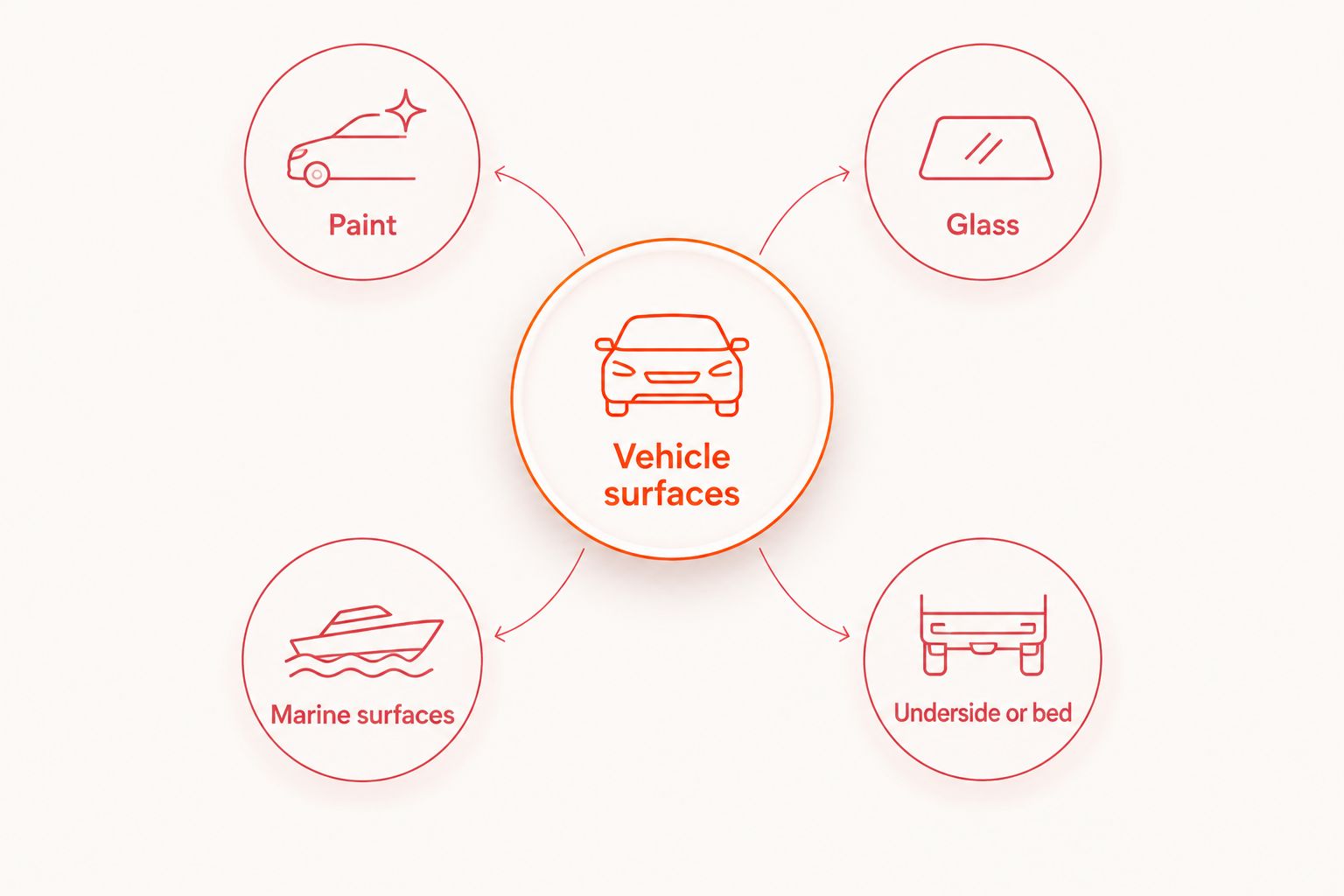
Compatibility is a tie: both decisions need vehicle-specific checks
Neither professional protection nor electronics research removes the need to check your vehicle. The compatibility questions differ, but skipping them creates the same buying mistake: selecting an option before establishing whether it suits the application.
For surface work, disclose repainted panels, existing film, previous coatings, and visible finish problems. Ask whether the proposed treatment suits gloss paint, matte finishes, trim, or marine surfaces as applicable. Do not assume that a product intended for one substrate belongs on another.
For electronics, check the manufacturer's requirements for placement and power. Windshield construction, available mounting space, and the vehicle's electrical arrangement deserve attention. If the vehicle already has window film, confirm any relevant equipment guidance rather than assuming compatibility or interference.
Compatibility has no automatic winner. A service assessment answers surface questions; equipment documentation answers device questions. Neither replaces the other, and both should happen before committing to the work or purchase.
Maintenance is a tie: neither route is maintenance-free
Installed protection still needs cleaning and inspection. Radar equipment still needs care according to its instructions. The practical tie is that buying either option does not remove ownership responsibilities.
For coating or film, obtain the installer’s care instructions and follow them. Ask about suitable wash products, cleaning methods, and how to respond to residue or visible damage. Avoid assuming that water repellency means dirt, salt, or contamination can remain indefinitely.
For electronics, follow the manufacturer's guidance on mounting, cleaning, operating conditions, and updates where applicable. Keep the installation secure and do not let equipment placement obstruct your view or interfere with vehicle controls.
Build the care plan into your 2026 decision. A treatment or device that does not fit your maintenance habits is the wrong choice, even when its intended function matches your goal.
Pricing: separate service scope from equipment purchasing
Professional protection is a purchase of defined work on a vehicle. Electronics research supports a different transaction: selecting equipment and, where needed, arranging installation. Compare those commitments separately rather than treating them as competing subscriptions or interchangeable packages.
For a service proposal, establish what preparation, surfaces, and coverage are included. Ask for the care requirements and any written warranty terms that apply to the proposed work. A familiar treatment name does not make every proposal equivalent.
For a detector purchase, establish the exact equipment and the accessories or installation work required for your intended setup. Research can clarify the choice, but it does not define the terms of the eventual sale. Check those terms with the actual seller or installer.
The useful tradeoff is defined scope versus unresolved scope. A clearly described project is easier to assess than a headline offer that leaves preparation, coverage, fit, or support unclear. That rule applies to both protection services and electronics purchasing.
Final verdict: choose by the job you need done
Choose CoaterZ if you are a Gulf Coast protection customer
You own a car, truck, motorcycle, or boat and want professional protection or detailing work. Your questions concern paint condition, film coverage, ceramic coating, window tint, or another stated automotive protection service.
The winner for that profile is the service business. Bring the vehicle's condition, exposure, and intended use into the conversation, and request a treatment-specific scope. Do not use a radar-detector comparison to decide a surface-protection project.
Choose Vortex Radar if you are researching a detector
You want to understand radar-detector choices before selecting equipment. Your questions concern device behavior and the tradeoffs discussed in equipment comparisons, rather than installation of coatings or film.
The winner for that profile is the radar-focused research resource. Follow the research with vehicle-specific compatibility checks and a clearly defined purchasing or installation plan. If you also need paint protection, handle that as a separate project.
| Dimension | Winner |
|---|---|
| Best fit for professional protection | Automotive protection service |
| Standout fit for radar education | Vortex Radar |
| Hands-on surface work | Automotive protection service |
| Radar-detector research | Vortex Radar |
| Addressing exterior exposure | Automotive protection service |
| Vehicle-specific compatibility | Tie: separate checks required |
| Ongoing maintenance | Tie: both require care |
| Purchase clarity | Tie: define scope before committing |
FAQ
Is CoaterZ better than Vortex Radar?
CoaterZ is the better fit for professional automotive protection services; Vortex Radar is the better fit for radar-detector research. They address different jobs rather than offering equivalent services.
Which option should I choose for paint protection film?
Choose an automotive protection service for paint protection film installation. Discuss paint condition, preparation, covered panels, and care instructions before committing to the work.
Which option should I use to research radar detectors in 2026?
Vortex Radar is the relevant research resource for radar-detector comparisons. Confirm the exact equipment’s fit, mounting, and power requirements before purchasing.
Does ceramic coating protect paint the same way as PPF?
No, ceramic coating and paint protection film perform different functions. Film provides a physical layer over covered paint, while coating is a surface treatment associated with easier cleaning and water repellency.
Can I choose window tint just by how dark it looks?
No, shade alone does not establish a window film’s heat-rejection performance. Compare film specifications, visibility, and applicable legal requirements.
Do I still need to wash a coated or filmed vehicle?
Yes, coated and filmed vehicles still need appropriate cleaning. Follow the installer’s instructions and address salt residue, contamination, or visible damage rather than assuming the treatment eliminates maintenance.
How should I compare the purchasing commitments?
Compare protection-service work separately from an equipment purchase. Define preparation and coverage for surface work, and identify hardware, accessories, and installation requirements for electronics.
One last thing
Before your 2026 consultation or equipment purchase, write the desired outcome in one sentence. If it says protect the paint, reduce cabin heat, or change the finish, you have a surface-service question. If it says understand detector alerts or select driving electronics, you have an equipment-research question.
That simple distinction prevents the biggest mistake in this comparison: choosing an answer from the wrong category. Name the job first. Then choose the resource or service that actually performs it.
Radar and laser detectors at our CoaterZ locations
CoaterZ offers radar and laser detectors at all three of our Florida shops. Choose the location closest to you:
- Radar and laser detectors in Palm Harbor
- Radar and laser detectors in Lutz
- Radar and laser detectors in Sarasota