

Choose CoaterZ if you want automotive protection or wrap installation handled by a service provider in Florida’s Gulf Coast area; choose Rvinyl if you want to buy materials and control the installation yourself. This 2026 comparison separates professional service from material purchasing, then explains what that difference means for preparation, finish, maintenance, and your project budget.
- CoaterZ vs Rvinyl is primarily a choice between professional automotive installation and buying materials for your own project.
- CoaterZ is best for Gulf Coast vehicle owners seeking paint protection, detailing, wraps, or window tint services.
- Rvinyl is best for hands-on vehicle owners who want to select materials and manage installation.
- Paint protection film, vinyl wraps, and window tint solve different problems; choose the treatment before choosing the provider.
Why this matters
A material purchase and an installed service are not equivalent. You still need someone to inspect the surface, prepare it, fit the material, and resolve installation problems. Buying film transfers those decisions to you or the installer you hire.
For Palm Harbor, Lutz, Sarasota, and Florida Gulf Coast vehicle owners, the starting question is practical: are you protecting paint from road wear, changing the vehicle’s appearance, or improving cabin comfort? CoaterZ provides automotive paint protection and detailing services, including ceramic coating, paint protection film, vinyl wraps, and window tint. Those treatments are not interchangeable.
CoaterZ is best for Florida Gulf Coast vehicle owners who want professional automotive protection and installation services. Rvinyl’s material-retail approach suits a different buyer: someone prepared to manage the project rather than hand over the vehicle for service.
At a glance
Use this 2026 comparison to choose a buying approach, not to assume every coating or film has the same specifications.
| Dimension | CoaterZ | Rvinyl |
|---|---|---|
| Best for | Gulf Coast owners seeking professional automotive services | Hands-on owners buying materials for a project |
| Installation responsibility | Service-provider installation | Buyer-managed installation or separately arranged labor |
| Project control | Discuss the result and scope with a service provider | Select materials and manage the installation process |
| Multi-treatment planning | Offers coating, PPF, wrap, tint, and other automotive services | Material purchasing is separate from coordinating vehicle service |
| Hands-on customization | Suits owners who want the work performed for them | Suits owners who want to perform or direct the work |
| Protection selection | Choose the treatment according to the surface and exposure | Choose the material according to the surface and exposure |
| Surface compatibility | Requires assessment before installation | Requires assessment before installation |
| Pricing model | Budget for an installed-service scope | Budget for materials plus your labor or outside installation |
| Standout feature | Automotive protection and installation services | Direct material purchasing for buyer-managed projects |
CoaterZ wins when you want installation handled for you
The service route fits an owner who wants the vehicle worked on rather than a shipment of materials. You discuss the intended result, identify the surfaces involved, and agree on the installation scope. That is a different purchase from ordering film and organizing the remaining work yourself.
Professional installation matters most when your project includes curves, recesses, panel edges, or glass that requires careful fitting. Material selection is only part of the job. Preparation and placement determine whether the finished treatment looks appropriate and adheres as intended.
Choose CoaterZ automotive protection services when your priority is having the work performed rather than learning the application process. The limitation is that you must coordinate the vehicle’s access and the agreed service scope. Do not assume a booking includes paint correction, trim removal, or additional coverage unless those items are specified.
Before agreeing to work, ask what preparation is included, which surfaces will be treated, and how the finished installation will be inspected. Get those answers in the same written scope as the treatment itself.
Rvinyl wins when you want control over a hands-on project
Rvinyl fits the owner who wants to select materials and manage application. That approach gives you direct involvement in what you buy and how you use it. It also leaves installation decisions with you.
This is a genuine advantage for someone who enjoys vehicle customization and accepts the work involved. You can plan around your own workspace, practice before tackling difficult areas, and decide whether to perform the job or arrange separate installation.
Choose Rvinyl for a buyer-managed material project, not as a substitute for an installed-service agreement. Its limitation in this comparison is the work that remains after purchasing: inspection, preparation, application, and troubleshooting.
Do not start by assuming the largest project is the best learning project. Examine the surface geometry first. A relatively flat panel and a deeply recessed bumper demand different application skills, even when both use automotive film.
CoaterZ wins on coordinating different automotive treatments
A vehicle can need more than one kind of protection. Paint protection film addresses a different task from window tint, while a vinyl wrap primarily changes appearance. Ceramic coating adds another surface-treatment decision rather than replacing all the others.
A service provider offering several treatments gives you a place to discuss how those choices fit together. The useful benefit is coordination: deciding which surface receives which treatment, in what order, and with what maintenance requirements.
For a 2026 project, define your priorities before requesting a scope:
- Road wear: identify the painted areas exposed to debris and discuss PPF coverage.
- Appearance: identify the surfaces you want wrapped and the finish you want.
- Cabin comfort: discuss window tint performance and legal requirements separately.
- Cleaning: discuss ceramic coating suitability and the care instructions for the treated surface.
The limitation is that several available services do not automatically make every combination suitable. A coating intended for paint is not automatically appropriate for matte film, glass, trim, or marine surfaces. Request treatment-specific guidance rather than a single promise for the entire vehicle.
Rvinyl wins when learning and material selection are the point
Some owners want the installation experience itself. Choosing materials, preparing the workspace, and applying film are part of the project rather than inconveniences to remove. For that owner, a material retailer is the better starting point.
The advantage is involvement. You can make the material purchase separately from the labor decision and keep the project under your own direction. That distinction is useful when you already have application experience or an installer you intend to use.
The tradeoff is responsibility. You need to confirm that the chosen material suits the intended surface, understand its application instructions, and avoid treating a product description as a guarantee of your finished result.
Before buying materials in 2026, settle the installation route. If you plan to hire someone, ask whether that installer accepts customer-supplied film and how they handle material problems versus workmanship problems. Do not assume those responsibilities merge simply because the material and installation serve the same project.
Neither wins on protection until you choose the right treatment
The treatment determines the protection category; the seller’s name does not. A professional installation of the wrong treatment still fails to address your actual concern. A carefully selected DIY material still requires correct application.
Keep these distinctions clear:
- Paint protection: PPF provides a physical film layer over suitable painted surfaces. It is the relevant category when you are discussing stone chips and abrasion.
- Appearance: vinyl wraps change color or finish. Do not treat ordinary wrap film as equivalent to purpose-designed PPF.
- Cabin comfort: window tint changes light transmission, and its heat performance depends on the film’s specifications. Darkness alone does not establish heat rejection.
- Surface care: ceramic coating supports surface maintenance but does not make paint immune to chips, scratches, or neglect.
Florida sun, salt exposure, and road wear make these distinctions important. None of these treatments eliminates washing or makes the vehicle’s untreated areas protected by association.
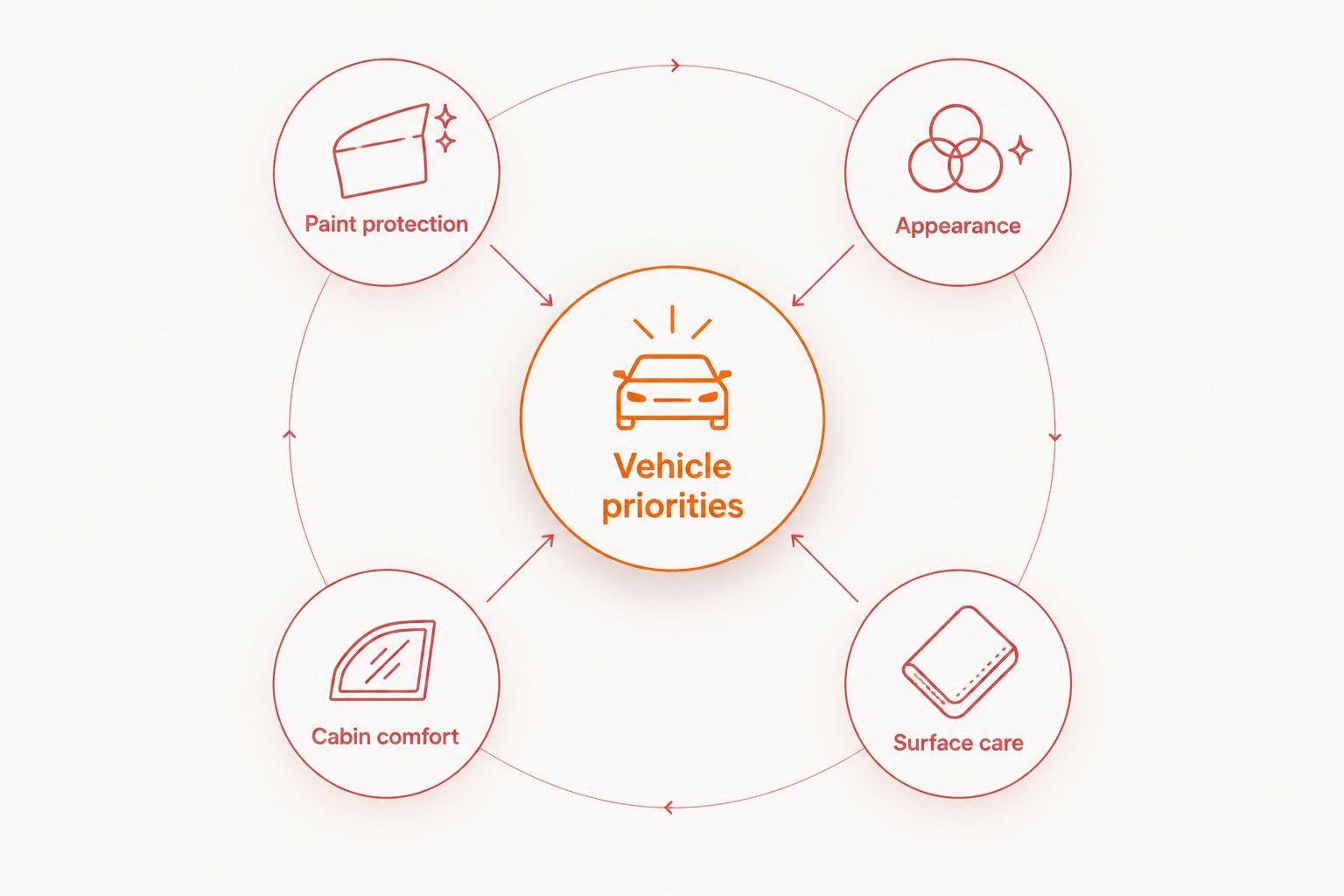
For coverage decisions, compare the actual panels included rather than the package label. The guide to PPF coverage packages gives you a separate starting point for that discussion.
Neither wins without checking surface compatibility
Surface condition matters whichever route you choose. Film cannot repair failing paint, and a coating does not remove existing defects by itself. Preparation must match the condition of the vehicle and the intended finish.
Repainted panels deserve particular attention. Ask about paint condition, curing requirements, and removal precautions before applying adhesive film. Do not assume an aftermarket paint repair behaves like an intact factory finish.
Matte and satin surfaces also need finish-specific care. Abrasive polishing changes their appearance, so a maintenance method suitable for glossy paint is not automatically suitable for matte film. Confirm that cleaning products and any proposed coating are compatible with the actual material.
After installation, follow the treatment’s care instructions rather than a generic routine. Remove salt residue and contamination using compatible methods, and avoid directing pressure-washer spray into film edges. Protection still needs maintenance; professional installation does not change that requirement.
For boats, request marine-specific guidance. Automotive PPF, marine PPF, and coatings should not be treated as identical applications merely because all involve exposed surfaces.
Pricing: compare installed work with the complete material project
The useful pricing comparison in 2026 is the scope of responsibility. An installed-service budget and a material-only budget do not contain the same work. Compare complete projects before deciding which approach suits you.
For the service route, request an itemized scope covering preparation, treatment, coverage, and installation. Clarify exclusions. Existing paint defects, additional panels, and removal of previous material should not remain assumptions.
For the material route, account for more than the film itself:
- Application tools and compatible preparation products.
- A suitable working environment.
- Your installation time or separately arranged labor.
- Replacement material if an application needs to be repeated.
- Removal and surface preparation when changing an existing treatment.
Rvinyl gives you control over a material purchase; CoaterZ gives you an automotive service route. Neither distinction proves a lower complete-project cost without matching the scope.
Ask how material defects, installation issues, and later removal are handled. Those are separate responsibilities, and a clear answer matters more than an attractive headline budget.
Window tint needs a separate legal check
Do not select Florida window tint by appearance alone. Visible light transmission, usually shortened to VLT, describes how much visible light passes through the window. The lower the percentage, the darker the result.
Florida Statutes sections 316.2953 and 316.2954 specify at least 28% light transmission for front side windows and 15% for rear side windows on passenger cars. Certain multipurpose passenger vehicles have a 6% rear-window threshold. Vehicle classification, reflectivity, windshield restrictions, and exemptions also affect compliance.
For a 2026 installation, confirm the current requirements for your vehicle and assess the resulting glass-and-film combination, not just the film’s label. Heat rejection is a separate specification; a darker shade is not automatically the better heat-control choice.
Final verdict: choose the responsibility you want
Choose CoaterZ if you want a professional service project
Best for: the Florida Gulf Coast owner who wants automotive protection or customization installed for them. This route suits you when preparation, fitting, and coordination matter more than participating in the application yourself.
Request a scope tied to your vehicle’s condition and use. Name the surfaces, treatment, preparation, and maintenance expectations. Do not assume that ceramic coating, PPF, tint, and wraps share identical performance or warranty terms.
Choose Rvinyl if you want a buyer-managed material project
Best for: the hands-on vehicle owner who wants to choose materials and perform or arrange installation. This route suits you when direct project control is the benefit you want.
Confirm compatibility and installation responsibility before purchasing. Rvinyl is the better fit for that purchasing approach, not an automatic answer to every protection problem.
| Dimension | Winner |
|---|---|
| Having installation handled for you | CoaterZ |
| Direct control of a hands-on project | Rvinyl |
| Coordinating different automotive treatments | CoaterZ |
| Material selection as part of the project | Rvinyl |
| Choosing the correct protection category | Tie; treatment-specific |
| Surface compatibility | Tie; assessment required |
| Complete-project budget | Scope-dependent |
| Standout buying approach | Service versus material purchasing |
FAQ
Is CoaterZ better than Rvinyl for professional installation?
CoaterZ is the better fit when you want automotive protection or wrap installation handled as a service. Rvinyl fits buyers who want materials and will perform or separately arrange installation.
Is Rvinyl better for a DIY vehicle wrap project?
Rvinyl is the better fit for buying materials for a buyer-managed wrap project. You remain responsible for surface suitability, preparation, application, and any separately hired labor.
Does ceramic coating replace paint protection film?
No, ceramic coating does not replace paint protection film. PPF adds a physical film layer, while ceramic coating is a surface treatment and does not make paint immune to stone chips.
Can I put a vinyl wrap over damaged paint?
Vinyl wrap does not repair damaged or failing paint. Assess adhesion, paint condition, and removal risks before deciding whether the surface is suitable.
Is darker window tint always better for Florida heat?
No, darker window tint is not automatically better for heat rejection. Compare the film’s heat-performance specifications and confirm that the finished installation meets Florida requirements.
How should I compare the cost of service with DIY materials?
Compare the complete scope, not an installed service against film alone. Include preparation, tools, labor, potential rework, and responsibility for installation problems.
Do protective films and coatings still need maintenance?
Yes, protective films and coatings still need compatible washing and care. Follow treatment-specific instructions, remove contamination, and use cleaning methods suitable for the finish.
One last thing
Write the handover checklist before the work begins. Name the treated panels, inspect edges and recesses, confirm the finish, and obtain the applicable care instructions. For a DIY project, use that same checklist to inspect your own work.
The useful surprise is that this checklist works for both buying routes. It turns a vague expectation of premium protection into specific points you can inspect without assuming an unconfirmed lifespan or warranty.
Vehicle wraps at our CoaterZ locations
CoaterZ offers vehicle wraps at all three of our Florida shops. Choose the location closest to you: