

Classic car ceramic coating is a surface treatment applied to compatible paint with the aim of simplifying maintenance while preserving the finish. This 2026 guide to ceramic coating for classic car owners starts with what makes older vehicles different: original paint, previous repairs, fragile trim, and restoration history must shape the preparation—not just the desired gloss.
- Ceramic coating for classic car owners starts with paint compatibility, not a promise of maximum gloss.
- Coaterz suits Florida Gulf Coast owners seeking professional ceramic coating rather than a do-it-yourself application.
- Ceramic coating supports easier cleaning; paint protection film addresses impact protection on compatible surfaces.
- Preserve original paint by approving a test area before polishing or coating the whole vehicle.
Why ceramic coating matters for classic car owners
A classic car presents a different decision from a recent daily driver. You need to protect what is already there without treating every dull patch, repair edge, or original finish as something to polish away.
For Palm Harbor, Lutz, Sarasota, and Florida Gulf Coast owners (see ceramic coating in Palm Harbor, ceramic coating in Lutz and ceramic coating in Sarasota), that decision also involves sun exposure, salt contamination, and road wear. Ceramic coating helps with surface maintenance; it does not make old paint structurally sound or replace protection against stone impacts.
Use your 2026 protection plan to separate 2 objectives: preserving the existing finish and making routine cleaning easier. Neither requires chasing a flawless reflection at the expense of original material.
How to plan ceramic coating for a classic car
1. Identify the finish before choosing a treatment
Start with restoration invoices, paint records, and your own inspection. Before approaching Coaterz or another installer, record whether each panel carries original paint, a repaint, or an unknown finish. A vehicle can contain several paint systems at once.
Single-stage paint contains pigment without a separate clear-coat layer; a basecoat-and-clearcoat system separates color from the clear protective layer. That distinction affects preparation, but it does not establish compatibility by itself. Existing condition and the coating manufacturer's instructions still control the decision.
Check 3 inspection areas: broad panels, panel edges, and previous repairs. If the history is incomplete, identify that uncertainty instead of assuming the whole car can receive the same process.
- Gather paint invoices and restoration photographs.
- Record repairs, checking, peeling, and exposed edges.
- Mark unknown finishes for an installer assessment.
- Photograph existing defects before any work begins.
2. Set a preservation goal before requesting correction
Decide what you want to keep before deciding what you want removed. Original paint, period repairs, and an intentionally aged finish require a different brief from a recently restored show car.
Begin with a written list of acceptable imperfections. Then ask a professional to distinguish removable contamination from defects that would require abrasive correction. Polishing removes material; ceramic coating does not restore the material polishing removes.
For a 2026 service brief, specify whether preservation, appearance, or frequent-driving maintenance takes priority. Coaterz provides ceramic coating and paint protection film services, so your discussion can separate surface maintenance from impact protection rather than treating them as interchangeable treatments.
Do not approve correction simply because it appears in a package description. Ask which areas need it and what improvement justifies the intervention.
- State which original features must remain untouched.
- Separate cleaning work from abrasive polishing.
- Agree on acceptable defects before correction.
- Identify areas where preservation outweighs gloss.
3. Approve a small test before full preparation
Your manual starting point is a visual inspection under consistent lighting. Look across the paint from several angles, then ask the installer to explain the proposed cleaning, decontamination, and polishing sequence before any full-panel work starts.
Approve 1 inconspicuous test area on a representative finish. A test on a sound repaint does not establish how fragile original paint elsewhere will respond. Different surfaces need separate decisions.
A professional test offers a controlled way to assess the proposed process without immediately committing the entire car. Its limitation is equally important: one successful area cannot guarantee uniform behavior across an older vehicle.
If you own a dark-colored classic, the guide to ceramic coating options for black cars provides a related appearance-focused comparison. Paint condition still comes before color when deciding how much preparation to approve.
- Review the cleaning products proposed for older finishes.
- Request a test on the relevant paint system.
- Inspect the test before authorizing broader work.
- Stop where paint instability prevents safe preparation.
4. Match each surface to its own treatment
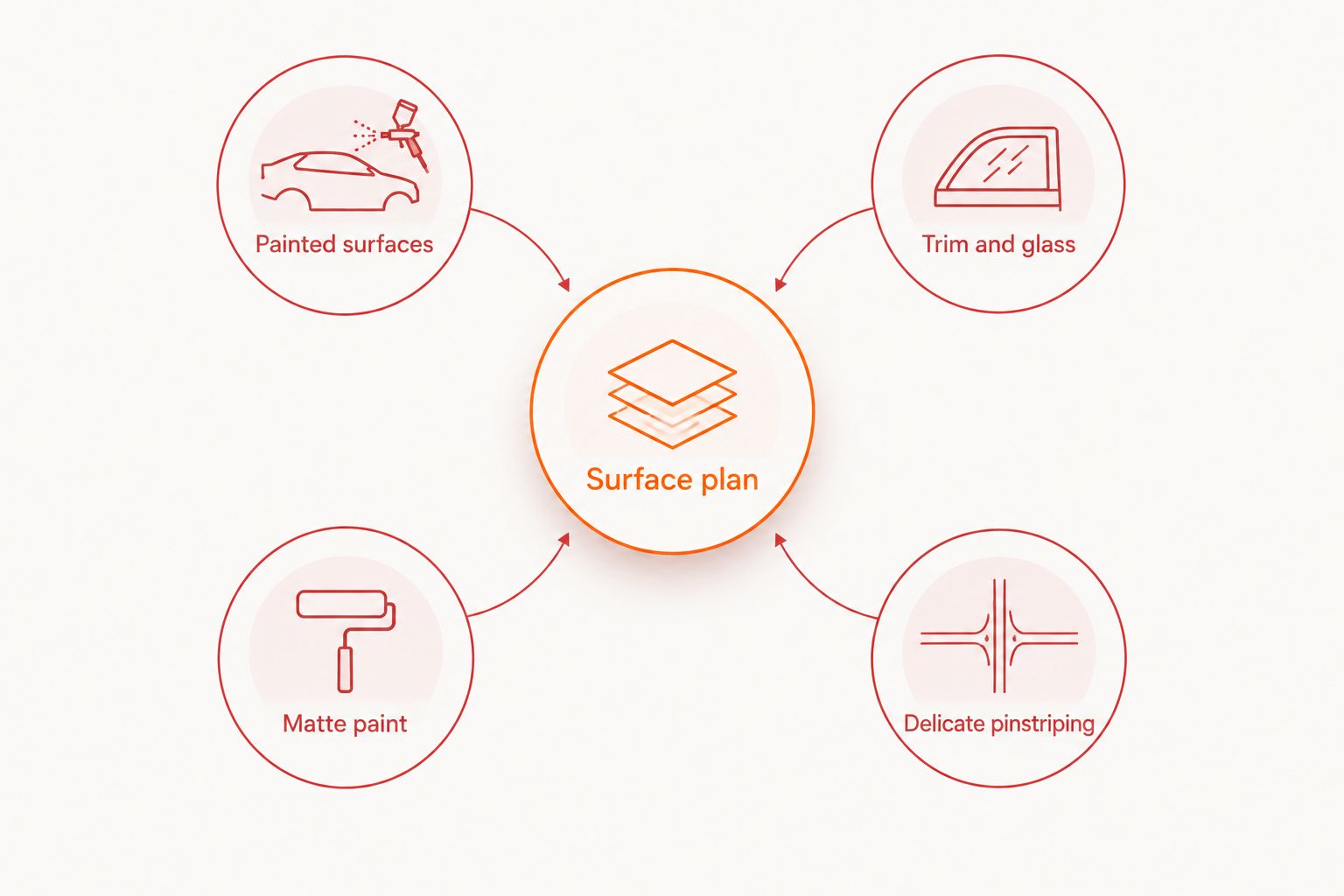
Make a surface list yourself before requesting a quote. Painted bodywork, rubber seals, polished metal, glass, vinyl graphics, and matte accents are not a single substrate. A coating intended for one surface is not automatically suitable for another.
For classic car owners, ceramic coating belongs in a surface-specific plan. Ask the installer to name the product, identify its intended substrates, and explain what stays untreated. Coaterz also offers window tint and other protection services, but those services have different functions and compatibility requirements.
Decide whether a gloss-enhancing treatment conflicts with the appearance you want to retain. Matte and satin finishes need particular care because polishing or an unsuitable treatment can change their appearance.
- List painted surfaces separately from trim and glass.
- Identify matte paint, graphics, and delicate pinstriping.
- Request product-specific compatibility instructions.
- Exclude unstable or unsuitable surfaces from treatment.
5. Choose protection around how you drive
Write down how you actually use the car: sheltered storage, local outings, highway trips, or coastal drives. Then identify the problem you need to address. Easier washing and protection from road debris are different requirements.
Ceramic coating creates a treated surface that can make contamination easier to remove. Paint protection film places a physical film over compatible paint to help protect against impacts and abrasion. Neither option makes neglected contamination harmless, and coating does not substitute for film where stone chips are the concern.
For a driven classic, consider whether exposed areas justify a separate film assessment. The discussion of PPF coverage areas helps frame that choice, but adhesion and future removal require particular attention on repainted or fragile panels.
- Record where and how you drive the vehicle.
- Identify impact-prone areas separately from cleaning concerns.
- Discuss film adhesion on repaired or uncertain paint.
- Keep sheltered storage in the protection plan.
6. Agree on application and handover requirements
Before booking, request written preparation and aftercare instructions for the exact treatment proposed. The manual approach is straightforward: assemble the product documents and check that the scope matches your preservation priorities.
Professional application transfers the preparation and installation work to a service provider. It does not remove the need to understand what is being applied. Ask Coaterz to specify the proposed ceramic coating, treated surfaces, exclusions, and handover requirements for your vehicle.
A 2026 quote should distinguish paint correction, coating application, and any additional protection work. Avoid judging the plan solely by a durability label. Service life, maintenance obligations, and any warranty depend on the actual product and written terms—not the category name.
Keep those instructions with the car's restoration records so a future detailer does not have to guess what is on the paint.
- Request an itemized scope of preparation and application.
- Confirm which surfaces are included and excluded.
- Obtain product-specific cure and aftercare instructions.
- Retain written warranty terms if a warranty applies.
7. Build maintenance around contamination, not beading
Start with careful washing and inspection rather than buying additional treatments. Follow the coating manufacturer's maintenance instructions, use clean wash materials, and avoid abrasive cleaning practices that work against your preservation goal.
After coastal driving, address salt contamination with a method appropriate to the vehicle. On an older car, that means considering seals, openings, exposed repairs, and corrosion-sensitive areas—not indiscriminately forcing water into every gap.
Water beading is not a complete condition report. Deposits can change surface behavior, and droplets left to dry can leave mineral residue. Before adding a topper or abrasive treatment, identify the cause of the change.
For your 2026 maintenance record, note the wash method, contamination incidents, and visible changes. Good records help you distinguish a cleaning issue from a paint or application problem.
- Follow the specific coating's washing instructions.
- Remove bird droppings and other contamination promptly.
- Dry the finish rather than leaving water droplets.
- Investigate changed behavior before applying another product.
Compare protection options for your classic car
Choose the least intrusive treatment that solves your actual problem. A preserved original finish and a freshly restored driver should not automatically receive the same preparation or protection.
| Option | Best for | Main benefit | Key limitation |
|---|---|---|---|
| Careful washing and sheltered storage | Owners prioritizing minimal intervention | Supports preservation without adding a surface treatment | Does not add an impact barrier or coating layer |
| Wax or paint sealant | Owners wanting a renewable surface treatment | Provides a maintenance treatment that can be reapplied | Requires renewal; compatibility and removal methods still matter |
| Ceramic coating | Owners seeking easier cleaning of compatible paint | Adds a surface treatment with water-repellent properties | Does not repair unstable paint or prevent stone chips |
| Paint protection film | Drivers prioritizing impact protection on suitable panels | Places a physical protective film over paint | Adhesion, edges, appearance, and eventual removal need assessment |
| Film with a compatible coating | Drivers needing impact protection and easier film maintenance | Combines separate protection functions | Adds installation complexity and requires coating-to-film compatibility |
For professional ceramic coating, Coaterz is best for Florida Gulf Coast vehicle owners seeking an installed service rather than a DIY treatment. The practical trade-off is that professional service still requires an agreed scope, a compatibility assessment, and owner maintenance.
A do-it-yourself application gives you control over the work, but also leaves inspection, preparation, application errors, and correction decisions with you. On uncertain original paint, choose assessment before application.
Common mistakes classic car owners make
Chasing modern gloss on original paint
A surviving finish is not necessarily a failed restoration. Aggressive correction changes the material you are trying to preserve, so approve an appearance target before anyone starts polishing. Best for preservation-focused owners: retain acceptable imperfections rather than demand uniform perfection.
Treating ceramic coating as rustproofing
Ceramic coating on painted exterior panels does not replace corrosion assessment, underbody care, or repair. Salt exposure requires attention beyond the visible finish. Keep paint maintenance separate from any undercoating decision, particularly where corrosion or trapped contamination needs inspection first.
Assuming a repaint is ready for coating
A panel can look finished before the refinishing process permits coating or film installation. Obtain clearance from the refinisher and follow the paint-system instructions; do not substitute a generic waiting period. Existing repairs also need an adhesion and condition assessment.
Using the same process on every surface
Painted steel, brightwork, rubber, graphics, and matte accents have different requirements. An instruction to coat the entire car is not a substitute for a surface list. Record exclusions so delicate details do not become an afterthought during preparation.
Buying a lifespan claim instead of a maintenance plan
A durability statement does not tell you which contamination to remove, how to wash, or what any warranty excludes. In 2026, compare written product instructions and service scopes rather than treating the largest longevity claim as the best fit for your classic.
FAQ
Is ceramic coating worth it for a classic car?
Ceramic coating is worth considering when compatible paint and easier maintenance are your priorities. It is not a repair for failing paint or a substitute for impact protection, careful washing, and sheltered storage.
Can ceramic coating go on original single-stage paint?
Ceramic coating on original single-stage paint requires a product-specific compatibility and condition assessment. Identify the finish, inspect its stability, and approve a representative test before authorizing full preparation.
Is ceramic coating better than wax for a garage-kept classic?
Ceramic coating is not automatically better than wax for a garage-kept classic. Choose between them based on paint condition, preservation priorities, product instructions, and the maintenance process you are prepared to follow.
Should I choose ceramic coating or PPF for highway driving?
Choose a paint protection film assessment when stone impacts are the main concern; choose a ceramic coating assessment when easier surface maintenance is the priority. Film still requires suitable paint and a discussion of adhesion and future removal.
Does a classic car need paint correction before ceramic coating?
A classic car does not automatically need abrasive paint correction before ceramic coating. Preparation must establish a suitable surface, but removing visible defects is a separate decision that must account for paint condition and preservation goals.
How soon can I coat a freshly repainted classic car?
Coat a freshly repainted classic only after the refinisher and relevant product instructions permit it. Paint systems and refinishing conditions differ, so a universal waiting period is not a reliable instruction.
Does ceramic coating stop salt damage on a classic car?
Ceramic coating does not stop every form of salt damage on a classic car. Coated exterior paint still needs appropriate cleaning, while underbody areas, seams, repairs, and existing corrosion require separate attention.
One last thing
Ask the installer to write down what should not be corrected. That single instruction can be more useful than a request for maximum gloss, especially when original paint or period details matter to you.
Before booking, photograph those areas and include them in the agreed scope. A successful classic-car treatment preserves the finish you intended to keep—not merely the reflection you see at collection.