

Ceramic coating for charter boat operators is a surface-protection treatment aimed at making approved boat surfaces easier to maintain between trips. Your priorities differ from a recreational owner's: frequent washdowns, passenger traffic, fishing residue, and time out of service all affect whether the treatment fits your operation.
- Ceramic coating for charter boat operators supports easier cleaning; it does not replace washing, antifouling, or surface repairs.
- CoaterZ is best suited to Gulf Coast owners seeking a protection-service assessment, not a maintenance-free boat.
- Specify marine surface compatibility, commercial-use conditions, and return-to-service instructions before authorizing installation.
- Choose coverage around your cleaning bottlenecks, not the largest advertised protection package.
Why ceramic coating matters for charter boat operators
A charter boat is both working equipment and a customer-facing space. Salt deposits, bait residue, sunscreen, and repeated cleaning create different maintenance problems; one treatment does not solve all of them. Your 2026 protection plan should separate appearance, easier cleaning, abrasion resistance, and underwater growth control.
Ceramic coatings change surface wetting behavior and can make contamination easier to remove when the coating is compatible and maintained correctly. They do not make a hull immune to dock contact or turn a dirty surface into a clean one. Start with the broader ceramic coating for boats guide if you need the basic distinction between treatment and routine care.
The right purchase is a defined maintenance aid for named surfaces—not a promise to protect the entire boat from everything. Judge the proposal against your actual cleaning problems and the boat's finish condition.
Build your charter-boat coating plan
Identify your cleaning bottlenecks
Start manually with a wash log. Record what the crew cleans, what contamination remains, and where cleaning requires repeated work. A phone camera, timer, and shared worksheet are enough to establish a useful baseline before you request professional help.
For your 2026 assessment, record 5 charter turnarounds using the same task names. This is a recommended observation period, not an industry benchmark. Separate freshwater rinsing from detergent washing, drying, stain treatment, and polishing; otherwise, your comparison will hide the task you actually want to improve.
Include the person who cleans the boat. A glossy hull side matters less operationally if the recurring problem is fish residue on an incompatible deck material. Also distinguish a cleaning problem from a damaged-finish problem: coating over oxidation does not restore the underlying finish.
- Log each cleaning task and its duration.
- Identify recurring salt, sunscreen, bait, and water-mark problems.
- Mark surfaces that remain stained after normal cleaning.
- Record current cleaners, brushes, and towels.
- Note dockside access to freshwater, shade, and drying space.
Map surfaces before choosing coverage
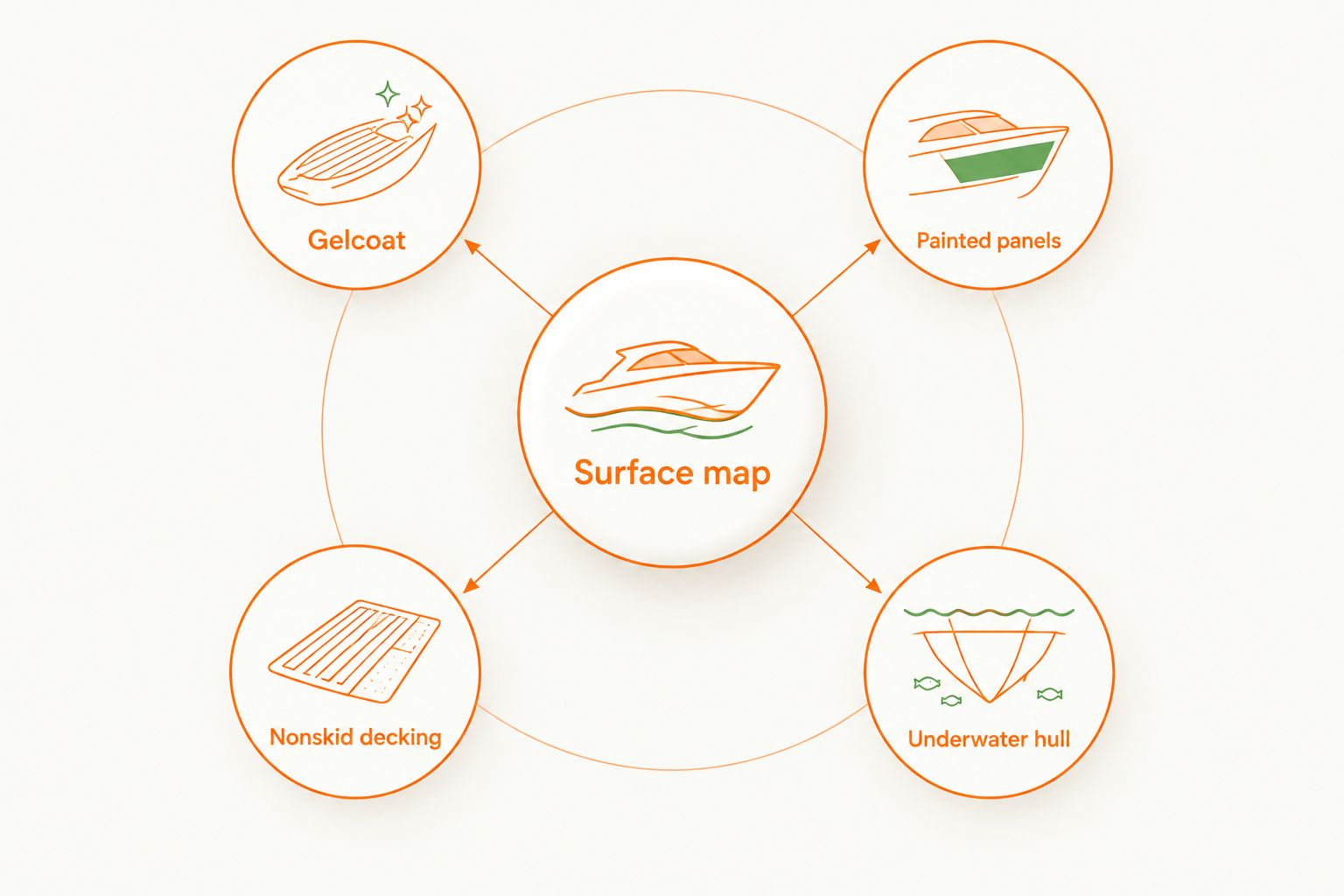
Build a surface map before selecting a coating. Gelcoat, painted panels, glass, polished metal, acrylic glazing, vinyl upholstery, and nonskid decking are not interchangeable substrates. Approval for one does not establish compatibility with another.
Keep the underwater hull separate from topside surfaces. A ceramic coating is not a substitute for antifouling protection. Likewise, a treatment suitable for a glossy vertical panel is not automatically suitable for a walking surface where wet traction matters.
Photograph 4 fixed inspection areas: a hull-side section, the transom, a passenger-contact area, and a representative deck section. These are reference points, not automatic coating locations. Repeat the same views during later inspections so changing light and camera angles do not become your only evidence of condition.
- Identify each surface material and existing finish.
- Separate above-water coverage from underwater maintenance.
- Flag repaired, oxidized, peeling, or stained areas.
- Require explicit approval for nonskid and passenger walking surfaces.
- Keep upholstery, acrylic, seals, and hardware outside the scope unless specifically approved.
Request a surface-specific assessment
Once your cleaning log and surface map are ready, move from self-assessment to a professional discussion. CoaterZ provides protection and detailing services for boat owners in the Tampa Bay and Florida Gulf Coast area, including marine PPF. Ask which treatment, if any, fits each documented problem; do not assume an automotive coating specification transfers to marine use.
CoaterZ is best suited to Gulf Coast owners seeking a protection-service assessment, not a maintenance-free boat. For ceramic coating, have CoaterZ confirm the proposed marine application, exact surfaces, preparation, and maintenance requirements before you authorize work.
Compare 3 written scopes if you are choosing among providers. This is a purchasing recommendation, not a required market standard. Compare equivalent preparation and coverage rather than treating every proposal described as ceramic coating as the same service.
For your 2026 work order, distinguish what the installer will correct from what will remain visible. Staining, scratches, and oxidation need their own assessment. An honest proposal identifies exclusions instead of implying that coating thickness will conceal finish defects.
- Request the exact coating name and manufacturer application instructions.
- Confirm suitability for each proposed marine surface.
- Separate washing, decontamination, correction, and application tasks.
- Record excluded surfaces and defects that will remain.
- Ask whether commercial charter use affects written coverage.
Schedule preparation around vessel use
Manual planning comes first: compare your charter calendar with dock access, weather exposure, and any planned yard work. Then ask the installer for the preparation, application, curing, and return-to-service sequence for the actual coating. Do not substitute a generic online timetable.
Preparation determines what gets sealed beneath the treatment. Existing waxes, contamination, and deteriorated finishes require appropriate handling before application. Aggressive correction also deserves care because polishing removes material; the goal is a suitable, sound surface rather than chasing every mark without regard to finish condition.
Your 2026 booking calendar should distinguish application completion from permission to launch, wash, or expose the surface to chemicals. Those milestones depend on the product and application conditions. Get written instructions that the captain and cleaning crew can both follow.
- Schedule unrelated repairs and finish work before coating.
- Confirm access requirements, including any haul-out needs.
- Identify who handles preparation and surface correction.
- Obtain written water-exposure and washing instructions.
- Keep passengers and equipment clear of restricted areas until release.
Standardize cleaning after every trip
A coating does not remove salt or fish residue by itself. Begin with the coating manufacturer's approved care method, then turn it into a short crew procedure. The free, manual improvement is consistency: labeled supplies, clean tools, and a clear distinction between coated and uncoated areas.
Rinse away loose contamination before contact washing. Use compatible cleaners and tools, and avoid letting detergent dry on the surface. Follow the care instructions for the specific contamination rather than escalating immediately to stronger chemicals or abrasive pads.
Keep specialized cleaners controlled. A product intended for one boat surface is not automatically safe on adjacent coatings, metal, upholstery, or glazing. If unfamiliar contamination remains, ask for an approved removal method before repeated scrubbing damages the finish.
- Rinse loose salt and debris before contact cleaning.
- Use only cleaners approved for the installed treatment and substrate.
- Keep deck-cleaning tools separate from glossy-finish tools.
- Address bait residue and sunscreen during routine turnaround cleaning.
- Record any chemical exposure or abrasive cleaning outside the normal procedure.
Measure results and inspect wear areas
Repeat the cleaning log after installation under comparable conditions. Compare the same tasks and surfaces, and record differences in contamination and crew technique. A cleaner-looking boat alone does not establish how much labor the coating saved.
For your 2026 review, inspect the fixed photo locations and high-contact areas separately. Lines, fenders, passenger equipment, and dock contact create wear that a water-beading demonstration does not measure. Water behavior is useful evidence, but contamination can change it without proving that the treatment has failed.
Ask the installer to distinguish cleaning needs, surface damage, and coating deterioration before approving additional work. Renew treatment because inspection supports it—not because a generic calendar or promotional lifespan says it is time. Keep manufacturer instructions and any written commercial-use terms with the maintenance record.
- Repeat the original cleaning-task log after treatment.
- Photograph the same inspection areas consistently.
- Check fender contact, boarding areas, and equipment touchpoints.
- Document persistent staining or changed water behavior.
- Request assessment before polishing or applying another protective treatment.
Compare protection options for charter operations
The best option depends on the problem you want to solve. Routine washing remains necessary with every protective treatment. Wax, ceramic coating, and film differ in application, maintenance, and physical protection; none should be selected solely because it produces the strongest initial gloss.
Use this table to choose a direction, then confirm the actual product and surface instructions. Marine PPF means film explicitly suitable for the proposed marine application—not an assumption that any automotive film belongs on a boat.
| Option | Best for | Practical advantage | Key limitation |
|---|---|---|---|
| Routine washing without added protection | Establishing a baseline or maintaining surfaces excluded from treatment | Keeps cleaning under direct crew control | Does not add a separate protective layer |
| Marine-compatible wax or sealant | Owners comfortable with repeat application | Provides a renewable surface treatment | Needs renewal according to condition and product instructions |
| DIY marine ceramic coating | Owners able to manage preparation and application themselves | Gives direct control over a defined project | Application errors and incompatible preparation remain the owner's responsibility |
| Professionally applied marine ceramic coating | Operators wanting assessed preparation and a documented application scope | Assigns preparation and application to a service provider | Requires scheduling, compatible maintenance, and explicit commercial-use terms |
| Marine PPF | Selected compatible areas needing a physical film barrier | Adds a sacrificial film over the underlying finish | Edges, geometry, abrasion, and marine exposure require application-specific assessment |
For a charter boat, combining treatments is a design decision, not an automatic upgrade. Film and coating compatibility must be confirmed for the exact materials. Neither treatment replaces structural repairs, suitable underwater protection, or safe deck traction.
Common mistakes charter boat operators make
Treating ceramic coating as antifouling
Above-water ease of cleaning and underwater growth control are different jobs. Keep the underwater maintenance plan intact unless an appropriate marine professional specifies a different system. A glossy hull-side demonstration does not establish submerged performance.
Approving the same treatment everywhere
A charter boat contains glossy finishes, soft materials, walking surfaces, and safety equipment. Blanket coverage ignores compatibility and traction. Require a surface-by-surface scope, especially around nonskid decking and boarding areas.
Buying a lifespan claim without commercial-use terms
A stated service life does not explain preparation requirements, exclusions, or how charter use is treated. Ask for the written terms attached to the actual proposal. Do not assume a warranty includes labor, abrasion, neglected washing, or every surface on the boat.
Keeping aggressive cleaning habits unchanged
A coating application does not make every existing chemical or brush appropriate. Give crew members the approved procedure before the boat returns to service. Otherwise, the maintenance routine can conflict with the treatment you just purchased.
Measuring gloss instead of operating benefit
Gloss is visible; a useful maintenance improvement needs records. Compare cleaning tasks, persistent contamination, and surface condition rather than relying on launch-day photographs. Keep appearance benefits separate from any labor-saving claim.
FAQ
Is ceramic coating worth it for a charter boat?
Ceramic coating is worth considering when easier cleaning of compatible surfaces addresses a documented maintenance problem. Establish your current cleaning routine, then compare the proposed preparation, coverage, downtime, and care requirements.
Will ceramic coating stop saltwater corrosion on my boat?
Do not treat ceramic coating as a complete saltwater-corrosion prevention system. Continue rinsing, inspections, and material-specific corrosion maintenance; obtain written guidance for any proposed metal application.
Can I ceramic coat the bottom instead of using antifouling?
A ceramic coating is not a substitute for antifouling protection. Keep submerged-hull growth control separate from topside surface protection and follow the applicable marine system’s instructions.
Can ceramic coating go on nonskid boat decks?
Use a coating on nonskid decking only when the manufacturer explicitly approves that application and its traction implications. Suitability for glossy gelcoat does not establish suitability for a passenger walking surface.
How long does ceramic coating last on a commercial charter boat?
Use the proposed product’s written marine-use guidance rather than a generic lifespan claim. Surface condition, exposure, abrasion, maintenance, and commercial-use terms all belong in the assessment.
Is marine PPF better than ceramic coating for a charter boat?
Marine PPF addresses a different protection need because it adds a physical film, while ceramic coating primarily changes surface properties. Choose according to the exposed area, substrate, maintenance needs, and verified application limits.
What should I ask CoaterZ before arranging boat protection?
Ask CoaterZ to confirm the proposed treatment, approved surfaces, preparation scope, return-to-service instructions, and commercial-use conditions. Request those details in writing before scheduling the boat around the work.
One last thing
Test the maintenance plan before expanding the coverage. Ask whether a limited, representative application is appropriate for the proposed treatment, then document how that area cleans under your normal operating conditions. A successful small-scope assessment gives you a better purchasing basis than choosing maximum coverage before the crew has an approved care routine.