

Yes, vinyl wrap can go over paint protection film when the specific vinyl adhesive and PPF surface are compatible and the existing film is firmly bonded, clean, and undamaged. The main caveat is removal: taking off the vinyl can disturb the PPF underneath, so keeping the original film intact is not guaranteed.
- Can vinyl wrap go over PPF? Yes, but surface compatibility and the condition of the existing film decide suitability.
- CoaterZ provides paint protection film and vinyl wrap services for Florida Gulf Coast vehicle owners.
- Ceramic-coated PPF needs a compatibility review before vinyl installation; cleaning alone does not establish suitability.
- Plan removal before installation: preserving the underlying paint protection film is not guaranteed.
Why this matters
A color change should not leave you with lifting edges or a removal problem. When you cover existing PPF, the vinyl depends on a surface that already has its own adhesive, topcoat, seams, and maintenance history.
For a 2026 project in Palm Harbor, Lutz, or Sarasota, start with the vehicle's current condition rather than a color sample. CoaterZ offers both paint protection film and vinyl wrap services, making the relationship between those treatments relevant to your installation plan.
The decision is not whether vinyl sticks today; it is whether the complete installation remains serviceable later.
Can vinyl wrap go over PPF?
Yes, but approval belongs to the specific combination of materials—not to vinyl and PPF as broad categories. Different films have different surface treatments and application instructions, so a successful installation on another vehicle does not establish compatibility with yours.
Use this comparison to choose the starting point for an inspection:
| Installation approach | Best for | Main benefit | Main limitation |
|---|---|---|---|
| Vinyl over existing PPF | Owners retaining sound, compatible protection | Changes appearance without first removing usable PPF | Underlying seams can show, and later vinyl removal can disturb PPF |
| Vinyl after PPF removal | Owners with deteriorated or unsuitable existing film | Removes the compromised layer from the installation | Existing PPF is sacrificed; paint condition still needs inspection |
| Keep the existing PPF uncovered | Owners prioritizing the current protected finish | Avoids adding another adhesive interface | Does not deliver an opaque vinyl color change |
The layered assembly has 3 main layers: paint, PPF, and vinyl, with 2 adhesive interfaces connecting them. Adhesion between vinyl and PPF does not tell you whether the PPF is securely attached to the paint.
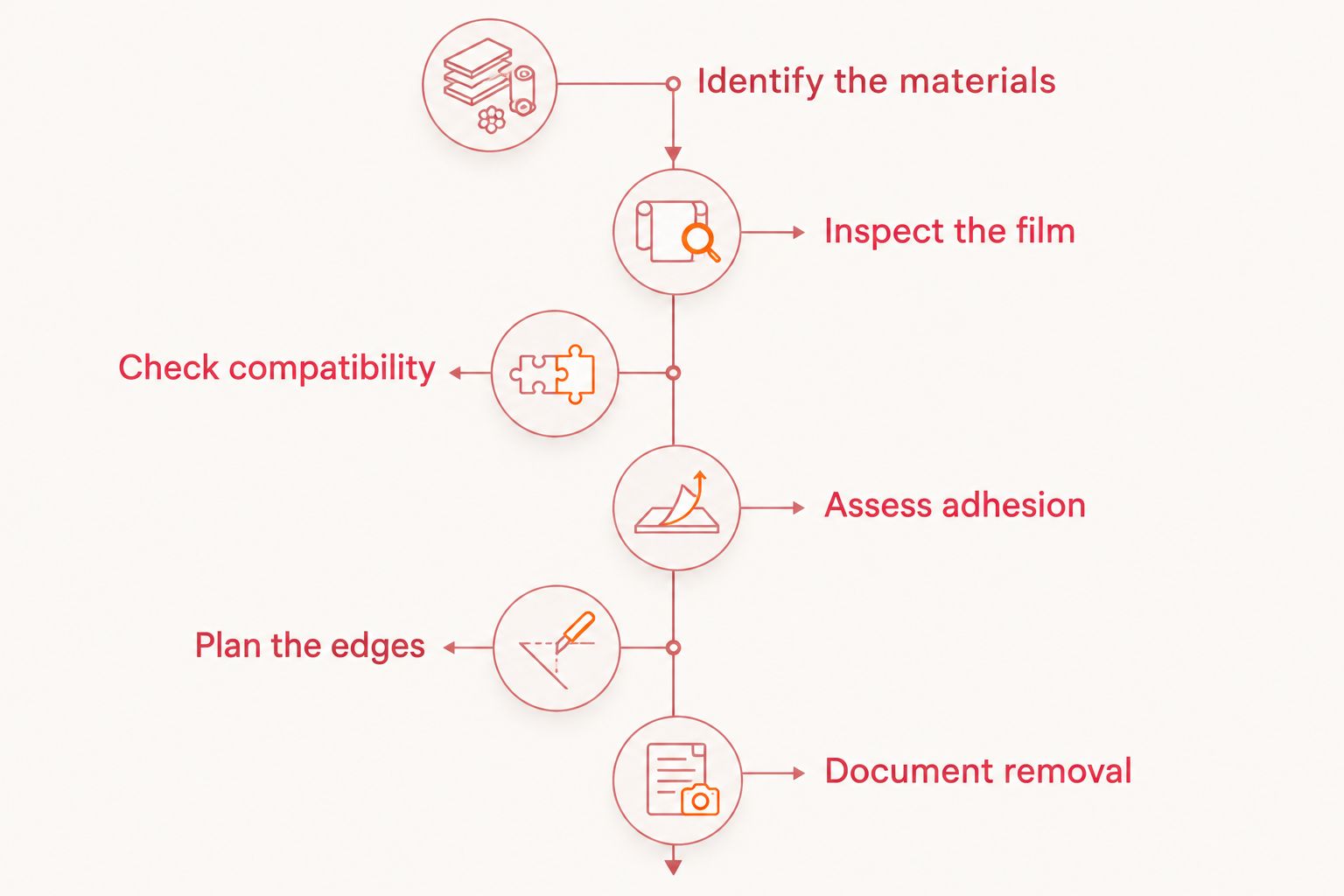
Before authorizing a 2026 installation, follow this sequence:
- Identify the materials. Record the existing PPF and proposed vinyl products, plus any coating applied over the PPF.
- Inspect the film. Check edges, seams, chips, staining, lifting, and evidence of earlier repairs.
- Check compatibility. Review the relevant manufacturers' application and removal guidance for the proposed substrate.
- Assess adhesion. Have the installer determine whether an appropriate test area is needed. A local test does not prove every panel will behave identically.
- Plan the edges. Agree on seam placement, trimming methods, and transitions between protected and unprotected panels.
- Document removal. Establish what happens if removing the vinyl also lifts or damages the PPF.
Each step answers a different question. A clean surface cannot compensate for failing underlying adhesive, and a sound PPF installation cannot override an incompatible topcoat.
Vinyl over sound, uncoated PPF
Best for: owners whose existing film is intact and accepted as a substrate for the proposed vinyl. This is the clearest candidate for retaining the current PPF, but an uncoated surface is not automatic approval.
Inspect broad panel areas and edges separately. Film that looks good across the hood can still have loose corners, damaged margins, or contamination near an emblem.
The benefit is retaining usable protection while changing the visible finish. The drawback is that vinyl follows the surface underneath: an existing PPF edge, overlap, or defect can remain visible through the finished wrap.
Ask the installer to explain where those transitions will sit. A color sample shows appearance, not how an underlying seam will look on your vehicle.
Vinyl over ceramic-coated or treated PPF
Best for: owners willing to verify the existing surface treatment before choosing a wrap plan. Ceramic coatings and other treatments change the surface to which the vinyl adhesive must bond.
Water beading is not an adhesion test. A slick, clean-looking panel does not establish that a pressure-sensitive adhesive will perform as intended.
Do not assume a routine wash removes a ceramic coating, or that polishing is an acceptable preparation method for every PPF topcoat. The preparation process needs to match the specific film and treatment; an aggressive correction method can damage the surface you intend to keep.
For a 2026 project, bring the original installation paperwork if you have it. Product identification is more useful than guessing from gloss, slipperiness, or water behavior.
Vinyl over damaged, lifting, or unidentified PPF
Best for: inspection and a revised installation plan—not immediate wrapping. Vinyl is not a repair for loose PPF, and concealing a damaged layer does not restore its bond to the paint.
Lifting edges, cracking, trapped contamination, and damaged sections need evaluation before another adhesive film goes on top. The vinyl's appearance and attachment depend on the substrate beneath it.
Unidentified PPF presents a different problem: the installer lacks the material information needed to check compatibility. That does not prove the film has failed, but it removes a useful basis for approving the layered installation.
Do not use a color change to hide a substrate problem. Resolve the condition of the PPF first, then decide whether retention or removal makes sense.
Why vinyl-over-PPF results vary
These factors explain why the same general request can lead to different installation recommendations:
- PPF surface chemistry. The topcoat and any added treatment affect the surface the vinyl adhesive contacts. Check the actual material guidance rather than assuming all clear films behave alike.
- Existing adhesion. The lower film must remain bonded to the paint. Vinyl adds another layer; it does not renew the PPF adhesive beneath it.
- Panel geometry. Recesses, tight curves, corners, and panel edges demand more shaping than broad, flat areas. Review these locations before approving coverage.
- Seams and coverage boundaries. Partial PPF creates transitions beneath a wrap. Their location affects the finished appearance and the edge plan.
- Exposure and maintenance. Florida sun, coastal salt deposits, road contamination, washing methods, and storage belong in the care discussion. Follow the instructions for the installed materials.
- Removal requirements. Future disassembly affects the practical value of retaining existing PPF. Discuss responsibility for film replacement instead of assuming both layers will separate cleanly.
None of these factors supports a universal lifespan promise. For your 2026 plan, request the care instructions and applicable warranty terms for the proposed material combination in writing.
Will removing the vinyl damage the PPF underneath?
Removing vinyl can lift or damage the PPF underneath; preserving the lower film is not guaranteed. The vinyl adhesive contacts the PPF surface, while the PPF has its own bond to the vehicle.
Removal technique matters, but careful work cannot erase the effects of material incompatibility, deterioration, or weak existing adhesion. An apparently tidy installation does not establish how the layers will separate later.
Before approval, read about vehicle wrap removal and ask whether the removal plan includes inspection of the exposed PPF. Agree on who authorizes replacement if the original film cannot be retained.
Does vinyl over PPF provide extra rock-chip protection?
Vinyl over PPF should not be treated as a quantified increase in rock-chip protection without evidence for that exact assembly. A color-change vinyl film and an impact-protection film serve different primary purposes.
Retained PPF remains part of the protective assembly, but adding vinyl does not establish a new impact rating or a longer service life. Nor does it make the vehicle chip-proof.
If road wear is your main concern, prioritize the PPF's condition and coverage. Choose the vinyl for the appearance you want, not an unsupported promise of additional protection.
Can you wrap only the panels that already have PPF?
You can consider wrapping selected PPF-covered panels, subject to the same compatibility and condition checks. Partial coverage makes edge placement especially important because the finished vehicle can include several substrate transitions.
A hood covered in PPF and an adjacent unprotected fender do not present identical installation surfaces. Ask the installer to describe the plan panel by panel, including how visible boundaries will be handled.
That discussion also prevents confusion during later repairs. Record which panels have vinyl over PPF and which have vinyl directly over paint.
What should you ask before approving the installation?
For a Florida Gulf Coast vehicle, describe how you actually use and store it. Outdoor parking, highway driving, and coastal exposure help frame the maintenance discussion without justifying an invented durability estimate.
CoaterZ paint protection film and vinyl wrap services are best for Gulf Coast owners seeking those services from a local installer. The right installation choice still depends on your vehicle's existing film and the materials proposed for the job.
Ask for clear answers to these questions:
- What identifies the PPF already on the vehicle?
- Has a ceramic coating or another surface treatment been applied?
- Does the proposed vinyl's guidance accept this substrate?
- Which seams, edges, or defects will remain visible?
- How will trimming avoid damage to the underlying surfaces?
- What preparation and aftercare instructions apply to this combination?
- What happens if the PPF lifts during installation or removal?
- Which written warranty terms apply to each layer?
Do not treat silence about layered applications as approval. Warranty coverage, installation suitability, and removal responsibility are separate questions.
Plan your vehicle’s protection and finish
Discuss your existing PPF, desired wrap finish, and removal expectations before choosing the installation.
How should you maintain vinyl installed over PPF?
Maintain the exposed vinyl according to its manufacturer's instructions, while observing any additional restrictions for the underlying installation. The visible surface is now vinyl, not the original PPF topcoat.
Use approved cleaning products and methods. Avoid directing pressure washing at film edges, and address salt deposits, bird droppings, and road contamination according to the applicable care instructions rather than scrubbing aggressively.
Watch for lifting corners, bubbles that develop after installation, or changing seams. Have the installer inspect the cause instead of pushing an edge down and assuming the underlying film is sound.
Keep a 2026 installation record with material names, coverage notes, and photographs of existing defects. That record gives a future installer a clearer starting point when removing or replacing either layer.
FAQ
Can vinyl wrap go over PPF without removing it first?
Yes, vinyl wrap can go over PPF when the existing film is sound and the specific materials are compatible. Inspect the film, identify surface treatments, and agree on a removal plan before installation.
Will vinyl hide scratches and lifting edges in my PPF?
Vinyl does not repair scratches or lifting edges in PPF. Surface defects and film boundaries can remain visible, while loose underlying film remains an unsuitable foundation until addressed.
Can I wrap over PPF that already has ceramic coating?
Ceramic-coated PPF requires a compatibility review before vinyl installation. Do not assume washing removes the coating or that an abrasive preparation method is safe for the PPF topcoat.
Will my PPF warranty still apply after adding vinyl?
Warranty coverage depends on the written terms for the specific PPF and proposed application. Obtain confirmation rather than assuming an added vinyl layer is covered.
Can I remove the vinyl later and keep the PPF?
Keeping the PPF after vinyl removal is not guaranteed. The lower film can lift or suffer surface damage, so discuss replacement responsibility before the wrap is installed.
Does wrapping over PPF make my car chip-proof?
Wrapping over PPF does not make your car chip-proof. Do not assign extra impact protection or a longer lifespan to the combined layers without evidence for that exact installation.
Can I pressure wash a vinyl wrap installed over PPF?
Follow the installed vinyl manufacturer’s pressure-washing instructions and any restrictions for the layered installation. Avoid directing the spray at edges, where water pressure can encourage lifting.
One last thing
A clean separation later is part of a good installation decision today. Before choosing the wrap color, ask how the installer intends to uncover the PPF again.
For your CoaterZ consultation, bring any PPF paperwork and explain whether retaining that film after a future color change is essential. That requirement belongs in the installation discussion—not in a surprise conversation during removal.