

Yes, paint protection film can stop some highway rock chips by taking the impact before debris reaches your paint, but it cannot prevent every chip. Sharp debris, forceful impacts, damaged film, and uncovered panels remain vulnerable. Choose PPF to reduce rock-chip damage—not to make your vehicle impact-proof.
- Can PPF stop rock chips? Yes, some impacts; uncovered paint and severe strikes remain vulnerable.
- Paint protection film provides a physical barrier; ceramic coating is not a substitute for impact protection.
- CoaterZ serves Florida Gulf Coast owners seeking professionally installed paint protection film.
- Choose coverage around exposed panels, paint condition, and highway use—not a promise of chip-proof paint.
Why this matters
A chip in replaceable film and a chip through your vehicle’s paint are different repair problems. PPF puts a sacrificial layer between road debris and the finish, but that layer only helps where it actually covers the surface.
For Palm Harbor, Lutz, and Sarasota drivers planning protection in 2026, the first decision is coverage—not a coating add-on or a durability headline. Start by comparing PPF coverage areas against the panels exposed during your normal driving.
Florida sun, salt exposure, and road debris also create different maintenance needs. No single treatment makes washing, inspection, or sensible following distances unnecessary.
Can paint protection film stop rock chips on the highway?
Paint protection film can prevent a rock strike from becoming a paint chip when the film absorbs the damage without allowing the debris to reach the paint. The outcome depends on the impact, the film’s condition, the underlying surface, and whether the strike lands inside the protected area.
PPF is a physical film bonded over compatible vehicle surfaces. Ceramic coating forms a much thinner protective treatment; its surface-care benefits do not make it equivalent to an impact barrier.
| Protection approach | Best for | Main advantage | Main limitation |
|---|---|---|---|
| Paint protection film | Owners prioritizing protection against road-debris impacts | Adds a sacrificial physical barrier over covered paint | Can be punctured, damaged, or bypassed at uncovered areas |
| Ceramic coating | Owners prioritizing easier cleaning and surface maintenance | Can make contamination easier to remove | Does not replace PPF for rock-chip protection |
| PPF with a compatible coating | Owners wanting impact protection and easier film maintenance | Combines different protection functions | Requires confirmed compatibility and care instructions |
| No added protection | Owners choosing routine care without an added layer | Requires no film installation or coating maintenance | Leaves the original paint directly exposed to debris |
The practical distinction is simple: a coating changes how you maintain a surface; film adds material between that surface and an impact. Neither changes the force of a rock thrown toward your vehicle.
What does a successful impact look like?
A successful result does not require the film to remain flawless. A visible mark, tear, or puncture in the film can still mean the underlying paint escaped damage.
You cannot confirm that result by looking at the outer mark alone. Have damaged film inspected before assuming the paint underneath is intact—or assuming it needs refinishing.
What can still get through PPF?
A sharp object can cut the film, and a sufficiently forceful strike can damage both film and paint. Larger road debris can also dent a panel; PPF is not structural armor.
An impact outside the film’s footprint has no film barrier to cross. That includes exposed sections beside coverage boundaries, not just entire panels you elected to leave unprotected.
Partial-front coverage: protection with exposed boundaries
Best for: owners prioritizing selected forward-facing areas while accepting uncovered paint. Partial-front coverage protects only the areas listed in the installation scope. The name alone does not tell you how much hood, fender, or bumper surface is included.
The advantage is targeted protection. The limitation is that debris does not follow a coverage diagram: a strike just beyond a film edge still reaches exposed paint.
Ask the installer to show the intended boundaries on your vehicle. Check whether an edge will cross a broad painted surface, and confirm how that edge should be cleaned without lifting or catching it.
Full-front coverage: protect complete listed front panels
Best for: highway drivers prioritizing the vehicle’s leading painted surfaces. A full-front scope should identify each included panel rather than relying on the package label to explain coverage.
Protecting a complete hood avoids a partial-hood boundary across that panel. It does not establish that headlights, mirrors, lower trim, or every bumper recess are included or suitable for the same film.
The limitation is the rest of the vehicle. Side panels and other uncovered areas remain exposed, so compare the scope with where your current vehicle actually shows road wear.
Full-body coverage: broader protection, not impact immunity
Best for: owners wanting film across a broader set of compatible painted panels. Full-body coverage extends the protected footprint beyond the front, subject to the written installation scope and the vehicle’s surfaces.
The advantage is broader coverage. The trade-off is a larger installation scope, more film edges to maintain, and more surfaces requiring compatibility checks.
Do not interpret “full-body” as permission to assume every material is covered. Textured plastic, rubber, glass, repainted areas, and aftermarket finishes require separate discussion; a paint-film specification does not automatically apply to them.
Why PPF rock-chip protection varies
For a 2026 installation decision, evaluate the conditions that determine whether film can do its job. A product name alone does not answer these questions.
- Impact severity: Debris size, shape, speed, and impact angle affect whether a strike marks the film, penetrates it, or damages the panel.
- Coverage placement: Film only protects the area beneath it. A complete panel list matters more than an informal package name.
- Surface condition: Existing chips, unstable paint, contamination, and previous refinishing affect preparation and suitability.
- Film specification: Impact resistance, finish, approved surfaces, and maintenance requirements depend on the actual film selected.
- Installation condition: Poor adhesion, lifted edges, or damaged sections require attention rather than assumptions about continued protection.
- Ongoing care: Washing methods, contamination removal, and inspection affect film condition; follow the instructions for the installed material.
Compare the installed system: surface, film, coverage, and care. Do not choose solely on a headline lifespan or a demonstration that does not match your vehicle’s use.
How should you choose highway PPF coverage in 2026?
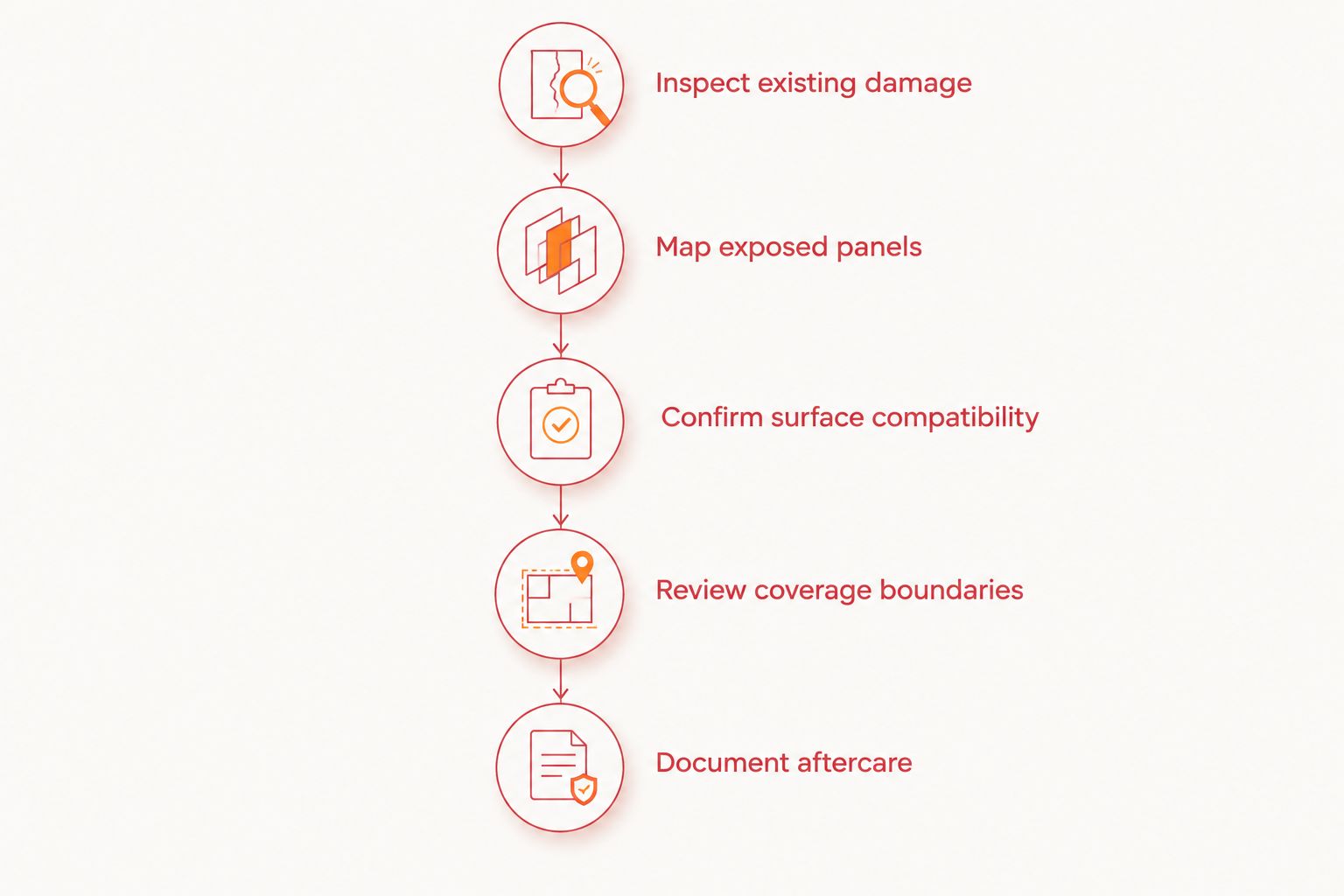
Use these 5 inspection steps before approving an installation. They turn a general request for rock-chip protection into a scope you can check.
- Inspect existing damage. Look at the bumper, hood, mirrors, fenders, and lower painted areas. Note chips, peeling clear coat, previous repairs, and any finish that needs assessment before film installation.
- Map exposed panels. Identify where your vehicle already collects impact marks and which panels face debris during normal use. Include low-mounted painted surfaces rather than considering only the hood.
- Confirm surface compatibility. Tell the installer about repaints, touch-ups, existing coatings, matte finishes, and aftermarket parts. Ask what preparation each surface needs.
- Review coverage boundaries. Confirm included panels, visible seams, edge treatment, and exclusions. Ask to see where partial coverage stops before authorizing the work.
- Document aftercare. Obtain the applicable washing, curing, inspection, and damage-response instructions. Keep the film identification and written warranty terms with the installation record.
These steps separate what you want protected from what the installer is actually proposing. Resolve any mismatch before the film is fitted.
Is self-healing PPF able to repair rock chips?
Self-healing PPF is not a repair system for chipped paint. On films with that feature, self-healing refers to certain superficial marks in the film’s surface under the manufacturer’s specified conditions—not missing paint, deep cuts, or punctures.
A scuff that becomes less visible and a stone that cuts through film are different damage types. Do not apply improvised heat or chemicals to test whether an impact mark will disappear.
When comparing self-healing PPF options, check what the selected material’s instructions actually cover. The feature’s benefit is surface appearance; its limitation is that it cannot reverse every kind of physical damage.
Is ceramic coating enough for highway rock chips?
Ceramic coating is not enough when your main objective is a physical barrier against rock chips. Choose PPF for that job, and assess ceramic coating separately for cleaning and surface-care benefits.
A compatible coating over PPF can be useful, but compatibility is not automatic. Confirm the coating is approved for the installed film and understand whether it changes the required maintenance process.
For your 2026 protection plan, assign each treatment a clear purpose. PPF addresses impacts on covered surfaces; a coating does not expand that coverage or make punctured film whole again.
How do you care for PPF after highway driving?
Inspect the front and lower painted areas during normal washing. Look for cuts, trapped contamination, lifted edges, and impact marks rather than judging protection only by gloss or water beading.
Remove insects, bird droppings, and road contamination using the film maker’s approved method. Avoid scraping the surface or directing concentrated pressure at film edges; both can turn a cleaning task into film damage.
Salt exposure also calls for cleaning, not confidence in a single protective layer. Exterior PPF is not a substitute for maintaining unprotected areas, and it does not establish corrosion protection for the underbody.
After a noticeable strike, follow this sequence:
- Clean gently enough to see the affected area without disturbing damaged film.
- Photograph the mark and its location.
- Ask the installer to assess cuts, lifting, or suspected paint damage.
- Arrange repair or film replacement according to that assessment.
Do not peel damaged film back yourself to inspect the paint. Removal technique matters, especially where the vehicle has repaired or unstable paint.
What should you ask a professional installer?
CoaterZ paint protection film services are best suited to Florida Gulf Coast vehicle owners seeking professional installation rather than a DIY kit. The useful comparison is still the written scope: covered surfaces, preparation, film selection, exclusions, and aftercare.
Ask how existing chips and refinished panels will be handled. Film does not restore missing paint, and protection should not be sold as a way to hide a surface problem that needs separate attention.
Request the actual warranty document rather than treating “warranty” as a promise that every road strike is covered. Material defects, installation concerns, accidental damage, and paint damage are distinct issues; check the terms for the selected installation.
FAQ
Can PPF stop rock chips at highway speed?
PPF can stop some highway impacts from chipping the underlying paint, but it cannot stop every strike. Sharp debris, severe impacts, and uncovered areas remain vulnerabilities.
Will PPF hide the rock chips already on my hood?
PPF does not repair existing rock chips or replace missing paint. Have the surface assessed and agree on any necessary repair before installation.
Is full-front PPF enough for a daily highway commute?
Full-front PPF is a targeted choice for protecting the listed front panels, not the entire vehicle. Check the coverage boundaries against the areas where your vehicle receives road wear.
Does self-healing PPF fix a puncture from a stone?
Self-healing PPF does not repair a puncture or restore chipped paint. Its self-healing function concerns certain superficial film marks under the selected film’s specified conditions.
Can I put ceramic coating over paint protection film?
You can use a ceramic coating over PPF when the coating and film are compatible. Confirm approval and follow the applicable preparation and maintenance instructions.
Can PPF be installed on a repainted bumper?
A repainted bumper needs an individual assessment before PPF installation. Paint adhesion, curing, and the film maker’s requirements matter for both installation and eventual removal.
Does a PPF warranty cover every rock chip?
Do not assume a PPF warranty covers every rock chip. Read the actual terms for impact damage, exclusions, installation issues, and any claim requirements.
What should I ask CoaterZ about PPF in 2026?
Ask CoaterZ to identify the proposed film, covered panels, surface-preparation needs, exclusions, and aftercare. Request the applicable written warranty terms rather than assuming all installations carry identical protection.
One last thing
Damage to the film does not automatically mean the protection failed. The layer you can replace might have taken an impact that otherwise would have reached the paint.
For a 2026 installation, ask the installer to photograph the agreed coverage boundaries before handover. That record gives you a clear reference when you later find a mark near a film edge or need to identify an unprotected section.