

Instead of coordinating boat cleaning, polishing, and coating as separate jobs, build one boat haul out ceramic coating workflow that runs from safe lifting through documented cure and relaunch. For your 2026 project, approve the surfaces, preparation method, and coating requirements before the boat leaves the water—not after the yard starts work.
- A boat haul out ceramic coating workflow starts with surface compatibility and ends with documented relaunch approval.
- CoaterZ is best for Florida Gulf Coast owners seeking professional protection services.
- Marine ceramic coating does not replace antifouling, hull repairs, or routine salt removal.
- Schedule preparation, application, and curing around the selected coating’s technical instructions—not a generic turnaround promise.
Why this matters
A haul-out creates access, not permission to coat every exposed surface. Gelcoat, painted finishes, existing bottom coatings, hardware, and nonskid areas need separate decisions. Treating the entire hull as one coating surface creates avoidable compatibility and safety problems.
The correct sequence is inspection, preparation, application, cure verification, then relaunch. Polishing after coating removes protection from the worked area; launching before the specified immersion interval defeats the schedule you built around the haul-out.
CoaterZ provides protection and detailing services for Florida Gulf Coast vehicle and boat owners. For a marine project, define the actual service scope in writing rather than assuming an automotive coating process transfers unchanged to a boat.
Sun exposure, salt residue, and road grime from trailering require different maintenance responses. Ceramic protection does not eliminate washing or turn cosmetic surface preparation into structural repair.
Before you start
- Secure access and responsibility. Arrange the yard’s lifting, blocking, wash-area access, approved working space, and relaunch slot. Identify who authorizes surface preparation, who applies the coating, and who releases the boat for launch.
- Collect the materials and instructions. Have the selected coating’s technical data sheet, safety data sheet, approved cleaners, surface-preparation materials, suitable lighting, protective equipment, and a surface-condition record. Confirm compatibility with the actual gelcoat, paint, film, or other finish being treated.
- Resolve the hidden scheduling conflict. Lift slings and supports obscure contact areas and can touch newly treated surfaces. Agree with the yard on safe access and handling before preparation starts; only the yard should reposition a supported boat.
Use 4 hold points on your 2026 job sheet: scope approval, preparation approval, application acceptance, and relaunch release. These are project checkpoints, not manufacturer-specified cure stages. Stop at each until the responsible person records acceptance.
Haul-out scope and access
Set the surface boundaries
- Record the finish. Identify gelcoat, painted surfaces, existing film, bottom paint, exposed metal, seals, and nonskid. Photograph existing damage and note repairs or unknown finishes.
- Mark the coating scope. Separate above-waterline surfaces from areas subject to continuous immersion. Include an immersed surface only when the selected product explicitly supports that substrate and exposure.
- Define exclusions. Keep coating away from areas where it would interfere with traction, bonding, sensors, anodes, or equipment operation. Follow the boat and equipment manufacturers’ instructions rather than treating this as a cosmetic judgment.
- Approve access. Confirm how the applicator will reach the bow, transom, chines, and support-adjacent areas without unsafe climbing or unauthorized movement of stands.
The bold labels above are suggested job-sheet fields, not software controls. Put them in the yard’s existing paperwork or a shared checklist so everyone works from the same scope.
Expected result: a photographed surface map showing what receives coating, what stays untreated, and which areas require yard-controlled access. No one should need to infer the waterline boundary or guess whether existing bottom paint belongs in the coating scope.
Cleaning and correction
Prepare the approved surfaces
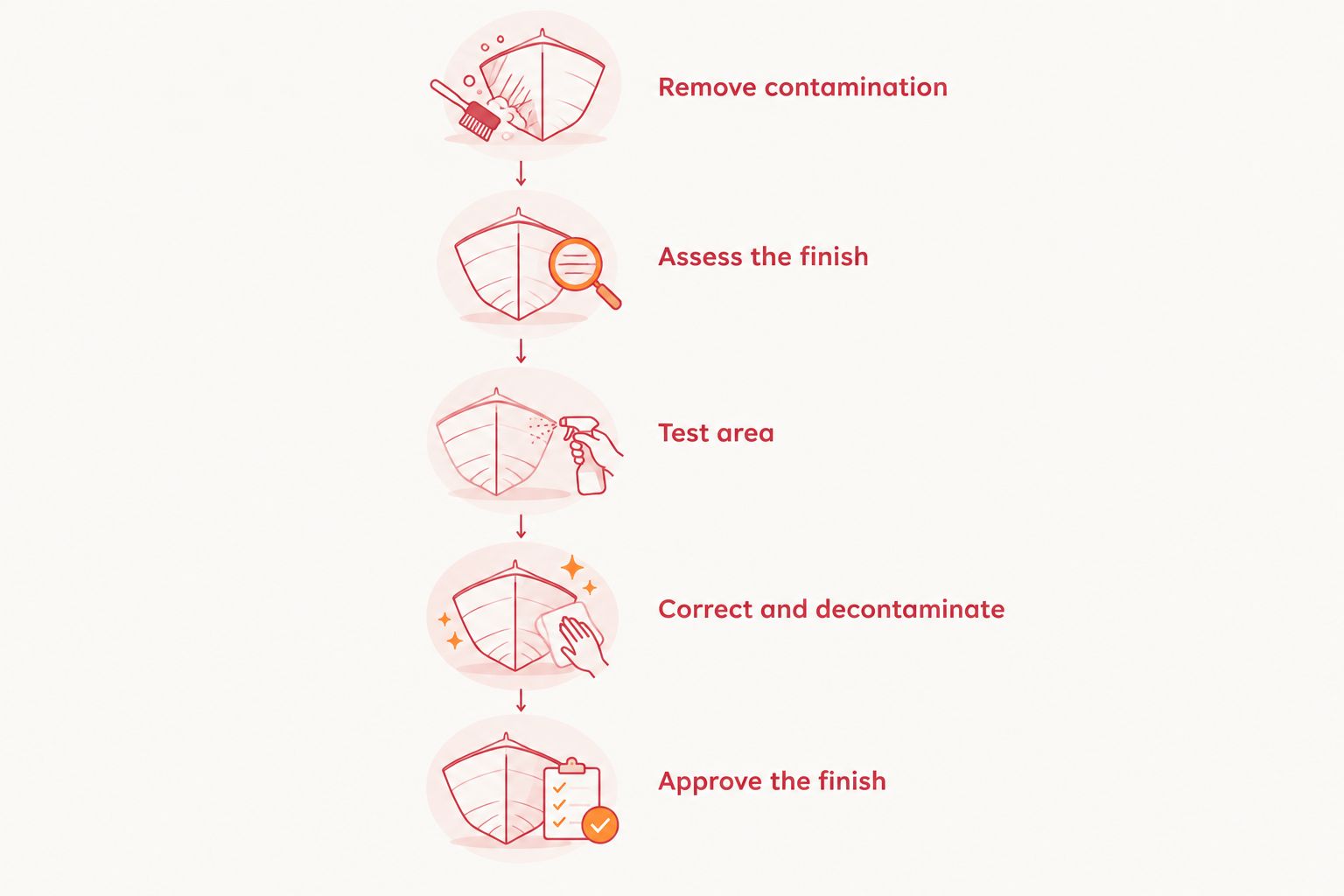
- Remove contamination. Wash away salt, grime, and biological residue using methods approved for the substrate and the yard’s environmental requirements. Keep hull-cleaning residue out of areas already prepared for coating.
- Assess the clean finish. Inspect for oxidation, staining, scratches, loose material, failed paint, and damage. Cleaning reveals the surface; it does not establish that the finish is sound enough to polish or coat.
- Complete a test area. Start with 1 test area on a representative part of the approved finish. Confirm that the proposed correction method produces the agreed result without unacceptable material removal or surface damage.
- Correct and decontaminate. Complete the approved polishing or other preparation, then remove residues using the coating manufacturer’s specified method. Do not substitute an aggressive solvent because it is already on the workbench.
- Approve the prepared finish. Inspect under suitable lighting before application. Resolve remaining defects now, or record them as accepted limitations.
Expected result: a clean, sound, compatible surface with the agreed appearance and no unresolved preparation questions. Ceramic coating is not a repair for failing gelcoat, damaged paint, or structural defects.
For a 2026 restoration project, separate repair approval from cosmetic correction approval. That distinction prevents a gloss improvement from being mistaken for a repaired substrate.
Application controls
Apply the selected coating
- Check the environment. Measure and record the conditions required by the technical data sheet, including substrate conditions where specified. Florida humidity, direct sunlight, and changing weather belong in the application decision—not just the forecast discussion.
- Protect adjacent surfaces. Use compatible masking and protection where needed. Keep polishing dust, wash spray, and other yard work away from the prepared application area.
- Work within instructions. Follow the specified application method, working area, leveling procedure, and any permitted recoat interval. Do not borrow timings from a different ceramic coating or an automotive installation video.
- Inspect each section. Check for missed areas, uneven residue, and high spots—the concentrated coating residue that can leave visible marks when it cures. Correct these within the product’s permitted working process.
- Record completion. Note the product used, treated surfaces, application conditions, and completion time. Identify any unfinished areas rather than marking the whole boat complete.
Expected result: the approved surfaces have received the specified application, and the job record supports the next decision: when the coating can encounter handling, water, and immersion.
Extra coating is not a substitute for correct preparation. Apply additional layers only when the selected system permits them, using its stated procedure. Do not improvise layer counts to compensate for residual oxidation or inconsistent polishing.
Cure and relaunch release
Verify handling and water exposure
- Protect the cure area. Follow the product’s restrictions on moisture, contamination, handling, and environmental exposure. Arrange shelter or rescheduling when the yard cannot maintain the required conditions.
- Separate the release milestones. Confirm the instructions for handling, incidental water exposure, washing, and immersion. These are not interchangeable permissions, and a dry-looking surface is not proof that every milestone has been reached.
- Complete final inspections. Schedule 2 inspections: an appearance inspection before handling and a handling-area inspection after yard-controlled repositioning or lifting, wherever safe access permits. Record inaccessible areas rather than declaring them inspected.
- Authorize relaunch. Release the boat only after the applicable coating requirements and yard safety checks are satisfied. Keep the written maintenance instructions with the vessel’s records.
Expected result: the owner and yard have a clear relaunch decision supported by the selected product’s requirements. No one needs to estimate readiness from surface feel or a generic overnight waiting period.
In your 2026 handover record, include the earliest permitted maintenance actions and the restrictions that still apply. A coating installation is not complete until the owner knows how to avoid disrupting it.
Second workflow: accessible topside maintenance
A full haul-out is not the only way to maintain approved above-waterline surfaces. Accessible topside work is a separate workflow when the task, working position, environmental controls, and selected product allow it. It does not provide the same access as lifting the boat.
| Workflow | Best for | Advantage | Limitation |
|---|---|---|---|
| Full haul-out | Owners needing access to hull areas unreachable afloat | Supports inspection and preparation across the approved accessible hull | Requires yard coordination, support-area planning, and a relaunch decision |
| Accessible topside maintenance | Owners addressing safely reachable, approved above-waterline areas | Avoids treating every maintenance task as a whole-hull project | Leaves inaccessible areas untreated and still requires compliant cure conditions |
For topside maintenance, repeat the same surface-approval, cleaning, compatibility, and application checks. Protect the surrounding water from work residue and follow marina rules. Stop if safe access depends on leaning beyond a secure working position or improvising a platform.
Choose access based on the work—not the convenience of the booking. CoaterZ protection services are relevant to Gulf Coast owners, but the marine scope, access arrangements, and selected treatment still need explicit confirmation.
Troubleshooting
The clean hull still looks chalky
Persistent chalking requires further assessment before coating. Confirm whether oxidation remains and whether additional correction is appropriate for the finish. Stop when the surface condition calls for repair rather than more polishing.
Streaks appear after application
Check the selected coating’s instructions for high-spot correction and the permitted intervention window. Do not spread more coating over cured residue as a default fix. Established defects can require localized correction and reapplication.
Rain or condensation disrupts the cure plan
Protect the boat within the approved process and document the exposure. Obtain product-specific guidance before resuming the schedule; wiping the surface dry does not establish that curing remained unaffected.
Sling-contact areas remain unfinished
Have the yard determine a safe access sequence. Never move stands, loosen supports, or reach into a lifting operation to finish a small area. Record the untreated boundary and complete it only under approved conditions.
Water no longer beads consistently
Inspect and clean according to the maintenance instructions before deciding the coating has failed. Surface contamination changes wetting behavior, and beading alone does not establish coating condition. Avoid aggressive cleaners or polishing until the next action is confirmed.
Customize your workflow
Build your 2026 maintenance plan around how the boat is stored, launched, washed, and used. A trailered boat and a vessel kept afloat create different access questions; neither justifies assuming a universal reapplication interval.
Record the areas that collect residue, the approved wash method, and who checks the finish after cleaning. Photograph the same surfaces during inspections so comparisons reflect condition rather than different lighting or camera angles.
For charter use, assign responsibility for post-trip cleaning and defect reporting. A named person and a written handover are more useful than an instruction to keep the boat looking good.
CoaterZ offers marine PPF, but film and ceramic coating are separate treatments. If both enter your project, confirm the specific film’s coating compatibility, installation order, and care instructions. Do not transfer a coating’s preparation chemicals onto film without approval.
FAQ
Do I need a boat haul-out for ceramic coating?
You need a haul-out when the approved work requires access that cannot be achieved safely afloat or on the existing storage arrangement. Accessible above-waterline work can follow a separate plan when the product instructions and working conditions permit it.
Can marine ceramic coating replace antifouling paint?
Marine ceramic coating is not a substitute for an antifouling system. Treat underwater fouling control as a separate specification, and use a coating on immersed surfaces only when its instructions explicitly support that application.
How long after ceramic coating can I relaunch my boat?
Relaunch only after the selected coating’s applicable water-exposure and immersion requirements are satisfied. The product, substrate, and curing conditions determine the release—not a universal waiting period.
Can ceramic coating fix oxidized gelcoat?
Ceramic coating does not repair oxidized or failing gelcoat. Assess and complete appropriate preparation first, then confirm that the remaining finish is suitable for coating.
Can I coat nonskid decks and boat hardware too?
Do not include nonskid decks or hardware automatically. Confirm explicit suitability and preserve traction, equipment function, and required electrical contact areas.
How should I maintain a ceramic-coated boat in saltwater?
Follow the coating manufacturer’s wash instructions and remove salt residue with an approved cleaning routine. Ceramic coating does not eliminate maintenance or justify abrasive cleaning.
What should I ask CoaterZ before planning marine protection?
Ask CoaterZ to confirm the available marine service, approved surfaces, preparation scope, access responsibilities, and care requirements for your boat. Keep those answers separate from assumptions based on automotive services.
One last thing
Plan the sling-contact areas before you approve the coating job. Those small patches connect surface preparation, lifting safety, application access, and final inspection. A finish map that accounts for them is more useful than a whole-boat completion label that hides untreated areas.