

Best overall: 50% VLT ceramic tint. Best for preserving a lighter view: 70% VLT ceramic tint. Best for added privacy: 35% VLT ceramic tint. These are shade-based starting points for the best window tint shades for heat rejection in 2026, not a measured heat-rejection ranking: film construction and published performance specifications determine how much solar heat a tint rejects.
- Best window tint shades for heat rejection: start with 50% VLT ceramic tint for a balanced cabin and view.
- Choose 70% VLT ceramic tint when a lighter appearance matters; compare heat-rejection specifications before choosing.
- Darker 35% VLT tint adds privacy, but darkness alone does not establish better heat rejection.
- CoaterZ installs window tint for Tampa Bay vehicle owners; confirm the film, glass and legal fit before installation.
Why this matters in Florida
A vehicle parked in Florida sun needs a tint choice based on more than how dark the glass looks. Visible light transmission, or VLT, describes how much visible light passes through the tint. A 50% VLT label describes a lighter shade than a 20% VLT label; it does not tell you which film rejects more solar heat. For a 2026 installation, ask for both the shade and the film’s published heat-rejection specifications.
CoaterZ offers window tint installation for vehicle owners in the Tampa Bay and Florida Gulf Coast area. CoaterZ is best for local owners who want window tint considered alongside their vehicle’s other protection needs. Tint addresses sunlight through glass. It does not protect paint from salt or road wear; those are separate surface-protection decisions.
What makes the best window tint shade for heat rejection?
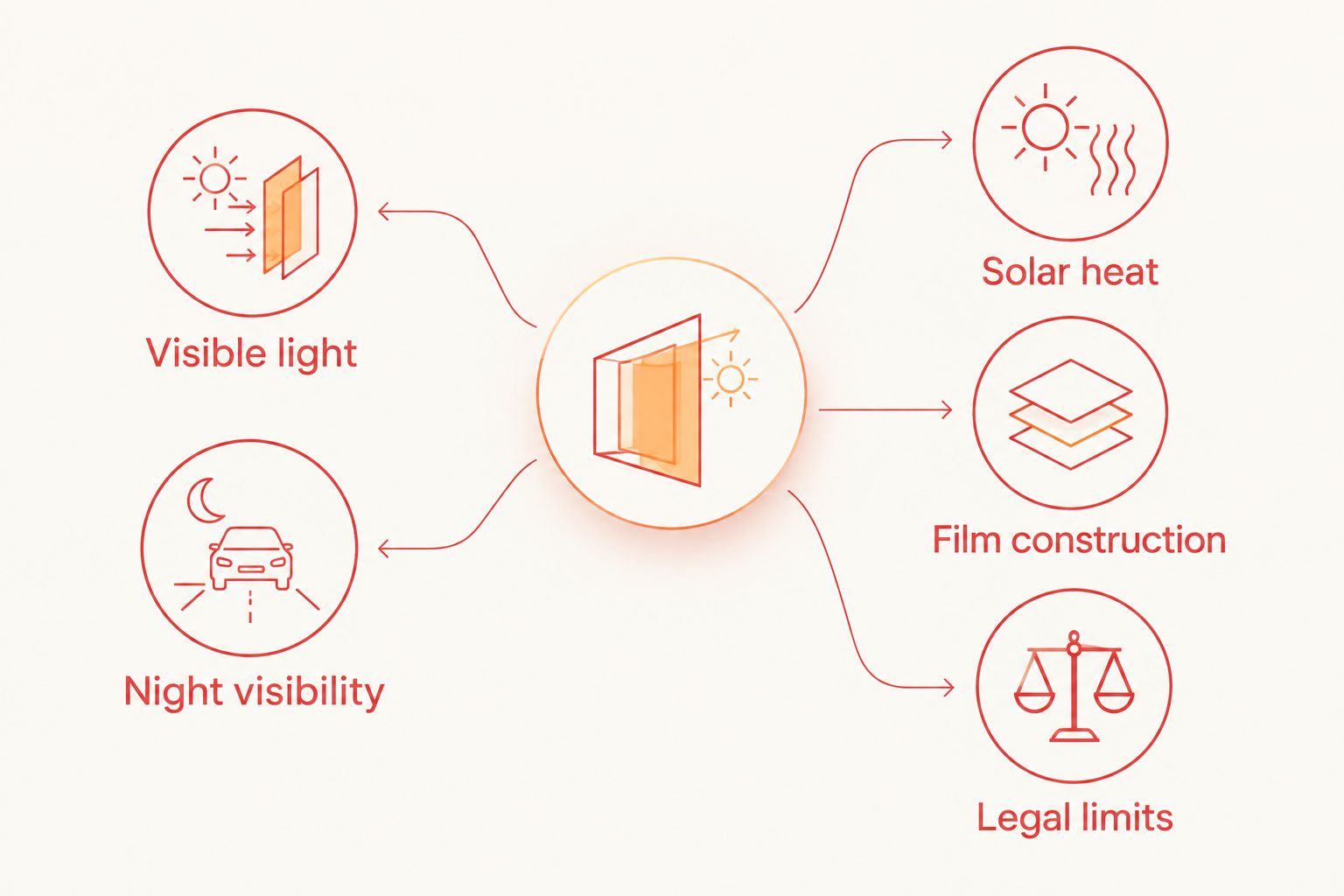
Use these criteria before comparing shades in 2026. They separate what you can see through the glass from what the film is specified to do.
- Visible light: Check VLT for the exact film and the finished window. Existing glass affects the final result, so a film label is not necessarily the window’s measured VLT.
- Solar heat: Compare the manufacturer’s total solar energy rejection specification for the films under consideration. Do not substitute darkness or a single infrared figure for a whole-film comparison.
- Film construction: Compare the actual ceramic and other available film specifications. The word ceramic identifies a film category, not a guaranteed heat-rejection result.
- Legal limits: Confirm current Florida requirements for each window and vehicle type before selecting a shade. A shade suitable for one piece of glass is not automatically suitable for every window.
- Night visibility: Look through the proposed shade in conditions that resemble how you drive. A darker appearance comes with less visible light passing through the glass.
- Surface condition: Ask how the installer handles existing tint and glass condition. New film will not make damaged glass or a failing existing layer disappear.
The distinction is simple: VLT tells you how much visible light passes through; a heat-rejection specification addresses solar energy. If you are choosing between two films in 2026, request their specifications at the shades you actually want rather than treating the shade number as a performance score.
Window tint shades at a glance
This ranks shades by practical fit for a heat-focused buyer, not by measured heat rejection. No film-specific performance data is supplied for these options. A published specification can change which film is the stronger heat-rejection choice, even when its shade looks lighter.
| Rank and shade | Best for | Standout feature | Key limitation |
|---|---|---|---|
| 1. 50% VLT ceramic tint | Balanced everyday use | Lighter view than the darker options below | Heat rejection depends on the specific film |
| 2. 70% VLT ceramic tint | Preserving a lighter appearance | Allows more visible light through than 50% VLT film | Offers less shade-based glare and privacy control |
| 3. 35% VLT ceramic tint | More privacy with a moderate-looking shade | Darker appearance than 50% VLT film | Reduces visible light further; legal fit needs checking |
| 4. 20% VLT ceramic tint | Rear-window privacy where permitted | Stronger darkening than 35% VLT film | Greater visibility and placement trade-offs |
| 5. 5% VLT ceramic tint | A very dark appearance where permitted | Greatest darkening in this comparison | Severe visibility trade-off; not a default road-use choice |
How to read the ranking
Every percentage in the table is a VLT shade designation, not a percentage of heat rejected. Even films sold at the same nominal shade can have different solar-performance specifications. Before approving a 2026 installation, compare the exact film options available for your vehicle and confirm where each can legally go.
1. 50% VLT ceramic tint: best for balanced everyday use
Best for: A driver who wants an everyday starting point without choosing a notably dark appearance. At 50% nominal VLT, this shade sits between the lighter 70% and darker 35% options in this guide. That makes it the default shade recommendation, not an automatic winner on heat rejection.
A 50% VLT ceramic film is still a film choice, not a complete specification. Ask for the manufacturer’s heat-rejection information for the exact product and have the installer check the finished glass against the applicable rules. If another eligible film posts stronger whole-film heat performance at a lighter shade, choose on those specifications rather than on this ranking.
50% VLT ceramic tint pros:
- Keeps a lighter appearance than the 35%, 20% and 5% options.
- Provides a clear reference point when comparing published film specifications.
- Avoids making maximum darkness the goal of a heat-focused installation.
50% VLT ceramic tint cons:
- Does not guarantee a specific heat-rejection result.
- Gives less shade-based privacy than darker options.
- Still requires a window-by-window legal check.
Verdict: Buy if its published heat performance meets your goal and the finished windows comply with current requirements.
2. 70% VLT ceramic tint: best for a lighter appearance
Best for: A driver who wants to preserve more visible light while shopping for heat rejection. A nominal 70% VLT film is lighter than the 50% VLT choice, but it can still be considered for heat control when its published specifications support that purpose. Darker is not a reliable shortcut to better heat performance.
This is the option to investigate when you dislike a darkened look or regularly drive in low-light conditions. Check the specifications for the exact film; do not assume every 70% VLT ceramic film performs alike. For windshield or front-window questions, confirm the applicable Florida requirements and the finished glass result before installation.
70% VLT ceramic tint pros:
- Preserves more visible light than the other shades listed here.
- Lets you pursue a lighter appearance and evaluate heat performance separately.
- Makes shade selection less dependent on privacy preferences.
70% VLT ceramic tint cons:
- Offers less visual privacy than darker shades.
- Provides less shade-based glare reduction than a darker film.
- Its light appearance says nothing conclusive about its heat-rejection specification.
Verdict: Buy when a lighter view is the priority and the chosen film’s published heat figures support the decision.
3. 35% VLT ceramic tint: best for added privacy
Best for: A vehicle owner who wants more shade-based privacy than 50% VLT offers, without starting with the darkest choices. A nominal 35% VLT film transmits less visible light than 50% VLT film. That darker appearance is the reason to consider it; it is not proof that it rejects more heat.
If heat is your primary reason for tinting, put the 35% and 50% film specifications side by side. Compare the same heat-rejection measure and check which windows can receive each option under current rules. Judge the view from inside the vehicle as carefully as the appearance from outside it.
35% VLT ceramic tint pros:
- Adds visible darkening compared with 50% VLT.
- Gives privacy-focused buyers a middle choice before 20% VLT.
- Can be evaluated against lighter films using published heat data.
35% VLT ceramic tint cons:
- Lets less visible light through than 50% or 70% VLT.
- Does not establish better heat rejection by shade alone.
- Placement depends on the vehicle, glass and applicable law.
Verdict: Buy for added privacy only after the film and finished windows pass the heat-performance and legal checks.
4. 20% VLT ceramic tint: best for permitted rear-window privacy
Best for: A driver seeking a distinctly dark rear-window appearance where that installation is permitted. A nominal 20% VLT film transmits less visible light than 35% VLT film, so the visibility trade-off deserves more attention. Do not carry a rear-window choice over to front glass without a separate legal check.
For 2026, compare heat specifications before treating 20% VLT as an upgrade over a lighter ceramic film. Ask to assess the view from inside the vehicle, especially for reversing and driving after dark. The right rear-window choice still has to work for how you use the vehicle.
20% VLT ceramic tint pros:
- Delivers more shade-based privacy than the lighter options here.
- Gives owners seeking a dark rear-glass appearance a distinct choice.
- Keeps the heat-performance question open for a specification-based comparison.
20% VLT ceramic tint cons:
- Passes less visible light than 35% VLT film.
- Is not an all-window recommendation.
- A dark appearance can distract from a weaker published heat specification.
Verdict: Hold until window placement, night visibility and the exact film specifications are confirmed.
5. 5% VLT ceramic tint: best only for a very dark permitted application
Best for: An owner whose primary objective is an extremely dark appearance in an application where it is permitted. A nominal 5% VLT film is the darkest option in this guide. It ranks last for a heat-focused buyer because choosing the least visible light is not the same as choosing the strongest documented heat rejection.
The visibility trade-off is substantial compared with every lighter shade listed above. Confirm legality for the intended window and assess whether you can use the vehicle comfortably in low light. If your goal is a cooler cabin rather than maximum darkness, start by comparing eligible films with published heat-performance figures.
5% VLT ceramic tint pros:
- Creates the darkest appearance among these options.
- Provides the most shade-based privacy in this comparison.
- Gives appearance-led buyers a clearly distinct endpoint.
5% VLT ceramic tint cons:
- Allows very little visible light through relative to the other choices.
- Is a poor default for drivers who need an easier low-light view.
- Its darkness does not prove superior heat rejection or legal suitability.
Verdict: Skip as a general heat-rejection recommendation; consider it only for a permitted application after a visibility assessment.
How the shades were ranked
The ranking puts a useful everyday starting point first, then separates lighter-view, privacy-focused and very-dark choices. It weighs visible-light trade-offs and the need to verify legal placement. It does not award a heat-performance win without comparable specifications for named films.
That distinction matters in 2026 because the primary keyword asks for heat rejection while the available shade labels describe light transmission. To rank actual films by heat, you need the manufacturer’s figures for each film and shade under comparison. For a finished installation, you also need to account for the vehicle’s existing glass.
Which window tint shade should you choose?
Choose 50% VLT ceramic tint as the default shade to investigate, then let the exact film specifications decide the heat winner. Move to 70% VLT if preserving a lighter view matters more, or assess 35% VLT if you want added privacy. Treat 20% VLT as a placement-specific privacy choice and 5% VLT as an exceptional dark-appearance choice, not a heat-control shortcut.
For a Tampa Bay vehicle owner, CoaterZ can discuss window tint as one part of a broader vehicle-protection decision. Keep the jobs separate: window tint addresses sunlight through the glass, while ceramic coating and paint protection film address different exterior-surface concerns. In 2026, ask which film is proposed for each window, request its published heat data and confirm the finished glass meets current requirements.
FAQ
What are the best window tint shades for heat rejection in 2026?
Start with 50% VLT ceramic tint for a balanced shade, then compare the published heat-rejection specifications of the exact films available. Shade alone cannot establish which film rejects the most solar heat.
Does darker window tint reject more heat?
No, darkness alone does not establish heat rejection. VLT measures visible light transmission; compare the films’ published solar-performance specifications instead.
Is 70% VLT ceramic tint better than 35% VLT for heat?
Neither shade is automatically better for heat rejection. The exact films’ published heat specifications determine the comparison, while 70% VLT preserves more visible light.
Is 50% VLT tint dark enough to reduce heat?
A 50% VLT label does not tell you how much heat a film rejects. Check the proposed film’s published heat data rather than judging its performance by darkness.
Can the same tint shade go on every car window in Florida?
Do not assume one shade is suitable for every window. Confirm current Florida requirements for the vehicle and each proposed window before installation.
Does ceramic tint protect car paint from Florida salt and road wear?
No, window tint does not protect exterior paint from salt or road wear. It is a glass treatment; exterior-surface protection requires a separate decision.
What should I ask a window tint installer before choosing a shade?
Ask for the exact film and shade, its published heat-rejection specification, and the expected finished-glass VLT. Confirm legal placement and assess visibility for how you drive.
One last thing
Ask to compare the film from inside the vehicle, not just from the curb. A darker exterior look is easy to judge; the view you drive with and the film’s documented heat performance are the decisions that last. That is the practical test for choosing a window tint shade in 2026.
Window tint at our CoaterZ locations
CoaterZ offers window tint at all three of our Florida shops. Choose the location closest to you:
Related guides
- Ceramic coating for boats: complete guide — a separate guide for owners considering protection for a different surface.