

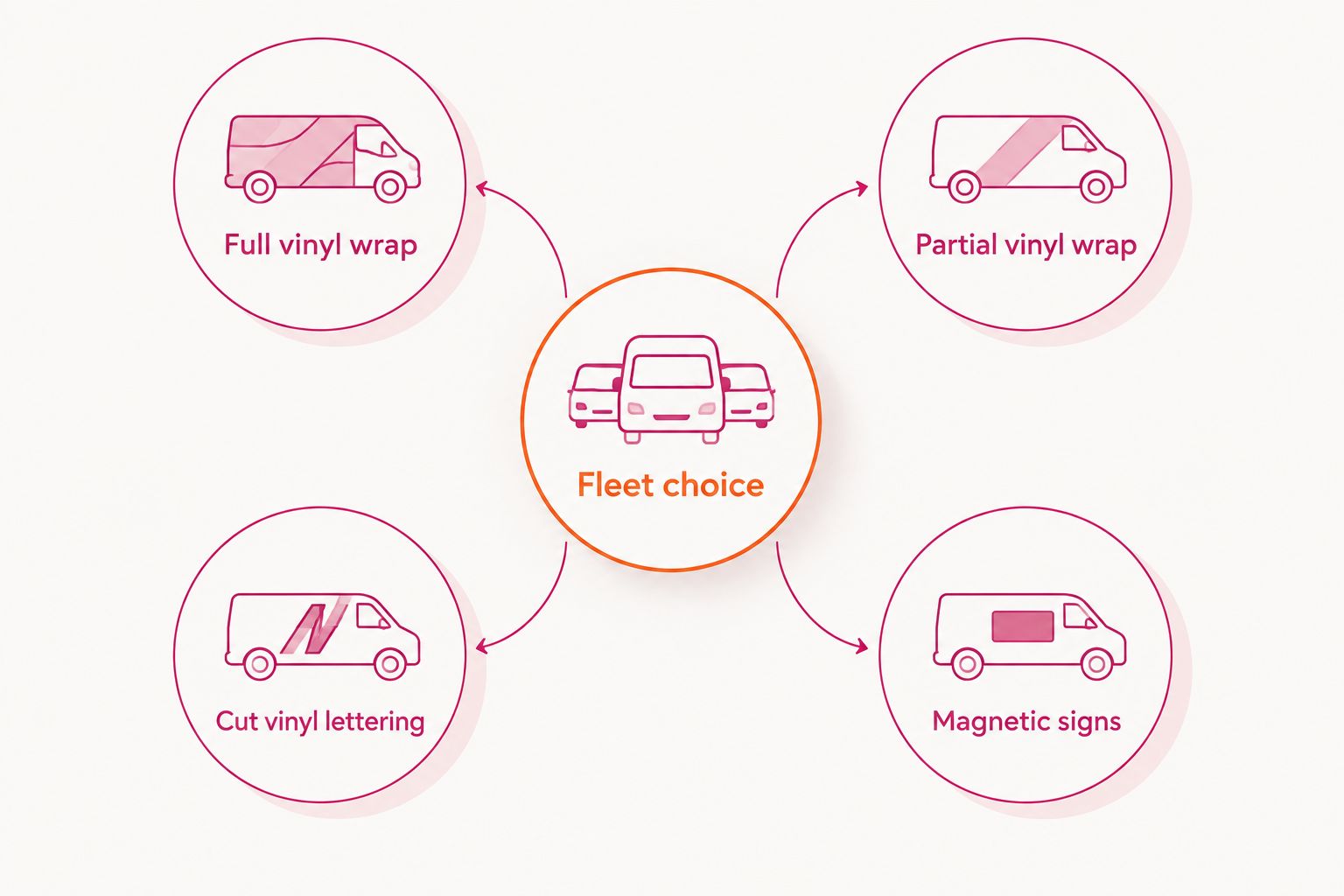
Best overall for a consistent small-business fleet: a full vinyl wrap. Best for selective coverage: a partial wrap. Best for essential business details: cut vinyl lettering. Best reversible option: magnetic signs. CoaterZ offers vinyl wraps for Florida Gulf Coast vehicle owners; confirm the scope of a fleet project before choosing a design.
- For the best vehicle wraps for business fleets, choose full vinyl wraps when consistent appearance across vehicles is the priority.
- Choose partial wraps for selected panels and cut vinyl lettering when your business name and contact details matter most.
- Magnetic signs suit reversible display, but the vehicle panel and sign must be suitable for the application.
- CoaterZ offers vinyl wraps on the Florida Gulf Coast; confirm fleet-project scope and surface condition before booking.
Why this matters for a Gulf Coast fleet
A business vehicle works as a moving identifier only when people can tell whose vehicle it is. A wrap can carry a larger design across body panels; lettering can keep the message to a name and contact detail. Those are different jobs, even when both involve vinyl. The same logic applies to a small business that also sells online: the vehicle carries the brand and the small business ecommerce platform carries the catalog, so the two should share one name and look.
Florida sun, coastal salt and road wear also make surface choice and maintenance part of the decision. Graphics do not correct damaged paint, and a clean installation does not remove the need to wash and inspect a working vehicle. Choose the smallest format that delivers the visibility your business needs, then check whether the vehicle's surface can support it.
This 2026 guide compares formats, not wrap manufacturers or unverified film specifications. CoaterZ offers vinyl wraps, but its provided service description does not establish fleet-design services, materials, coverage packages or warranties. Ask about those details for your vehicles rather than assuming every shop's vinyl-wrap service includes them.
What makes the best vehicle wraps for business fleets
Use these criteria before comparing designs. A format that works on one van can fail on a truck with different panel shapes, windows or existing graphics.
- Readable message: Identify the business first. If the name disappears into a photograph or dense pattern, the larger graphic is not doing its main job.
- Vehicle fit: Check doors, seams, handles, trim and windows before approving a layout. A design should account for the surfaces on the actual vehicles, not only a flat template.
- Fleet consistency: Decide which elements must repeat across every vehicle and which need to change with body style. Consistency does not require identical graphic placement on unlike vehicles.
- Paint condition: Inspect the finish before application. Vinyl follows the surface beneath it; a graphic should not be used to hide a condition that needs assessment.
- Maintenance access: Consider where road grime collects and how drivers will clean and inspect those areas. Creases, edges and lower panels deserve attention during routine washing.
- Change tolerance: Decide how often the business name, phone number or campaign message changes. Permanent-looking coverage is a poor match for information you expect to replace.
For a 2026 fleet refresh, get the design reviewed against each vehicle type before deciding how much of the body to cover. That check can prevent a consistent-looking proof from becoming an inconsistent set of installations.
Fleet wrap options at a glance
| Option | Best for | Standout feature | Key limitation |
|---|---|---|---|
| Full vinyl wrap | A consistent look across the vehicle body | Large design area | More body panels and edges to inspect and maintain |
| Partial vinyl wrap | Prominent graphics on selected panels | Focuses coverage where the message works best | Unwrapped paint remains visible and shapes the final look |
| Cut vinyl lettering | Clear business identification | Keeps the name and details prominent | Limited space for visual storytelling |
| Magnetic signs | Reversible identification | Can be removed without removing an applied vinyl graphic | Requires suitable panels and careful handling |
The table is a decision guide, not a durability ranking. Film choice, vehicle condition, installation details and maintenance affect the result. Confirm those points for each vehicle rather than treating one format as equally suitable for every fleet.
1. Full vinyl wrap: best for a consistent fleet identity
A full vinyl wrap is the strongest choice when the vehicle body itself carries the brand design. It gives the designer room to repeat recognizable colors, shapes and business identification across different vehicles. For a small business that wants its vehicles to read as one fleet, full coverage is the default pick.
That does not mean every panel should carry text. Place the business name where it remains readable, then let the rest of the design support it. A wrap that looks detailed while parked can become hard to understand when the vehicle is moving.
Full vinyl wrap pros:
- Gives the design substantial space across the vehicle body.
- Supports a repeated visual identity across different vehicle types.
- Can combine a prominent business name with supporting graphics.
Full vinyl wrap cons:
- Involves more seams, edges and contours to review during installation and maintenance.
- Depends on the condition of the underlying finish; it is not a repair for paint damage.
- Creates more design work when vehicles have different body shapes.
Best for: Businesses that want a coordinated vehicle appearance and can keep the core design consistent across their fleet.
CoaterZ offers vinyl wraps in the Florida Gulf Coast area. The useful question for CoaterZ is whether its vinyl-wrap service covers the specific vehicles, surfaces and design scope in your fleet; no fleet package or wrap lifespan is established in the provided information. Bring the vehicle list and proposed graphics to that discussion.
Verdict: Buy for consistent fleet identity once vehicle condition and project scope are confirmed. Hold if the business details are about to change or the paint needs assessment first.
2. Partial vinyl wrap: best for selective visual impact
A partial wrap uses selected areas of the vehicle rather than treating the entire body as the design surface. It works when a strong graphic belongs on the doors, sides or rear but the existing vehicle color can remain part of the finished look. Coverage should be decided on the actual body style.
Think about what a customer sees from the side and from behind. A design that depends on a long, uninterrupted side panel will need adjustment on a vehicle with multiple doors or prominent trim. In 2026, ask for layouts that show the design on each fleet vehicle type, not just one representative model.
Partial vinyl wrap pros:
- Concentrates the message on selected, visible areas.
- Allows existing paint color to remain part of the design.
- Gives the business more graphic space than lettering alone.
Partial vinyl wrap cons:
- Differences in vehicle color or paint condition can make fleet results less consistent.
- A poorly planned edge can make the design look unfinished.
- Limited coverage can leave a business name too small if artwork takes priority.
Best for: Fleets that need a recognizable graphic but do not need a coordinated design across the entire body.
Check how the wrapped and unwrapped areas meet. On a Gulf Coast work vehicle, include lower panels and high-contact areas in the condition review; those surfaces face routine grime and handling. Cleaning remains necessary whether a panel is wrapped or exposed.
Verdict: Buy when selected panels deliver a clear message on every vehicle. Hold until the design accounts for different paint colors and body layouts.
3. Cut vinyl lettering: best for essential business details
Cut vinyl lettering puts the business name and selected details directly on a suitable vehicle surface without a large background graphic. It is the clearest choice when identification matters more than a visual campaign. A simple layout also gives you fewer competing elements to read.
Start with the name, then decide whether a phone number or short service description earns space. For example, a layout might place the name on 2 front doors and a contact detail on 1 rear door. That is a planning example, not a required placement: door shapes, trim and available space determine the final arrangement.
Cut vinyl lettering pros:
- Keeps attention on the business name and essential information.
- Works without a full-body visual concept.
- Can be planned around the usable space on each vehicle.
Cut vinyl lettering cons:
- Offers less room for imagery or a distinctive graphic treatment.
- Small type can become difficult to read at a distance.
- An inconsistent layout across vehicles weakens fleet recognition.
Best for: Service businesses whose primary goal is to make each vehicle easy to identify.
Do not confuse simplicity with an automatic fit. Lettering still needs a suitable surface, careful placement and a maintenance plan. If a contact detail changes, inspect the affected area and discuss removal and replacement before applying new lettering over an old layout.
Verdict: Buy when the business name carries the message. Skip if the fleet needs large imagery to explain or distinguish its services.
4. Magnetic signs: best for reversible identification
Magnetic signs are removable panels rather than applied vinyl wraps. They belong in this comparison because a small business might consider them when a vehicle's business use changes. They are not a substitute for a wrap when the goal is a continuous design across body panels.
Panel suitability comes first. A magnetic sign needs a compatible, suitable surface and must be used according to the sign maker's instructions. Check the specific vehicle before designing around a door: body materials, contours, trim and panel condition affect where a sign can sit.
Magnetic sign pros:
- Allows business identification to be removed when the vehicle's use changes.
- Keeps the initial design focused on a defined panel.
- Avoids committing the entire vehicle to a graphic layout.
Magnetic sign cons:
- Is unsuitable where the intended panel cannot properly hold it.
- Needs removal, cleaning and inspection according to the maker's instructions.
- Cannot create the continuous appearance of an installed wrap.
Best for: Businesses that need reversible identification on vehicles with suitable panels.
A magnetic panel should not be the default simply because it is removable. Confirm fit and care requirements before using it on a working vehicle. If those checks fail, choose lettering or a wrap on an appropriate surface instead.
Verdict: Buy only when the vehicle and sign are confirmed compatible. Skip when panel suitability is uncertain or a coordinated wrapped appearance is the goal.
How to choose across different fleet vehicles
Fleet choice starts with the job of each vehicle, not the graphic format. A customer-facing vehicle that regularly appears alongside others benefits from recognizable repetition. A vehicle that changes roles needs a design that does not depend on business details staying fixed.
For a mixed fleet, use this order:
- List the vehicle types and photograph the surfaces available for graphics.
- Choose the 3 message elements that matter most, such as the business name, service and contact detail.
- Identify which elements must appear on every vehicle.
- Check surface condition, panel shape and the areas drivers need to clean.
- Review each design on the corresponding vehicle type before approving installation.
Keep the decision consistent in 2026 even if the vehicles are not identical. The same business name can remain prominent while the graphic changes shape to fit a van door, truck side or rear panel. Approving one proof for unlike vehicles skips the fit check that matters most.
How we ranked these options
The ranking prioritizes a clear, repeatable fleet identity, followed by flexibility of placement, readable business details and surface compatibility. Full wraps lead because they offer the largest area for a coordinated design. Partial wraps follow when selected panels are enough; lettering wins when the message should stay simple.
Magnetic signs rank last as a fleet-wrap choice because they are a different kind of graphic and depend on panel compatibility. They still have a defined use: reversible identification. This 2026 ranking makes no claim that one material lasts longer or protects paint better than another.
Which fleet wrap option should you choose?
Choose a full vinyl wrap if you want the fleet to present one consistent identity. Choose a partial wrap when the existing vehicle finish can support the design. Choose cut vinyl lettering when people mainly need to identify the business, and choose magnetic signs only when reversible use and panel compatibility both matter.
Before approving any 2026 design, ask to see how the name reads on each vehicle type and how the graphics interact with seams, handles, trim and windows. If window graphics are part of the proposal, review the applicable visibility and tint requirements rather than assuming a body-wrap design can extend onto glass unchanged.
Discuss your vehicle wrap
Bring your vehicle list and design goals to a vinyl-wrap discussion.
FAQ
What’s the best vehicle wrap for a small business fleet in 2026?
A full vinyl wrap is the best default when a consistent fleet identity is the priority. Confirm vehicle condition and review the layout on every body style before committing.
Is a partial wrap better than a full wrap for a business vehicle?
A partial wrap is better when selected panels can carry a readable message and the exposed paint fits the design. A full wrap offers more space for a coordinated appearance across the body.
Are cut vinyl letters enough for a fleet?
Cut vinyl letters are enough when clear business identification is the main goal. Keep the name prominent and check that placement works on each vehicle type.
Can magnetic signs replace a vehicle wrap?
Magnetic signs can provide reversible identification on suitable panels, but they do not create a continuous wrapped design. Check vehicle compatibility and follow the sign maker’s handling instructions.
Does a vehicle wrap repair damaged paint?
No, a vehicle wrap does not repair the surface beneath it. Have the finish assessed before approving graphics over damaged areas.
What should a Florida business ask before wrapping a fleet?
Ask how the design fits each vehicle, which surfaces are suitable and what cleaning the selected materials require. Include sun exposure, coastal grime and routine road wear in that discussion.
Does CoaterZ offer vinyl wraps for fleet vehicles?
CoaterZ lists vinyl wraps among its services, but the provided information does not confirm a dedicated fleet service. Share your vehicle types and project scope with the shop before planning an installation.
One last thing
The best-looking fleet proof is not the final test. Ask to review the business name on each actual vehicle shape before approving the 2026 design. A name placed well on one side panel can meet a door seam or handle on another; fixing that in the layout is better than discovering it during installation.