

Best overall for accessible areas that need ongoing inspection: soft-film oil undercoating. Best for enclosed seams: cavity wax. Best for repaired bare steel: epoxy primer within a compatible coating system. This 2026 undercoating and rustproofing guide ranks treatment types by surface condition and access—not by unsupported promises about service life.
- Choose undercoating and rustproofing by surface condition: soft-film oil for accessible areas, cavity wax for enclosed seams.
- CoaterZ offers undercoating services for Gulf Coast vehicle owners; match the treatment to your vehicle’s condition.
- Hard wax and rubberized coatings need sound preparation; neither replaces corrosion repair.
- Epoxy primer suits repaired bare steel within a compatible system, not inaccessible cavities.
Why this matters
Florida Gulf Coast vehicles face moisture, salt exposure, and road debris. Those conditions affect different surfaces differently: a truck frame, an enclosed rocker panel, and a painted wheel arch do not need identical treatment.
Choose the preparation and application plan before choosing the product. A coating cannot restore metal lost to corrosion, and covering loose rust makes the condition harder to inspect. For owners in Palm Harbor, Lutz, and Sarasota, CoaterZ offers undercoating services; discuss the vehicle’s existing corrosion, factory finishes, and exposure before selecting a treatment.
The practical distinction is simple. Undercoating generally protects exposed underside surfaces, while rustproofing also addresses seams and cavities where moisture collects. Some products serve both purposes, but access and application instructions determine where they belong.
What makes the best undercoating and rustproofing treatment?
Use these criteria to assess a product or installation proposal in 2026:
- Surface compatibility: Confirm suitability for bare steel, existing paint, galvanized surfaces, plastics, rubber, and factory sealers wherever the treatment will touch them.
- Preparation requirements: Check whether the product requires clean, dry, rust-free metal or explicitly permits application over a particular surface condition.
- Access and coverage: Exposed panels need different equipment and application methods from enclosed rails, seams, and rocker panels.
- Inspectability: Decide how you will detect corrosion, coating damage, or blocked drainage after application.
- Maintenance requirements: Follow the product’s inspection and renewal instructions rather than assuming protection is permanent.
- Repair compatibility: Consider future welding, mechanical work, and refinishing before coating serviceable components or repair areas.
No single treatment wins every criterion. An accessible, maintained soft film and a correctly prepared hard coating solve different problems.
Undercoating and rustproofing options at a glance
These rankings compare product categories, not named formulations. Individual products within each category have different preparation, compatibility, and application requirements.
| Rank and treatment | Best for | Standout feature | Key limitation |
|---|---|---|---|
| 1. Soft-film oil undercoating | Accessible underside areas with ongoing maintenance | Non-hardening film that can be renewed | Can transfer, collect dirt, and require renewal |
| 2. Cavity wax | Enclosed seams and hollow sections | Designed for cavity application using suitable access equipment | Coverage inside closed sections is difficult to verify |
| 3. Hard wax undercoating | Sound exposed surfaces needing a wax-based barrier | Forms a more settled protective film than non-hardening oil | Damage and deterioration still need inspection |
| 4. Rubberized undercoating | Prepared wheel-arch surfaces needing a resilient finish | Barrier coating with sound-damping properties | Poor adhesion or hidden corrosion can undermine protection |
| 5. Epoxy primer system | Repaired, accessible bare steel | Adhesive base layer within a compatible refinishing system | Requires thorough preparation and system-specific finishing |
1. Soft-film oil undercoating: best for maintainable undersides
Soft-film oil undercoating leaves a non-hardening protective film rather than a rigid shell. It suits accessible areas where you can inspect coverage and renew the treatment according to the manufacturer’s directions. Some formulations are intended to creep into seams, but confirm that capability for the specific product.
Best for: Owners who accept inspection and maintenance instead of expecting a permanent underside finish.
Soft-film oil undercoating pros:
- Accessible areas can receive localized renewal.
- The treatment does not depend on maintaining a rigid coating shell.
- It suits a maintenance-first approach to underside protection.
Soft-film oil undercoating cons:
- The film can transfer onto hands, tools, or nearby surfaces.
- Dirt accumulation can complicate inspection and service work.
- Compatibility with rubber, plastics, and existing coatings varies by formulation.
For Gulf Coast use in 2026, choose this category when continued access matters more than a dry, finished appearance. Keep application away from brakes, exhaust components, and other prohibited areas identified by the vehicle and product instructions.
Verdict: Buy for accessible areas when you will maintain the film; skip it where the product’s compatibility instructions prohibit use.
2. Cavity wax: best for enclosed seams and hollow sections
Cavity wax is intended for places such as enclosed rails, rocker panels, and overlapping seams. Suitable applicator wands distribute material beyond the opening; spraying the exterior of a panel does not treat its interior.
Best for: Vehicles whose protection plan includes enclosed metal sections rather than only visible underside surfaces.
Cavity wax pros:
- Addresses cavities that ordinary exterior spraying does not reach.
- Purpose-built application equipment helps distribute treatment internally.
- Complements an exposed-surface protection plan.
Cavity wax cons:
- Closed-section coverage is harder to verify than visible coverage.
- Access depends on the vehicle’s construction and approved openings.
- Incorrect application can obstruct drainage or contaminate nearby components.
Keep factory drains open. Do not drill access holes without checking the vehicle manufacturer’s repair guidance, and do not assume every cavity should receive the same treatment.
Cavity wax also does not repair a weakened rocker panel or frame section. If corrosion raises a structural concern, get the metal assessed before applying a coating that makes inspection more difficult.
Verdict: Buy for suitable enclosed sections with an approved access and drainage plan; hold when structural condition is unresolved.
3. Hard wax undercoating: best for sound exposed surfaces
Hard wax undercoating forms a protective wax film on exposed surfaces. Compared with non-hardening oil, it provides a more settled finish, although hardness, flexibility, and application requirements depend on the formulation.
Best for: Sound underside surfaces where you want a wax-based barrier and can inspect the finished coating.
Hard wax undercoating pros:
- Creates a barrier over correctly prepared surfaces.
- Provides visible coverage on accessible underside areas.
- Offers an alternative to a continually oily surface.
Hard wax undercoating cons:
- Application over contamination can compromise adhesion.
- Road damage can expose the substrate beneath the film.
- Renewal or repair requires preparation specified by the manufacturer.
In a 2026 protection plan, inspect seams, mounting points, and impact-prone areas rather than judging the coating by its overall appearance. An intact-looking panel does not prove that every edge remains sealed.
Do not confuse hard wax undercoating with ceramic coating for exterior paint. They address different surfaces and application requirements. Combining services is useful only when each treatment has a defined job.
Verdict: Buy for prepared, sound exposed surfaces; hold if rust, contamination, or existing-coating compatibility remains unresolved.
4. Rubberized undercoating: best for prepared wheel arches
Rubberized undercoating creates a resilient surface coating and can provide sound damping. It belongs on compatible, properly prepared areas—not as a shortcut for hiding rust beneath a uniform black finish.
Best for: Suitable wheel-arch surfaces where a resilient coating and sound damping are both relevant.
Rubberized undercoating pros:
- Provides a barrier on a compatible, prepared substrate.
- Can reduce sound transmission through treated panels.
- Gives accessible areas a visible, inspectable finish.
Rubberized undercoating cons:
- Rust beneath the coating becomes harder to assess.
- Adhesion failure can leave moisture behind a separated layer.
- Removing the coating for repairs can add work.
Ask what will happen to loose rust, old failing coatings, and contaminated seams before application. A thicker layer does not correct inadequate preparation, and coating over drainage openings creates a separate problem.
Do not assume every rubberized product accepts the same topcoat or tolerates the same operating temperature. Follow the specific technical instructions, particularly near hot components and existing finishes.
Verdict: Buy for appropriate, prepared wheel-arch surfaces; skip as a cover-up for active corrosion or failed coatings.
5. Epoxy primer system: best for repaired bare steel
Epoxy primer provides an adhesive base layer within a compatible corrosion-protection and refinishing system. It is a preparation-led option for accessible metal, not a substitute for cavity treatment or a universal spray-over-rust product.
Best for: Repaired bare-steel areas that can be cleaned, prepared, coated, and finished according to the system instructions.
Epoxy primer system pros:
- Establishes a base for a specified compatible coating system.
- Suits accessible areas undergoing repair or refinishing.
- Allows preparation and coverage to be checked before finishing.
Epoxy primer system cons:
- Surface preparation is essential to adhesion and performance.
- Mixing, application, and recoating requirements vary by product.
- It does not solve coverage inside inaccessible cavities.
In 2026, choose the complete system before starting the repair. The primer, seam treatment, and finishing layers must work together; selecting unrelated coatings independently creates avoidable compatibility questions.
Follow the product’s safety instructions and required protective equipment. For extensive corrosion, settle the repair scope before deciding which primer belongs on the resulting surface.
Verdict: Buy as part of a specified repair system; skip as a stand-alone answer for an untreated, corroded underside.
Match the treatment to the surface
Use three distinct surface categories: Exposed surfaces, Enclosed seams, and Repaired steel. Accessible undersides favor inspectable treatments; cavities require internal coverage; repaired steel needs a compatible refinishing system. One vehicle can need all three approaches without needing one product everywhere.
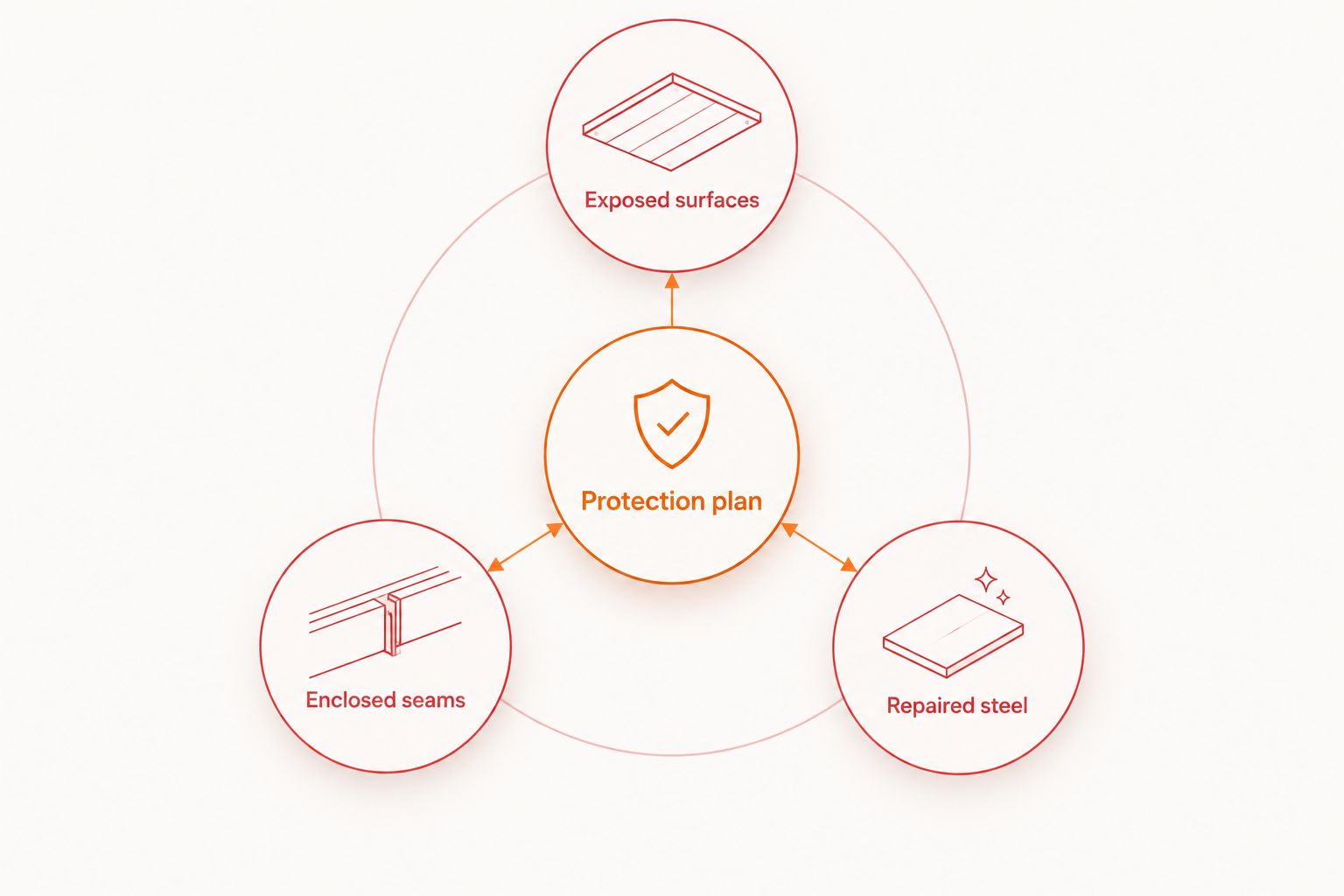
CoaterZ undercoating and rustproofing planning should start with those surface distinctions. Ask which areas the proposed treatment covers, which areas it excludes, and how the installer will preserve drainage and access for future service.
Inspect before you coat
Use a 3-stage inspection to organize the decision. This is a purchasing checklist, not a substitute for a qualified structural assessment.
- Assess condition: Identify loose rust, damaged finishes, contamination, and evidence of previous treatment. Escalate suspected structural corrosion before coating.
- Confirm compatibility: Identify the substrate and existing coating, then check the proposed product’s application instructions.
- Plan maintenance: Decide how coverage, drainage, and damage will be checked after treatment.
Request 2 inspection views where access permits: an overview showing treatment boundaries and close-up views of seams or problem areas. These make the proposed scope easier to understand than a general promise to coat the underside.
For an unfamiliar existing finish, ask whether the manufacturer specifies a compatibility test on 1 representative test area. A test area is not a guarantee; it addresses a defined compatibility question before broader application.
Plan your vehicle’s protection
Discuss surface condition, treatment coverage, and maintenance before choosing an undercoating.
How we ranked these options
The 2026 ranking prioritizes surface fit, inspectability, preparation, and maintenance. Soft-film oil takes the default position for accessible areas because this guide favors continued inspection and renewal over an assumed permanent finish.
Cavity wax wins its separate slot because exterior coverage does not address enclosed seams. Hard wax, rubberized coating, and epoxy systems follow for specific surface conditions—not because they are interchangeable alternatives with progressively weaker protection.
Which treatment should you choose?
Choose soft-film oil for a maintainable underside, cavity wax for suitable enclosed seams, and a specified repair system for repaired steel. Select hard wax or rubberized coatings only after confirming preparation and compatibility.
CoaterZ is best for Gulf Coast vehicle owners seeking professional undercoating service rather than selecting a treatment by appearance alone. Ask for a surface-specific plan, not an unsupported lifespan promise.
FAQ
What’s the best undercoating and rustproofing option in 2026?
Soft-film oil is this guide’s default for accessible underside areas that will receive ongoing inspection and maintenance. Cavity wax suits enclosed seams, while repaired bare steel needs a compatible repair coating system.
Is undercoating the same as rustproofing?
Undercoating generally protects exposed underside surfaces, while rustproofing also addresses seams and enclosed cavities. Check the proposed coverage rather than relying on the service name.
Can you apply undercoating over existing rust?
Apply a product over rust only when its instructions explicitly permit that surface condition after the required preparation. Loose rust and structural corrosion need assessment; a coating does not replace lost metal.
Is rubberized undercoating better than oil undercoating?
Rubberized undercoating and oil undercoating suit different priorities. Rubberized coatings need sound preparation and adhesion, while non-hardening oil supports a renewal-based approach but can transfer and collect dirt.
Do Florida vehicles need cavity wax as well as undercoating?
Cavity wax is relevant when the protection plan includes suitable enclosed seams or hollow sections. Exterior undercoating does not establish internal coverage, so assess cavity access and drainage separately.
How often should you inspect an undercoated vehicle?
Follow the coating manufacturer’s inspection guidance and check after damage, repairs, or exposure that affects coverage. There is no single interval that applies to every formulation and vehicle.
Does ceramic coating replace undercoating?
Exterior ceramic coating does not replace underside or cavity treatment. Choose protection according to the surface and exposure rather than assuming one service covers the whole vehicle.
One last thing
Drainage is part of protection. Before approving treatment in 2026, ask how the installer will keep drain openings clear and confirm they remain open afterward. A clean-looking finish is not the final inspection criterion.
Undercoating at our CoaterZ locations
CoaterZ offers undercoating at all three of our Florida shops. Choose the location closest to you: