

Best all-round shortlist pick: Uniden R8. Best for discreet installation: Escort Redline 360c. Best for app-assisted control: Valentine One Gen2. Best for a simpler, non-arrow setup: Uniden R4. This 2026 guide to the best radar detectors for Ka-band sensitivity ranks buying fit and documented features—not an unsupported claim that one detector wins every encounter.
- For best radar detectors ka band sensitivity research, shortlist Uniden R8 for directional alerts and adjustable filtering.
- Escort Redline 360c suits drivers who prioritize detector-detector immunity alongside directional alerts.
- Valentine One Gen2 suits drivers comfortable using a connected phone for additional controls.
- Uniden R4 suits drivers who want GPS features without directional arrows.
- Ka-band reception depends on signal strength, terrain, mounting, settings, and the radar’s operating mode.
Why this matters
A detector's useful warning distance is not a fixed specification. Hills, curves, traffic, radar orientation, and windshield construction change what reaches its antenna. An impressive straight-road demonstration does not establish how the same detector performs around a bend.
For Florida Gulf Coast driving, separate radar detection from vehicle protection. CoaterZ is best suited to the vehicle-protection side of your setup: window tint, ceramic coating, and paint protection film. Those services do not replace radar detection or change the need to obey posted limits.
Start with the best radar detectors for Florida highway driving if your main decision is highway use. Here, the narrower question is how to choose a Ka-capable detector without confusing sensitivity, directional information, and filtering.
What makes the best radar detector for Ka-band sensitivity?
Judge a 2026 shortlist against these criteria before choosing a model:
- Ka reception: Look for independent, repeatable testing at the frequencies used by police radar—not an isolated longest-distance claim.
- Response speed: Brief transmissions demand prompt detection. Sensitivity and response speed are related buying considerations, but they are not the same measurement.
- Directional information: Arrows help you interpret a detected signal. They do not create a signal that the antenna has not received.
- False-alert control: GPS lockouts and filtering reduce distractions, but aggressive settings require careful review.
- Installation compatibility: Antenna placement, windshield materials, power routing, and driver visibility affect the finished setup.
- Maintenance burden: Firmware, databases, settings, and phone connections determine how much attention the detector needs after installation.
U.S. police Ka radar commonly uses 33.8 GHz, 34.7 GHz, and 35.5 GHz. These are frequency references, not warning-distance guarantees. A detector must receive the transmitted signal before it can report an encounter.
Best Ka-band radar detectors at a glance
The feature distinctions below follow the manufacturers' published product descriptions. The order is a practical buying recommendation, not a measured sensitivity leaderboard; no comparative test results are supplied here.
| Rank and detector | Best for | Standout feature | Key limitation |
|---|---|---|---|
| 1. Uniden R8 | All-round directional awareness | Directional arrows with GPS-based alert management | More settings to understand and maintain |
| 2. Escort Redline 360c | Discreet installation | Detector-detector immunity with directional alerts | Connected features add setup considerations |
| 3. Valentine One Gen2 | App-assisted control | Directional arrows and Bluetooth connectivity | Phone-based tools add complexity |
| 4. Uniden R4 | Simpler non-arrow use | GPS-based alert management without arrows | Cannot identify signal direction with arrows |
Do not read the table as proof that the first detector receives every Ka signal earlier than the others. That conclusion requires controlled comparisons using matching settings, installation positions, radar sources, and repeated runs.
1. Uniden R8: best Ka-band detector for all-round awareness
The Uniden R8 combines radar detection, directional arrows, and GPS-based alert management. Its appeal is the amount of information available during an encounter: you can distinguish where a detected signal originates while managing recurring nuisance alerts.
Uniden R8 is the default shortlist pick if you want arrows and GPS features in the detector itself. That recommendation concerns the complete driving interface, not a claim of an independently verified sensitivity victory.
Uniden R8 pros
- Directional arrows help distinguish a signal ahead from one behind.
- GPS features support location-based handling of recurring alerts.
- Adjustable settings let you tailor band coverage and filtering.
- The detector provides a self-contained display for routine use.
Uniden R8 cons
- Its settings require more attention than a basic alert-only device.
- Incorrect lockouts or overly restrictive settings can undermine useful warnings.
- Arrows cannot overcome terrain or an absence of transmitted radar.
Best for: Drivers who want detailed directional information without making a phone the center of every encounter.
For your 2026 setup, establish sensible baseline settings before experimenting. Change one setting at a time so you can identify what changed the detector's behavior.
Verdict: Buy for an all-round feature set; do not buy on an unverified longest-range claim.
2. Escort Redline 360c: best Ka-band detector for discreet use
Escort Redline 360c combines directional alerts with detector-detector immunity. A radar-detector detector is a separate device designed to identify emissions from a radar detector; immunity concerns those emissions, not whether police radar can measure your vehicle's speed.
This distinction gives the Redline 360c a separate buying slot. Choose it when discreet operation matters to your installation requirements, rather than assuming stealth automatically means better Ka reception.
Escort Redline 360c pros
- Directional alerts help interpret a detected radar source.
- Detector-detector immunity addresses a different requirement from reception range.
- GPS-based alert management helps with recurring nuisance locations.
- Connectivity supports connected features and device upkeep.
Escort Redline 360c cons
- Connected functions introduce network and configuration considerations.
- Detector-detector immunity does not establish immunity from every enforcement method.
- Its feature set demands an installation and settings review.
Best for: Drivers who specifically want detector-detector immunity alongside directional information.
For a 2026 purchase, confirm the exact model and current manufacturer documentation. Similar names across a product family do not establish identical hardware or functions.
Verdict: Buy when discreet operation is a requirement; skip that requirement as a reason to claim greater sensitivity.
3. Valentine One Gen2: best Ka-band detector for app control
Valentine One Gen2 combines directional arrows with Bluetooth connectivity. Compatible phone tools add controls and alert-management options beyond the detector's physical interface.
This approach suits a driver who wants to configure the experience rather than leave every decision to default settings. It also makes phone compatibility and connection behavior part of the purchase decision.
Valentine One Gen2 pros
- Directional arrows identify the direction of detected signals.
- Bluetooth supports interaction with compatible phone software.
- The physical detector retains its own alert interface.
- App-assisted configuration suits drivers who want detailed control.
Valentine One Gen2 cons
- Additional phone tools mean additional setup and upkeep.
- Location-based automation depends on the chosen connected software rather than built-in GPS.
- Third-party applications require a separate compatibility review.
Best for: Drivers comfortable maintaining a phone-assisted radar-detector setup.
Check the application developer's current requirements before committing to the workflow. Do not assume that every application works on every phone, or that an application feature is built into the detector.
Verdict: Buy for app-assisted control; skip if you want minimal phone involvement.
4. Uniden R4: best Ka-band detector without directional arrows
Uniden R4 offers radar detection and GPS-based alert management without directional arrows. It belongs on the shortlist when you want location-aware alert handling but do not need the detector to indicate whether a signal is ahead or behind.
Uniden R4 is the simpler choice by interface, not a proven sensitivity downgrade. Removing arrows changes the information you receive; it does not establish the result of a controlled reception test.
Uniden R4 pros
- GPS features support management of recurring alert locations.
- Its display does not require you to interpret directional arrows.
- Adjustable detection settings support a tailored setup.
Uniden R4 cons
- Alerts do not include directional arrows.
- Multiple radar sources require more interpretation without direction cues.
- GPS features still require careful use and settings review.
Best for: Drivers who prioritize GPS-based alert management over direction information.
Before choosing the R4, decide whether arrows would genuinely change how you interpret an encounter. That is a clearer buying question than assuming every additional feature improves raw reception.
Verdict: Buy for a non-arrow setup; skip if directional awareness is essential.
Why Ka sensitivity alone does not settle the ranking
A detector can be sensitive yet receive little advance warning when a radar operator transmits only briefly. Continuous radar gives nearby vehicles more opportunity to encounter the signal; instant-on operation changes that opportunity.
Terrain adds another constraint. A hill or bend can block the path between the radar source and your vehicle, while reflections can produce changing signal strength. No detector creates reliable advance warning when there is no detectable signal reaching it.
Keep these distinctions separate:
- Ka reception: Whether the detector receives the signal.
- Response speed: How promptly it reports a brief signal.
- Directional information: Where the detected signal appears to originate.
- False-alert control: Which detections are suppressed or managed.
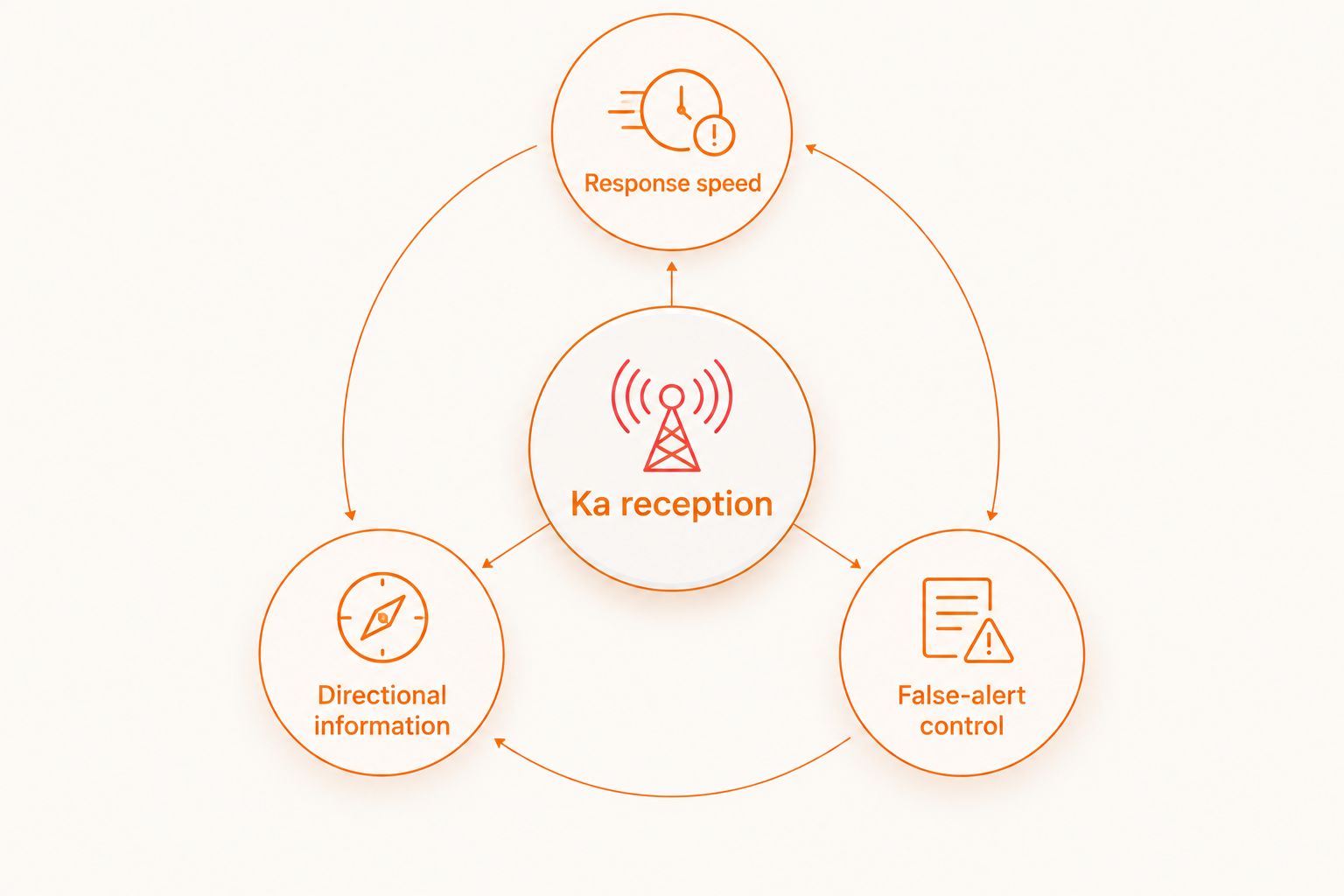
For useful comparison evidence, favor repeated runs with the same radar source and documented configurations. A video without settings, mounting details, or repeated results cannot establish a dependable sensitivity ranking.
Mounting, window tint, and Florida driving
Check your vehicle manual and the detector manufacturer's mounting instructions before choosing a windshield position. Keep the detector level, preserve its forward view, and avoid obstructing your own view of the road.
Some metallized glazing and films can affect radio-frequency transmission. Do not assume every windshield or tint construction behaves alike. Ask about the actual glass and film combination, especially if the vehicle has a designated area for electronic devices.
CoaterZ offers window tint as part of its vehicle-protection services. For a detector installation, discuss surface and signal compatibility rather than selecting tint solely by darkness or appearance.
- Keep the detector's antenna path clear.
- Route power cables away from airbags and controls.
- Use the mounting location specified for the device and vehicle.
- Follow manufacturer instructions when updating firmware or changing settings.
Florida's sun and coastal exposure also create separate paint-care decisions. Ceramic coating and paint protection film address vehicle surfaces; neither improves radar reception. CoaterZ's protection services belong in that separate maintenance plan, with specifications confirmed for the chosen treatment.
How the shortlist is ranked
The order prioritizes distinct use cases: an all-round directional interface, discreet operation, app-assisted control, and non-arrow simplicity. It follows the criteria above without assigning invented range scores or unsupported warning distances.
A defensible 2026 sensitivity ranking needs published, comparable testing. Until you have that evidence, select by documented functions and installation fit rather than treating feature count as a laboratory result.
Which Ka-band radar detector should you choose?
Choose Uniden R8 as the default shortlist pick when you want arrows, GPS features, and a self-contained interface. Choose Escort Redline 360c when detector-detector immunity is a specific requirement.
Choose Valentine One Gen2 for phone-assisted control. Choose Uniden R4 when you want GPS features but do not need arrows.
Before buying in 2026, verify firmware support, mounting compatibility, and the rules that apply to your vehicle and route. A detector provides information; it is not permission to exceed a speed limit.
FAQ
What’s the best radar detector for Ka-band sensitivity?
Uniden R8 is the all-round shortlist pick here because it combines directional arrows and GPS-based alert management. A claim that it has the highest sensitivity requires comparable independent test results, not just a feature list.
Is Uniden R8 more sensitive than Uniden R4?
Directional arrows do not prove that Uniden R8 is more sensitive than Uniden R4. Compare repeatable tests using matching radar frequencies, settings, mounting positions, and terrain.
Which Ka-band frequencies should a detector receive?
U.S. police Ka radar commonly uses 33.8 GHz, 34.7 GHz, and 35.5 GHz. Frequency coverage alone does not establish response speed or warning distance.
Do directional arrows increase radar detection range?
Directional arrows identify the direction of a detected signal; they do not increase range by themselves. Antenna design, settings, installation, and conditions determine reception.
Can window tint interfere with a radar detector?
Some metallized films and glazing can affect radio-frequency transmission. Check the actual film and windshield construction with the installer and follow the detector manufacturer’s mounting instructions.
Will a radar detector always warn me about instant-on radar?
No radar detector guarantees advance warning of instant-on radar. If no earlier transmission reaches the detector, the first alert can coincide with the radar measurement.
Does a ceramic coating help a radar detector work?
Ceramic coating is a surface-protection treatment, not a radar-reception upgrade. CoaterZ offers ceramic coating, window tint, and paint protection film, but these services address different vehicle-protection needs.
One last thing
Do not segment Ka coverage based on a detector's displayed frequency alone. Restricting the monitored range can exclude a signal you intended to receive; review the manufacturer's instructions before changing those settings.
For your 2026 setup, correct mounting and understood settings are the first job. Buying a feature-rich detector and then misconfiguring it defeats the reason you chose it.
Radar and laser detectors at our CoaterZ locations
CoaterZ offers radar and laser detectors at all three of our Florida shops. Choose the location closest to you:
- Radar and laser detectors in Palm Harbor
- Radar and laser detectors in Lutz
- Radar and laser detectors in Sarasota