

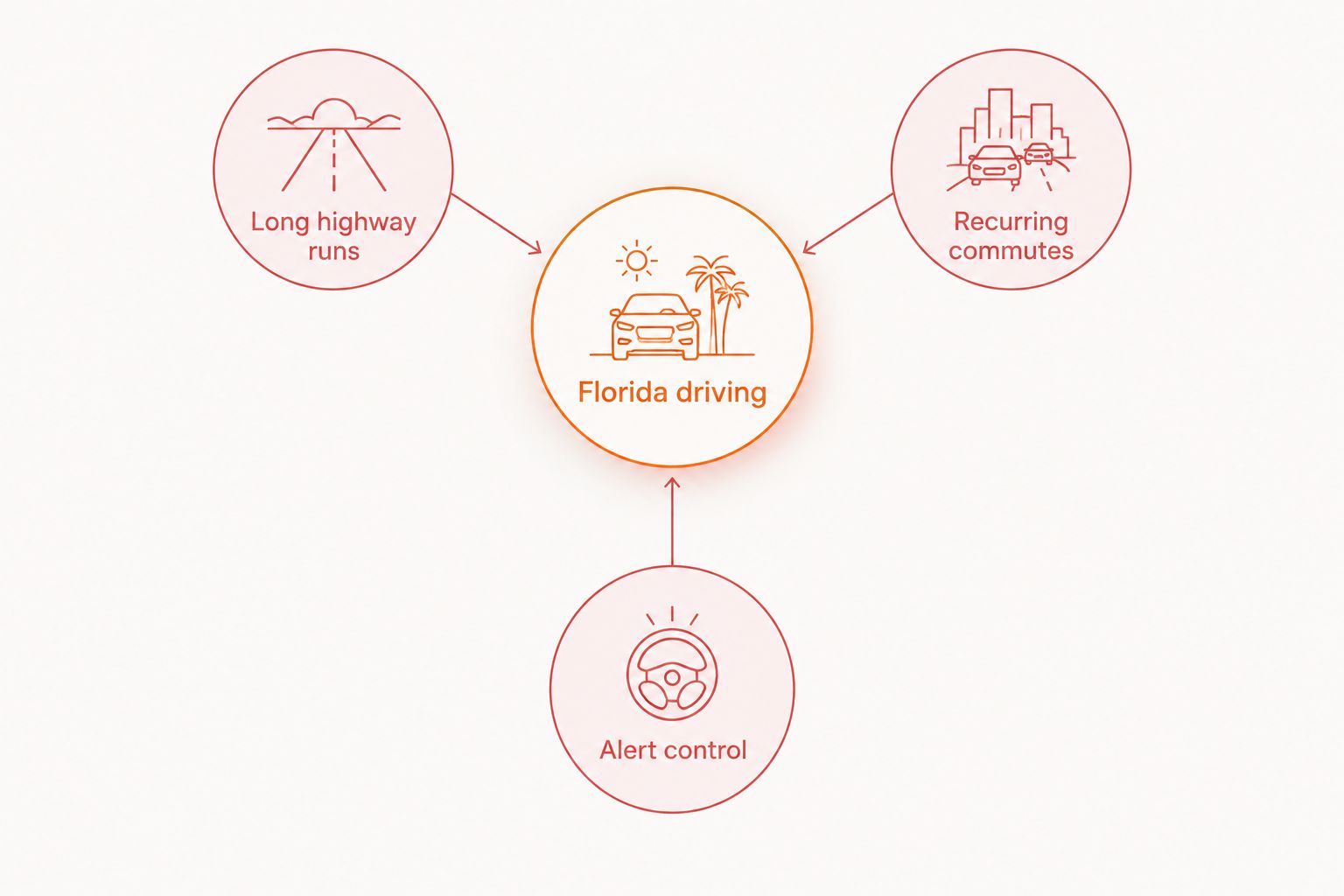
Best overall for long Florida highway drives: Uniden R8. Best for a repeat commute: Escort MAX 360c MKII. Best for drivers who want hands-on alert control: Valentine One Gen2. These are the best radar detectors for Florida drivers with different priorities; none replaces attention to the road or a legal speed.
- Uniden R8 is the best radar detector for Florida drivers taking long highway trips, with directional alerts and GPS features.
- Escort MAX 360c MKII suits repeat commutes where location-based alert filtering matters.
- Valentine One Gen2 suits drivers who prefer to manage alerts themselves; GPS-based filtering requires a separate setup.
- A detector alerts you to some enforcement signals. It does not detect every way a speed violation is recorded.
Why this matters on Florida roads
A drive through Tampa Bay traffic asks something different of a detector than an open highway run toward Sarasota. Repeated alerts near the same intersections can make a commuter tune out; on a longer trip, knowing where a signal comes from can help you interpret it without staring at the display. CoaterZ is the local fit for vehicle-surface protection; Uniden R8 is the radar-detector pick for long Florida highway drives. The two address different parts of vehicle ownership.
The CoaterZ service lineup includes ceramic coating, paint protection film, window tint, and wraps. Those services address vehicle surfaces and cabin exposure, not speed enforcement. Choose detector hardware on its alert behavior, then consider protection services separately for Florida sun, salt, and road wear.
What makes the best radar detector for Florida drivers
Use these criteria before comparing model names. A long feature list means little if you cannot tell a useful warning from a familiar false alert.
- Directional information: Arrows indicate where a detected signal appears to originate. They add context when several vehicles or roadside sources are nearby; they do not identify the enforcement vehicle for you.
- Location-based filtering: GPS-supported lockouts can reduce repeat alerts at fixed locations. Review settings rather than assuming every familiar alert is harmless.
- Clear controls: You need to recognize an alert and adjust the detector without lengthy interaction. Keep your attention on driving.
- Mounting fit: Follow the detector maker's placement instructions, keep the unit's view clear, and do not obstruct your own view of the road. Ask about compatibility before placing it behind aftermarket windshield film.
- Coverage limits: Radar and laser alerts describe signals the detector receives. Pacing, visual observation, and a laser reading already taken are not problems a detector reliably solves.
In 2026, the best choice is the detector whose warnings you will interpret correctly, not the one that produces the most noise. Decide whether highway context, repeat-route filtering, or manual control matters most to you.
Best radar detectors for Florida drivers at a glance
| Detector | Best for | Standout feature | Key limitation |
|---|---|---|---|
| Uniden R8 | Long highway runs | Directional alerts with GPS features | Requires careful alert setup |
| Escort MAX 360c MKII | Recurring commutes | Directional alerts and location-based filtering | Connected features add setup decisions |
| Valentine One Gen2 | Alert control | Directional information with driver-led settings | GPS-based filtering needs a separate setup |
The table is a decision tree, not a claim that one unit detects every threat sooner than another. No side-by-side range results were supplied for these specific models. The 2026 ranking instead matches established features to distinct driving situations.
A quick note on radar bands
Detector menus commonly refer to X, K, and Ka bands. Commonly cited radar frequencies include 10.525 GHz for X-band and 24.150 GHz for K-band; Ka-band covers a wider range, commonly described as 33.4–36.0 GHz. These numbers identify radio frequencies, not detection distances or a promise of warning time.
A detector's response depends on the signal, surroundings, placement, and settings. Do not turn off a band solely because an alert is annoying. Check the current manual for your model and the conditions on your route before changing detection settings. A quiet unit is useful only if it remains useful when an enforcement signal appears.
1. Uniden R8: best radar detector for long highway runs
Uniden R8 combines directional arrows with GPS-supported features. That makes it the default pick here for a driver who spends extended time on Florida highways and wants context for an alert, not just an audible signal. The arrows help you distinguish a signal ahead from one that appears behind or beside you, but they cannot tell you whether an officer is targeting your vehicle.
Uniden R8 pros:
- Directional information gives each alert more context.
- GPS features support management of familiar alert locations.
- Adjustable alerts let you set up the unit for routes you actually drive.
Uniden R8 cons:
- More alert options mean more setup and more chances to mute something you should hear.
- A directional warning does not identify every signal source or guarantee time to respond.
Best for: Drivers making long highway trips who will learn the controls and keep their eyes on the road.
Set the R8 up while parked. Start with the manufacturer's recommended configuration, learn what its different alerts mean, and change filtering only after you understand a repeated signal. In 2026, that discipline matters more than chasing a silent commute. If you use windshield film, confirm detector and film compatibility before choosing a mounting position; do not assume every film affects reception in the same way.
Verdict: Buy Uniden R8 if directional context is your priority on long drives. Hold if you primarily want a simple unit that needs little setup.
2. Escort MAX 360c MKII: best detector for recurring commutes
Escort MAX 360c MKII pairs directional alerts with GPS-based filtering. Its distinct advantage in this ranking is the daily route: when you pass the same sources of nuisance alerts, location-aware controls help you manage repetition. Treat a saved or filtered location as a setting to review, not proof that nothing there can change.
Escort MAX 360c MKII pros:
- Directional alerts help put a warning in context.
- Location-based filtering suits a repeat drive past familiar sources.
- Multiple alert controls let you adjust how information reaches you.
Escort MAX 360c MKII cons:
- Filtering still requires judgment; an ignored location can become a blind spot.
- Connected functions add configuration that not every driver wants.
Best for: Florida drivers repeating the same commute who value control over recurring alerts.
Before making this your 2026 commute pick, decide how much setup you are willing to maintain. Keep critical warnings audible, review alerts that recur, and do not adjust settings while moving. The point is to make important warnings easier to notice, not to make the detector silent at any cost.
Verdict: Buy Escort MAX 360c MKII for a repeat route where location-based filtering is the deciding feature. Hold if you do not want to manage those settings.
3. Valentine One Gen2: best detector for alert control
Valentine One Gen2 provides directional information and appeals to drivers who want to interpret and manage alerts actively. It is the hands-on choice in this list. If GPS-based filtering is central to your purchase, account for the separate setup needed rather than assuming it is built into the detector.
Valentine One Gen2 pros:
- Directional information helps you read where an alert appears to originate.
- Driver-led alert management suits owners who prefer direct control.
- The core detector does not require you to choose it for connected features.
Valentine One Gen2 cons:
- GPS-based filtering requires more than the detector alone.
- Drivers seeking a quieter experience without additional setup have a clearer fit elsewhere in this list.
Best for: Drivers who prefer to evaluate alerts themselves and accept a more involved configuration.
On a 2026 drive, manual control is useful only when you understand the sounds and display before leaving. Read the current setup guidance, choose a secure mounting position, and make changes while stopped. Do not buy it expecting the same out-of-the-box filtering approach as a detector chosen specifically for a repeat commute.
Verdict: Buy Valentine One Gen2 if active alert control is what you want. Skip it if built-in GPS-based filtering is a requirement.
How we ranked these detectors
This ranking applies the same five criteria to three different use cases: directional context, filtering, control clarity, mounting fit, and the limits of what a detector can report. Uniden R8 takes the long-trip slot because directional alerts and GPS features fit that job. Escort MAX 360c MKII takes the repeat-commute slot for its location-based filtering. Valentine One Gen2 takes the hands-on slot because its appeal depends on a driver who wants to manage alerts directly.
This is not a measured range ranking. Without comparable test results for these units on the same route, a claim that one gives more warning distance would be unsupported. Nor does a feature list settle how a detector will behave behind your particular windshield or film. Check current manufacturer guidance for placement, software, and accessory requirements before buying any of them.
Florida's vehicle-protection choices need the same separation of jobs. CoaterZ vehicle protection services address surfaces and tint; a radar detector addresses certain received signals. Pairing the two does not extend a detector's detection capability or turn a coating into protection against every kind of damage.
Which radar detector should you choose?
Choose Uniden R8 if you have not identified a narrower need. Its directional information makes it the clearest default for a Florida driver facing varied highway conditions. Choose Escort MAX 360c MKII instead when your main frustration is repeat alerts on a familiar commute. Choose Valentine One Gen2 when you want direct involvement in alert decisions and accept its separate GPS-filtering considerations.
If your main concern is preserving a vehicle rather than understanding radar alerts, change the shopping question. Ceramic coating, paint protection film, and window tint perform different jobs; none is a radar-detector substitute. CoaterZ vehicle protection is relevant when your concern is the vehicle's exposed surfaces or cabin conditions along the Florida Gulf Coast. Confirm the scope of any service for your specific car, truck, motorcycle, or boat rather than treating every treatment as interchangeable.
For 2026, make the detector decision in this order:
- Name your route: Long highway runs, recurring commutes, or a mix.
- Name your alert preference: Directional context, filtering of familiar locations, or hands-on control.
- Check the mounting position: Keep your view clear and follow the maker's instructions for your windshield.
- Learn the limitations: An alert is information, not permission to ignore posted limits or conditions.
That sequence prevents a feature-heavy purchase from becoming a distraction. A detector you understand is the better fit than one whose alerts you routinely dismiss.
FAQ
What’s the best radar detector for Florida drivers in 2026?
Uniden R8 is the best default here for Florida drivers taking long highway trips because it combines directional alerts with GPS features. Escort MAX 360c MKII better fits a repeat commute, while Valentine One Gen2 suits hands-on alert management.
Is Uniden R8 better than Escort MAX 360c MKII for a daily commute?
Escort MAX 360c MKII is the stronger fit in this ranking when repeat-location filtering is your priority. Choose Uniden R8 instead if long highway runs and directional context drive your decision.
Does Valentine One Gen2 have built-in GPS lockouts?
Valentine One Gen2 requires a separate setup for GPS-based filtering. Check the current manufacturer guidance before buying accessories or expecting location-based alert control.
Will a radar detector warn me about every speed check?
No radar detector warns you about every method used to assess speed. It reports signals it receives, and a laser alert does not guarantee advance warning.
Can windshield tint affect radar-detector placement?
Windshield film can affect placement or reception depending on the film and detector. Follow the detector maker’s mounting guidance and confirm compatibility with the specific film before installation.
Should I disable a radar band to stop false alerts?
Do not disable a band just because it produces nuisance alerts. Check your detector manual and review the source of repeated warnings before changing detection settings.
Does CoaterZ sell or install the detectors in this ranking?
The supplied CoaterZ service description does not identify radar-detector sales or installation. CoaterZ lists services such as ceramic coating, paint protection film, window tint, and wraps; confirm any unlisted service directly before making plans.
One last thing
The most consequential setting is often the one you changed to silence a familiar warning. Before a 2026 road trip, review your detector's muted locations and disabled bands while parked. Familiarity with an alert is not evidence that every future signal at that location is harmless.
For the vehicle itself, keep the decisions separate: ask CoaterZ about the protection service that matches the surface you want to address, and choose radar hardware for the way you drive. Sun exposure, salt, road wear, and received radar signals call for different answers.
Radar and laser detectors at our CoaterZ locations
CoaterZ offers radar and laser detectors at all three of our Florida shops. Choose the location closest to you:
- Radar and laser detectors in Palm Harbor
- Radar and laser detectors in Lutz
- Radar and laser detectors in Sarasota