

The best ProTint Orlando alternative in 2026 is CoaterZ if you want window tint alongside paint protection services in Tampa Bay; a dedicated tint installer is the better fit if your project is limited to glass. Compare the treatment, installation scope, and maintenance requirements—not just the name above the workshop door.
- For protint orlando alternatives, CoaterZ fits Tampa Bay drivers comparing window tint, ceramic coating, and paint protection film.
- Choose a dedicated tint installer for a glass-only project; compare film specifications and legal compliance.
- Ceramic coating and paint protection film address different problems; neither replaces window tint.
- Keep ProTint Orlando on your shortlist when its proposed installation matches your vehicle and protection goals.
Why this matters
A search for ProTint Orlando alternatives should end with the right installation, not a longer list of shop names. For drivers in Palm Harbor, Lutz, Sarasota, and the Florida Gulf Coast, the decision starts with what needs protection: glass, painted panels, cargo surfaces, or the underside of the vehicle.
Florida sun, coastal salt exposure, and road debris create different maintenance problems. Window tint addresses glass-related comfort and light transmission; paint protection film provides a physical barrier over covered surfaces. Ceramic coating helps with surface care, but it is not a substitute for impact protection.
Choose the protection method before choosing the installer. That order keeps you from buying a treatment that sounds impressive but does not address your main concern.
ProTint Orlando alternatives at a glance
For a 2026 comparison, separate named providers from service approaches. The options below show which type of installation to evaluate, without treating every workshop as interchangeable.
| Provider or approach | Best for | Standout distinction | How to compare with ProTint Orlando |
|---|---|---|---|
| ProTint Orlando | Keeping your existing reference point in the comparison | The specific installation proposal you are considering | Use the same vehicle, surfaces, and acceptance criteria for every proposal |
| CoaterZ | Tampa Bay owners considering tint and exterior protection | Offers window tint, ceramic coating, PPF, and vinyl wraps | Compare the relevant service scope, preparation, and aftercare |
| Dedicated window-tint installer | A glass-only project | A focused tint installation brief | Compare film specifications, finished glass transmission, and workmanship |
| PPF-focused installer | Drivers prioritizing paint protection from road debris | Physical film over specified panels | Compare coverage boundaries, edge treatment, and surface compatibility |
| Vehicle-wrap installer | Owners prioritizing a color or appearance change | Vinyl applied to selected exterior surfaces | Compare finish, coverage, substrate condition, and removal requirements |
No single row wins every use case. A tint-only comparison needs different evidence from a full exterior-protection comparison, even when the work concerns the same vehicle.
1. CoaterZ: best for coordinated vehicle protection
CoaterZ is the best ProTint Orlando alternative for Tampa Bay owners who want to compare window tint with paint protection services. Its stated services include ceramic coating, paint protection film, vinyl wraps, and window tint for vehicle owners in the Florida Gulf Coast area. That makes it a relevant option when your decision extends beyond glass.
Start with your priorities rather than a predetermined combination. A highway-driven car with vulnerable front panels presents a different brief from a family SUV whose owner primarily wants improved cabin comfort.
Where CoaterZ shines
- Offers several relevant protection services through one service business.
- Serves the Tampa Bay and Florida Gulf Coast audience addressed by this comparison.
- Includes options for cars, trucks, motorcycles, and boats, with marine PPF among its stated services.
- Lets you evaluate glass protection and exterior surface treatments as separate decisions.
Where CoaterZ falls short
- Its broader service range is unnecessary if you only need a narrowly defined glass installation.
- A ceramic coating does not replace PPF where physical impact protection is the priority.
- Different vehicle surfaces require different specifications; automotive paint, glass, and marine applications are not interchangeable.
Head-to-head decision criteria
| Dimension | CoaterZ | ProTint Orlando comparison requirement |
|---|---|---|
| Service match | Window tint, ceramic coating, PPF, and vinyl wraps are stated services | Match the proposal to the treatment you actually need |
| Vehicle match | Serves car, truck, motorcycle, and boat owners | Confirm suitability for your specific vehicle and surfaces |
| Regional fit | Serves Tampa Bay and the Florida Gulf Coast | Consider installation access and practical aftercare visits |
| Acceptance standard | Define preparation, coverage, and inspection requirements | Apply those same requirements to the competing proposal |
Best for: Tampa Bay vehicle owners considering more than one protection method.
Verdict: Buy the service that matches your surface and exposure—not an assumed all-purpose protection package.
2. Dedicated window-tint installer: best for glass-only work
A dedicated window-tint installer is a sensible alternative when the entire project concerns glass. Keep the brief focused: which windows need treatment, what visibility you want to retain, and which film specifications support your comfort goals.
Do not use darkness as a shortcut for performance. Visible light transmission describes how much visible light passes through the glazing system; it does not, by itself, establish heat rejection.
Where this approach shines
- Keeps the comparison focused on film, glass, and installation quality.
- Makes it easier to compare equivalent windows and film specifications.
- Avoids mixing unrelated paint treatments into a glass-only decision.
Where this approach falls short
- Tint does not protect painted panels from stone chips.
- A tint-focused brief leaves paint condition and exterior protection unresolved.
- A darker appearance does not establish better thermal performance.
Best for: Drivers satisfied with their paint protection who only want to address glass.
Verdict: Buy for a glass-only brief; hold if you also need exterior protection planning.
3. PPF-focused installer: best for exposed painted panels
A PPF-focused installer is the relevant alternative when road debris is the main concern. Paint protection film is a physical layer over the surfaces it covers; uncovered panels remain outside that protection.
Ask the installer to identify coverage on the vehicle itself. Terms such as front-end protection are less useful than a panel-by-panel scope that explains edges, seams, and exclusions.
Where this approach shines
- Directly addresses physical protection of covered painted surfaces.
- Allows you to prioritize exposed panels instead of treating every surface alike.
- Creates a clear inspection brief around coverage and finish.
Where this approach falls short
- Film does not make paint damage-proof.
- Existing paint defects and compromised finishes require assessment before installation.
- Partial coverage leaves a protection boundary that you need to understand.
Best for: Drivers whose main concern is damage to exposed painted panels.
Verdict: Buy for defined impact-protection needs; skip as a substitute for window tint.
4. Vehicle-wrap installer: best for an appearance change
A vehicle-wrap installer belongs on your shortlist when changing the vehicle's appearance is the main objective. Vinyl wraps and PPF are different categories; do not assume a color-change wrap provides equivalent physical protection.
Where this approach shines
- Centers the project on a chosen exterior appearance.
- Supports a surface-by-surface discussion of finish and coverage.
Where this approach falls short
- Existing paint condition affects installation and later removal considerations.
- An appearance-led wrap does not replace a clearly specified protection-film installation.
Best for: Owners prioritizing a new exterior look rather than a glass upgrade.
Verdict: Buy for appearance; hold if protection is the primary objective.
Match the treatment to the surface
The strongest 2026 protection plan assigns each treatment a specific job. Avoid treating ceramic coating, PPF, window tint, and vinyl wrap as different grades of the same product.
| Treatment | Main purpose | Important limitation | Maintenance question |
|---|---|---|---|
| Window tint | Control light transmission through glass | Does not protect body panels | Which cleaners and curing instructions apply? |
| Paint protection film | Add a physical barrier over covered panels | Does not cover unprotected areas | How should edges and contamination be maintained? |
| Ceramic coating | Support surface protection and easier cleaning | Does not prevent stone-chip damage | Which washing and decontamination methods apply? |
| Vinyl wrap | Change exterior appearance | Is not equivalent to impact-focused PPF | How should the finish be cleaned and inspected? |
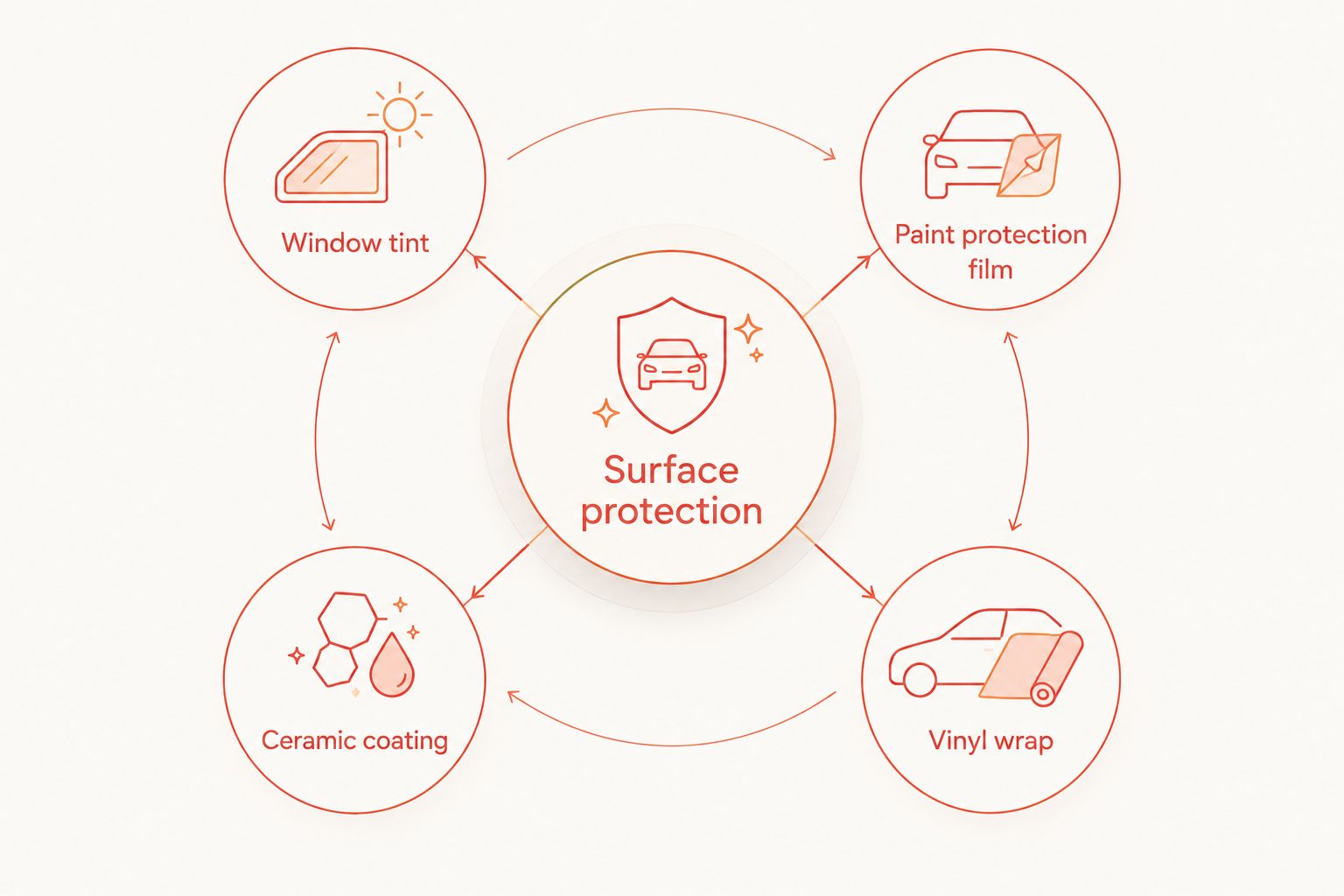
Salt residue still needs removal, even on a protected vehicle. Likewise, a coated vehicle still needs appropriate washing, and film edges need care rather than aggressive scrubbing. Follow the instructions for the actual installed material, not a generic routine copied from another treatment.
For trucks, assess bedliners and undercoatings separately. Cargo abrasion and underside exposure are different problems from glass performance or painted-panel protection; one service should not stand in for the others.
Compare tint legally, not just visually
For your 2026 tint decision, compare the finished glass-and-film combination. Existing factory glass affects visible light transmission, so a film's nominal shade is not the final legal measurement.
Florida Statutes sections 316.2953 and 316.2954 set these visible-light-transmission thresholds for covered windows, subject to statutory exceptions:
- Front side windows: at least 28% visible light transmission.
- Rear side windows and rear window on passenger cars: at least 15% visible light transmission.
- Rear side windows and rear window on multipurpose passenger vehicles: at least 6% visible light transmission.
These figures are legal thresholds, not heat-rejection ratings. Vehicle classification, reflectance restrictions, windshield rules, and exemptions also matter; have the installer confirm the applicable requirements for your vehicle.
Use the guide to window tint shades ranked by heat rejection to frame the performance discussion. Ask for comparable specifications rather than accepting a darker sample as proof of a cooler cabin.
Why people switch from ProTint Orlando
The practical reasons to choose an alternative are changes in your own requirements—not unsupported claims about another shop's workmanship. Use these decision triggers when comparing ProTint Orlando with a Tampa Bay option:
- Your project extends beyond glass. You also want to evaluate PPF, ceramic coating, or a wrap.
- Your vehicle use changes the priority. Road-debris exposure makes covered-panel protection a separate concern.
- Your ownership needs require local follow-up. Choose an installation arrangement that makes aftercare and inspection practical.
- Your preferred appearance changes. A wrap project needs a different specification from a tint installation.
None of these triggers proves that one provider performs better than another. They establish when a different service scope is the better fit.
What to ask before choosing an installer
Use the same questions for every 2026 proposal. A precise brief makes the comparison useful without relying on broad promises.
- Preparation: What cleaning, correction, or surface assessment does the work include?
- Compatibility: Is the proposed material appropriate for factory paint, repainted panels, existing film, or the relevant glass?
- Coverage: Which panels or windows are included, and where does coverage stop?
- Installation finish: How will seams, edges, and existing defects be handled?
- Aftercare: What curing, washing, and cleaning instructions apply to the installed material?
- Written terms: What do the actual warranty documents cover and exclude?
For marine work, specify the substrate and exposure separately. A boat application should not inherit assumptions from an automotive installation simply because both involve protective film or coating.
Compare your vehicle protection options
Explore tint, ceramic coating, PPF, and wraps for your vehicle’s protection goals.
When staying with ProTint Orlando is right
Keep ProTint Orlando in consideration when its proposed work matches your actual brief. If you want a glass-only installation, broader exterior services are not automatically an advantage.
Stay focused on evidence: a suitable material, a clear scope, applicable legal compliance, and usable aftercare instructions. Changing providers without improving that fit adds another decision without solving the original problem.
FAQ
What’s the best ProTint Orlando alternative for Tampa Bay drivers?
CoaterZ is the best fit for Tampa Bay drivers comparing window tint with ceramic coating, paint protection film, and vinyl wraps. For a glass-only project, compare dedicated tint installers using the same film and installation requirements.
Should I choose a tint shop or a paint protection installer?
Choose a tint installer for glass and a paint protection installer for covered exterior surfaces. If you need both, keep the specifications separate so each treatment addresses the correct problem.
Is darker window tint better at rejecting heat?
Darker tint is not, by itself, evidence of better heat rejection. Compare film performance specifications and the finished glass system rather than appearance alone.
Does ceramic coating replace paint protection film?
No, ceramic coating does not replace paint protection film for stone-chip protection. PPF adds a physical layer over covered surfaces, while ceramic coating supports surface care and cleaning.
What tint percentage is legal in Florida?
Florida’s general thresholds require at least 28% visible light transmission on front side windows, at least 15% on passenger-car rear windows, and at least 6% on multipurpose passenger-vehicle rear windows. Other restrictions and statutory exceptions apply, so confirm the vehicle classification and finished glass measurement.
Can I put protection film or a wrap over repainted panels?
Repainted panels require an assessment before film or wrap installation. Paint condition, adhesion, and material compatibility affect whether the proposed installation is appropriate.
When should I stay with ProTint Orlando?
Stay with ProTint Orlando when its proposed installation matches your vehicle, treatment goals, and aftercare needs. A different provider is useful when it offers a better match to your specific service brief, not simply a broader list of services.
One last thing
Ask for a coverage map, not just a treatment name. Have the installer mark the included panels or windows and explain the boundaries. That simple step separates protection you are buying from protection you are merely assuming.
Window tint at our CoaterZ locations
CoaterZ offers window tint at all three of our Florida shops. Choose the location closest to you: