

Best overall: a professionally installed full-front PPF kit. Best for localized wear: a contact-point kit. Best for extensive coverage: a full-body installation. This 2026 guide ranks the best PPF kits for daily drivers by coverage and installation approach—not by unsupported claims about film brands.
- The best PPF kits for daily drivers start with full-front coverage for road-facing paint.
- CoaterZ suits Florida Gulf Coast owners seeking professional paint protection film installation rather than a DIY kit.
- Choose contact-point protection for door cups, entry areas, and loading surfaces—not highway stone impacts.
- Compare exact panel coverage, paint condition, installation details, and care requirements before choosing a kit.
Why this matters
A daily-driven car encounters different hazards on different surfaces. Highway debris strikes forward-facing panels; shoes, fingernails, and luggage mark contact areas. Florida sun and coastal salt exposure also make cleaning and material care part of the protection decision.
CoaterZ is best for Florida Gulf Coast owners seeking professionally installed paint protection film rather than a DIY kit. For owners in Palm Harbor, Lutz, and Sarasota, CoaterZ offers PPF installation alongside other vehicle protection services. Choose the coverage around your driving and parking habits, not around a package name.
Here, a kit means a defined coverage configuration. It does not mean a named product sold by the shop, and coverage labels are not standardized across installers. In 2026, request a written panel list before comparing proposals.
What makes the best PPF kits for daily drivers
Judge a proposal against these criteria before choosing the extent of coverage:
- Impact coverage: Identify which forward-facing painted surfaces receive film. A front bumper alone is not full-front coverage.
- Panel continuity: Check whether the hood and fenders receive complete or partial coverage. Partial panels introduce visible film boundaries.
- Surface compatibility: Disclose repainted panels, chips, peeling clear coat, textured trim, and existing treatments before installation.
- Installation detail: Ask how the installer handles edges, complex curves, sensor openings, and areas where a pattern leaves exposed paint.
- Maintenance clarity: Get film-specific washing, drying, contamination removal, and aftercare instructions. PPF does not eliminate maintenance.
Use 3 coverage checks on every proposal: the panel list, the boundary placement, and the exclusions. These checks distinguish the protection you expect from the protection you actually receive.
PPF kit options at a glance
The ranking below separates five use cases. It does not compare proprietary film formulations or claim that every installer offers each configuration.
| Rank and option | Best for | Standout feature | Key limitation |
|---|---|---|---|
| 1. Full-front PPF | Regular highway commuting | Complete forward-facing panel coverage when specified | Leaves doors, rear panels, and other surfaces outside the package |
| 2. Partial-front PPF | Drivers accepting limited front coverage | Protects selected front-facing areas | Film boundaries remain across partially covered panels |
| 3. Contact-point PPF | Repeated entry and loading wear | Places film at specific touch and abrasion zones | Does not replace front-end impact coverage |
| 4. Full-body PPF | Owners prioritizing broad painted-panel coverage | Extends protection beyond the front end | Requires more extensive installation and surface assessment |
| 5. DIY pre-cut PPF | Experienced hands-on owners working on manageable areas | Vehicle-specific patterns avoid freehand shaping where supplied | Fit and finish depend on preparation and installation skill |
Full-front and partial-front kits address the same general hazard with different coverage boundaries. Contact-point film addresses a different problem entirely. Full-body coverage expands the protected area, while DIY pre-cut film changes who performs the installation.
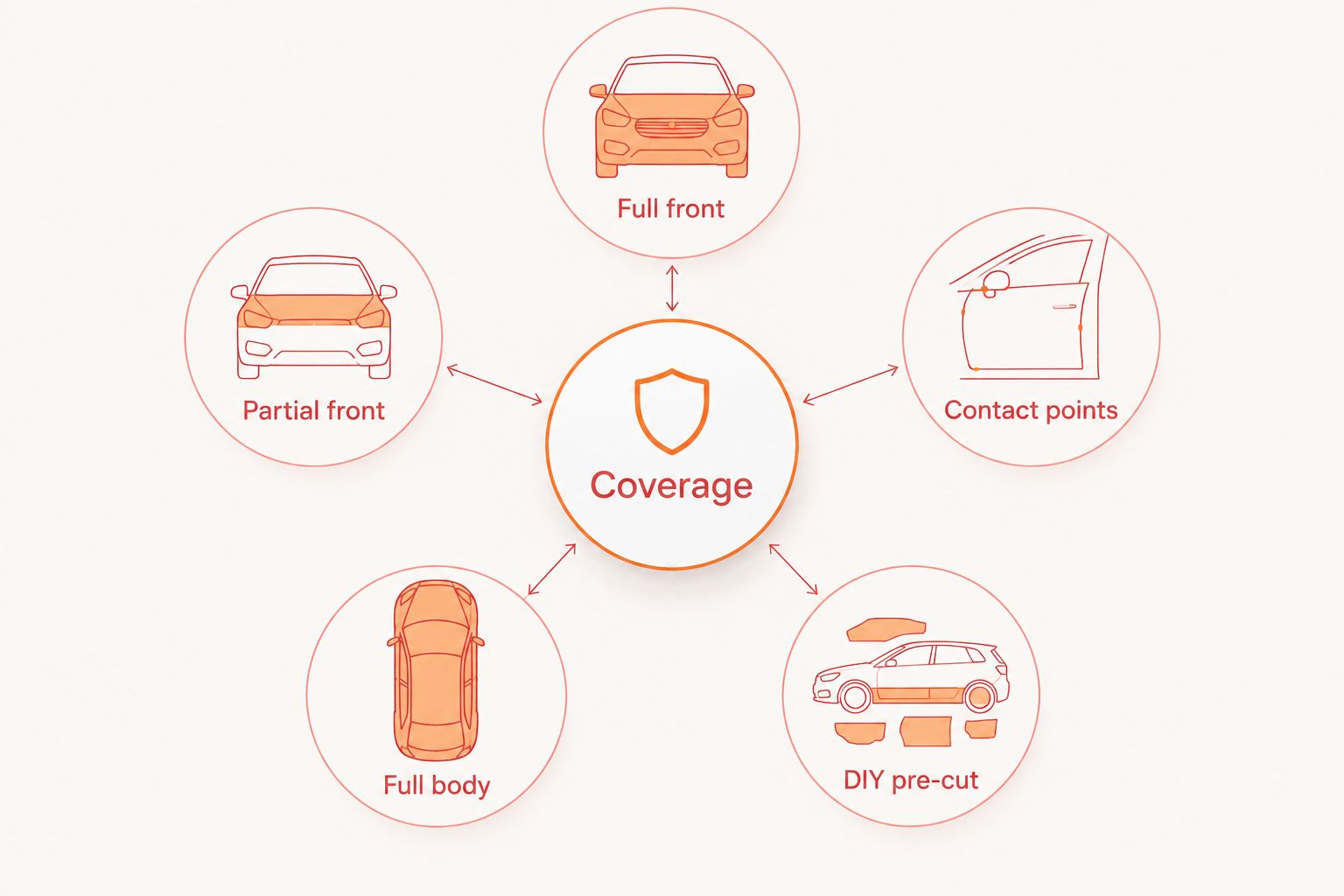
1. Full-front PPF: best for regular highway commuting
A full-front configuration typically covers the front bumper, complete hood, complete front fenders, and mirror caps. Treat that list as a specification to confirm, not a universal package definition. Other forward-facing surfaces need separate discussion.
For a daily driver that spends substantial time on highways, this is the default recommendation. Complete hood coverage avoids a film boundary across the hood, while complete fender coverage keeps protection from stopping partway up those panels.
Full-front PPF pros:
- Concentrates protection on road-facing paint.
- Avoids partial-hood and partial-fender boundaries when complete panels are included.
- Leaves a clear path to add contact-area coverage later.
Full-front PPF cons:
- Does not protect every painted panel on the vehicle.
- Complex bumper shapes and edges still require installation decisions.
Best for: Commuters who want front-end protection without covering the entire car.
Before approving a 2026 full-front proposal, identify exclusions such as pillars, roof edges, lower rocker panels, and lights. Do not assume that a nearby surface is included because the package name sounds complete. Ask separately whether film is appropriate for lights or non-painted components.
Verdict: Buy full-front coverage as the default for a highway-driven daily car.
2. Partial-front PPF: best for drivers accepting limited coverage
Partial-front configurations protect selected front areas, often including the bumper and sections of the hood or fenders. The exact pattern determines where protection stops. Confirm that boundary on your vehicle before installation.
There are 2 hood coverage options in this comparison: complete-panel coverage and partial-panel coverage. That distinction changes appearance and the amount of exposed paint; it is not merely a difference in package wording.
Partial-front PPF pros:
- Focuses film on selected forward-facing areas.
- Limits the installation scope compared with complete-panel coverage.
- Makes the protected and unprotected areas straightforward to identify.
Partial-front PPF cons:
- Leaves part of the hood or fenders exposed.
- Creates a film edge across the painted panel that requires careful cleaning.
Best for: Owners comfortable with a visible coverage boundary and a deliberately limited protection area.
Check the proposed boundary under lighting that reveals reflections. If a line across the hood will bother you, resolve that before installation. Extending the film later changes the work involved and does not turn the original partial installation into a seamless complete panel.
Verdict: Hold until you have seen and accepted the exact coverage boundary.
3. Contact-point PPF: best for entry and loading wear
Contact-point protection places film where people and objects repeatedly touch painted surfaces. Examples include painted door cups, suitable entry surfaces, and the painted loading edge near the trunk. Material compatibility and the actual pattern determine which areas are appropriate.
This configuration is useful when your main complaint is localized wear rather than front-end chips. It also complements a full-front installation because the two configurations protect different parts of the car.
Contact-point PPF pros:
- Targets specific areas you use every day.
- Adds protection outside a front-end package.
- Lets you choose coverage around your own loading and entry habits.
Contact-point PPF cons:
- Leaves forward-facing panels unprotected unless separately covered.
- Is not automatically suitable for textured plastics, rubber, or damaged paint.
Best for: Owners who repeatedly load luggage, handle door recesses, or scuff painted entry areas.
Walk around the vehicle and demonstrate the contact points instead of requesting a generic accessory kit. A door opening that looks suitable in a catalog can contain mixed materials on the actual car. The installer needs to distinguish painted surfaces from trim before recommending film.
Verdict: Buy targeted contact-point protection for documented wear areas; skip it as a substitute for front-end PPF.
4. Full-body PPF: best for broad painted-panel coverage
Full-body PPF extends coverage to painted panels beyond the front end. Doors, rear quarters, and other suitable exterior painted surfaces become part of the installation discussion. Even this label needs a written scope: panel coverage does not mean every edge, recess, or trim component receives film.
Choose this configuration when broad coverage is your priority. PPF does not make a vehicle immune to dents, deep impacts, or every scratch, and wrapping more panels does not remove those limitations.
Full-body PPF pros:
- Protects painted surfaces outside the highway-impact zone.
- Reduces the number of intentionally exposed exterior painted panels.
- Supports a panel-by-panel discussion of edges and coverage exclusions.
Full-body PPF cons:
- Expands the amount of preparation and installation work.
- Requires close assessment of repainted or compromised surfaces throughout the vehicle.
Best for: Owners who specifically want broad exterior painted-panel protection, rather than front-end coverage alone.
For a 2026 installation, discuss existing damage before selecting this scope. Film is a protective layer, not a repair for failing clear coat or a substitute for paint correction. Ask which marks need correction, which will remain visible, and which surfaces should not receive film.
Verdict: Buy full-body coverage when broad protection is an explicit goal; skip it if front-end coverage meets your needs.
5. DIY pre-cut PPF: best for experienced hands-on owners
A pre-cut kit supplies shaped film pieces intended for a particular vehicle or panel. Pattern compatibility matters: model year, body style, bumper design, and equipment differences can change the fit. Confirm those details with the kit supplier.
Pre-cut does not mean installation-free. You still need suitable paint, a clean work area, the specified installation materials, and the ability to position film without trapping contamination or damaging it.
DIY pre-cut PPF pros:
- Provides defined shapes instead of requiring every piece to be shaped from bulk film.
- Lets experienced owners handle manageable individual areas.
- Makes the supplied coverage pattern available for inspection before fitting.
DIY pre-cut PPF cons:
- Does not compensate for poor preparation or installation technique.
- Complex bumper contours are demanding surfaces for an inexperienced installer.
Best for: Experienced owners who understand film installation and accept responsibility for the finish.
For a first project, choose a simple, accessible surface rather than making a complex bumper your learning exercise. Follow the supplier’s instructions instead of improvising solution mixtures or stretching methods. Stop if paint condition or pattern compatibility is uncertain.
Verdict: Buy only when your installation skills match the panel; skip DIY for difficult shapes without that experience.
How the ranking works
This ranking prioritizes coverage that matches the stated use case, followed by panel continuity, surface compatibility, installation difficulty, and maintenance. It compares 5 coverage configurations, not test results for named films.
Full-front PPF ranks first because highway commuters need protection on forward-facing paint. Contact-point and full-body configurations earn separate recommendations because they serve different coverage goals. DIY belongs last as an installation-dependent choice, not because every pre-cut film is inferior.
Which PPF kit should you choose?
Choose professionally installed full-front coverage if you are undecided and regularly drive highways. Add contact-point film where daily use creates localized wear. Choose full-body coverage only when you want protection beyond those priority areas.
CoaterZ offers paint protection film installation for vehicle owners on the Florida Gulf Coast. For a 2026 PPF discussion, bring your typical routes, parking conditions, existing paint concerns, and desired coverage. Those details make the scope more useful than asking for an unspecified premium package.
Separate the protection jobs. PPF provides a physical barrier on the covered surface; ceramic coating is a surface treatment, not equivalent stone-impact protection. Window tint addresses glazing, while undercoatings and bedliners serve different surfaces. None should be treated as interchangeable with exterior paint film.
Discuss your daily-driver protection
Choose PPF coverage around highway exposure, paint condition, and daily contact areas.
FAQ
What are the best PPF kits for daily drivers in 2026?
A professionally installed full-front configuration is the default choice for a daily driver used regularly on highways. Confirm complete hood and fender coverage, the bumper scope, mirror coverage, and exclusions before approving the installation.
Is full-front PPF better than partial-front PPF?
Full-front PPF is better when you want complete coverage of the specified front panels without partial-panel boundaries. Partial-front coverage suits owners who accept exposed paint and a film edge across the hood or fenders.
Should I buy a DIY PPF kit or use an installer?
Use an installer when the panel shape exceeds your film-installation experience. A pre-cut pattern still requires preparation, accurate positioning, and careful handling; it does not guarantee a clean finish.
Does ceramic coating replace paint protection film?
Ceramic coating does not replace PPF for stone-impact protection. PPF adds a physical film layer, while ceramic coating treats the surface; any combined application needs compatible materials and the installer’s instructions.
Can paint protection film go over repainted panels?
Repainted panels require assessment before PPF installation. Disclose the repair and ask the installer to evaluate paint condition, curing requirements, adhesion, and removal concerns before proceeding.
Does a daily driver need full-body PPF?
A daily driver does not automatically need full-body PPF. Choose it when broad painted-panel coverage is your goal; full-front coverage and selected contact points address a more limited protection plan.
Does PPF eliminate washing and maintenance?
PPF does not eliminate washing or maintenance. Follow the installed film’s care instructions, address contamination promptly, and avoid directing concentrated pressure at film edges.
One last thing
Inspect the paint before choosing the film. A larger coverage package cannot correct a weak underlying finish, and clear film does not make existing defects disappear. For your 2026 installation discussion with CoaterZ, settle the surface condition and written coverage map before selecting additional treatments.
Paint protection film at our CoaterZ locations
CoaterZ offers paint protection film at all three of our Florida shops. Choose the location closest to you: