

Best overall: full-front PPF. Best for work-truck wear: custom high-impact coverage. Best for exterior coverage: full-body PPF. The best PPF for trucks in 2026 starts with the panels you need protected, not a package name; this guide compares five coverage configurations rather than named film products or advertised service bundles.
- The best PPF for trucks starts with full-front coverage for exposed forward-facing painted panels.
- Custom high-impact coverage suits work trucks with concentrated rocker, bedside, and loading-area wear.
- Full-body paint protection film covers more exterior paint but does not replace bedliners or undercoating.
- CoaterZ provides local paint protection film installation for Florida Gulf Coast vehicle owners.
Why truck coverage matters in Florida
A highway commuter, a landscaping pickup, and a weekend tow vehicle do not need identical coverage. Start with how your truck gets used, then match the film layout to the painted surfaces exposed to debris and contact.
CoaterZ is best for Florida Gulf Coast truck owners seeking professional paint protection film installation rather than a DIY kit. CoaterZ provides automotive protection services for owners in the Tampa Bay area. Treat the configurations below as a starting point for discussing your truck, not a claim that every configuration is an existing named package.
Florida sun, salt exposure, and road wear require different responses. PPF supplies a physical barrier over compatible painted surfaces; it does not make a truck corrosion-proof, eliminate washing, or protect uncovered panels.
What makes the best PPF for trucks?
Judge your 2026 installation proposal against these criteria before choosing coverage:
- Panel coverage: Identify complete panels and partial sections. A package title does not establish where the film ends.
- Exposure fit: Match coverage to highway debris, tire-thrown grit, loading contact, and your actual driving routes.
- Surface compatibility: Disclose repainted panels, failing clear coat, existing film, coatings, graphics, and textured trim before installation.
- Edge planning: Ask which edges can be wrapped, where seams remain, and how the installer handles complex contours.
- Maintenance requirements: Get instructions for washing, contamination removal, and inspecting edges after installation.
- Documented terms: Read the selected film's written coverage and exclusions. Do not assume different films share the same lifespan or warranty.
These criteria favor a clear installation scope over broad promises. The strongest proposal tells you what receives film, what remains exposed, and what preparation the paint needs.
Truck PPF packages at a glance
These are coverage categories, not standardized industry specifications. Confirm the included panels in writing.
| Rank and configuration | Best for | Standout feature | Key limitation |
|---|---|---|---|
| 1. Full-front PPF | Daily highway driving | Concentrates coverage on forward-facing painted panels | Leaves most side and rear paint exposed |
| 2. Custom high-impact PPF | Work trucks and repeated localized wear | Targets specific contact and debris zones | Requires a detailed, truck-specific panel map |
| 3. Full-body PPF | Owners prioritizing exterior paint coverage | Extends film across suitable exterior painted panels | Does not protect every material or component |
| 4. Partial-front PPF | Owners deliberately limiting installation scope | Protects selected leading sections | Leaves coverage boundaries across exposed panels |
| 5. Touchpoint PPF | Local-use trucks with concentrated handling marks | Focuses on small, repeated-contact areas | Offers little protection from highway debris elsewhere |
1. Full-front PPF: best truck coverage for highway driving
Full-front PPF is the default recommendation for a truck regularly driven on highways. Request a scope identifying the full hood, full front fenders, and suitable painted front-bumper surfaces; mirrors and other details need separate confirmation.
The advantage is coverage continuity across those panels. Unlike a partial-front layout, full-panel coverage avoids a film boundary partway across the hood, although exposed edges and seams still depend on the truck's shape.
Full-front PPF pros:
- Prioritizes forward-facing paint exposed during driving.
- Keeps partial-coverage lines off the middle of the hood.
- Gives you a clear foundation for adding other vulnerable areas.
Full-front PPF cons:
- Leaves doors, bedsides, and the tailgate largely outside the scope.
- Does not stop every impact or protect mechanical components.
Best for: Commuters and owners making frequent highway trips between Palm Harbor, Lutz, Sarasota, and other Gulf Coast destinations.
For realistic expectations, read whether paint protection film can stop highway rock chips. Film is sacrificial protection, not impact-proof armor.
Verdict: Buy full-front PPF as the starting configuration for a highway-driven truck.
2. Custom high-impact PPF: best truck coverage for work use
Custom high-impact coverage follows the truck's wear pattern instead of stopping at the front end. Discuss suitable painted rocker sections, lower doors, areas ahead of the rear wheels, and exterior loading touchpoints that experience repeated contact.
Inspect the truck with its normal accessories in place. Running boards, mud flaps, tire fitment, and cargo-handling habits help identify where coverage belongs; they do not establish that every adjacent surface accepts film.
Custom high-impact PPF pros:
- Directs coverage toward the areas your truck actually exposes.
- Accommodates differences between commuting and job-site use.
- Can supplement a front-end installation without covering every panel.
Custom high-impact PPF cons:
- Requires more scope detail than a simple package label.
- Does not replace bed protection against cargo abrasion.
- Leaves any omitted painted areas unprotected by film.
Best for: Contractors, towing owners, and drivers whose existing wear clusters around lower bodywork or loading areas.
Ask the installer to distinguish exterior paint protection from bedliner and undercoating work. Those services address different surfaces and should not be treated as interchangeable.
Verdict: Buy custom high-impact PPF when your truck's wear pattern extends beyond its nose.
3. Full-body PPF: best truck coverage for exterior appearance
Full-body PPF extends protection across suitable exterior painted panels rather than concentrating on a few impact zones. It suits owners who want a broader film barrier across the cab, doors, bed exterior, and other agreed painted surfaces.
For a 2026 proposal, define “full body” panel by panel. The phrase alone does not confirm roof coverage, painted trim, tailgate details, or how the installer handles badges and accessories.
Full-body PPF pros:
- Extends coverage beyond the front end and lower impact zones.
- Protects more painted surfaces from direct light contact.
- Lets you plan the exterior as one installation scope.
Full-body PPF cons:
- Does not automatically include textured plastics, glass, or the bed interior.
- Creates more film edges and covered areas to inspect and maintain.
- Does not turn damaged paint into a sound installation surface.
Best for: Owners who prioritize broad exterior paint coverage and accept the associated maintenance obligations.
Choose the finish deliberately. Gloss, satin, matte paint, and existing graphics require a compatibility discussion; the wrong finish choice can change the appearance you intended to preserve.
Verdict: Buy full-body PPF for broad exterior coverage, not as a substitute for whole-truck corrosion protection.
4. Partial-front PPF: best truck coverage for a limited scope
Partial-front coverage protects selected leading portions of panels rather than the entire hood and fenders. Have the installer show the proposed film boundaries on your truck before agreeing to the layout.
This configuration makes sense when you intentionally want a smaller coverage area. Its limitation is equally clear: the remaining portion of each partly covered panel stays exposed.
Partial-front PPF pros:
- Focuses installation on selected leading painted sections.
- Lets you define a narrower initial scope.
- Keeps the protected area easy to identify on a panel map.
Partial-front PPF cons:
- Places coverage boundaries across visible panels.
- Leaves adjacent paint exposed to the same driving environment.
- Requires careful cleaning around the film boundary.
Best for: Owners comfortable accepting a clearly defined coverage compromise.
Do not choose partial-front PPF because the package name sounds similar to full-front protection. Compare the marked-up panel maps, especially across the hood and front fenders.
Verdict: Hold until you have seen and accepted every partial-panel boundary.
5. Touchpoint PPF: best truck coverage for handling marks
Touchpoint coverage focuses on small areas exposed to repeated handling. Depending on surface suitability, discuss door cups, painted door edges, and painted exterior loading-contact areas.
This is targeted protection, not a highway package. It makes the most sense when inspection shows localized contact wear rather than widespread debris exposure.
Touchpoint PPF pros:
- Targets clearly identified repeated-contact areas.
- Works as a focused addition to broader coverage.
- Keeps the installation scope specific and easy to review.
Touchpoint PPF cons:
- Leaves most exterior paint uncovered.
- Cannot protect against heavy cargo impacts or dragging loads.
- Is unsuitable wherever the surface or geometry cannot support installation.
Best for: Primarily local-use trucks whose owners want protection at specific handling points.
Check that the selected areas are painted and suitable for the chosen film. A textured bed rail, rubber seal, and painted tailgate surface are different substrates, not interchangeable installation locations.
Verdict: Buy touchpoint PPF as targeted coverage; skip it as your only highway protection.
How the coverage configurations rank
The ranking prioritizes exposure fit, useful panel coverage, surface compatibility, edge planning, and maintenance clarity. Full-front PPF takes the default position because it addresses forward-facing paint without assuming every truck needs its entire exterior covered.
This is a coverage recommendation, not a laboratory film-brand comparison. No durability ranking or warranty comparison follows from a package layout alone.
Turn a package name into an installation scope
Before scheduling with CoaterZ, organize the truck inspection around 3 zones: front impact areas, lower-body areas, and handling areas. Use existing marks as evidence, but also discuss a change in use, such as a new highway commute or towing routine.
Ask for 2 written records: a panel map and care instructions. The map establishes the installation scope; the instructions establish how you should maintain the selected film afterward.
Check these details during the walkthrough:
- Paint condition: Identify chips, peeling clear coat, corrosion, and previous repairs before covering anything.
- Existing treatments: Disclose ceramic coatings, waxes, graphics, and older film so preparation follows the selected system's requirements.
- Edges and access: Confirm visible seams, wrapped edges, and any trim or accessory work included in the proposal.
- Exclusions: Mark unsuitable materials and deliberately uncovered areas rather than leaving them implied.
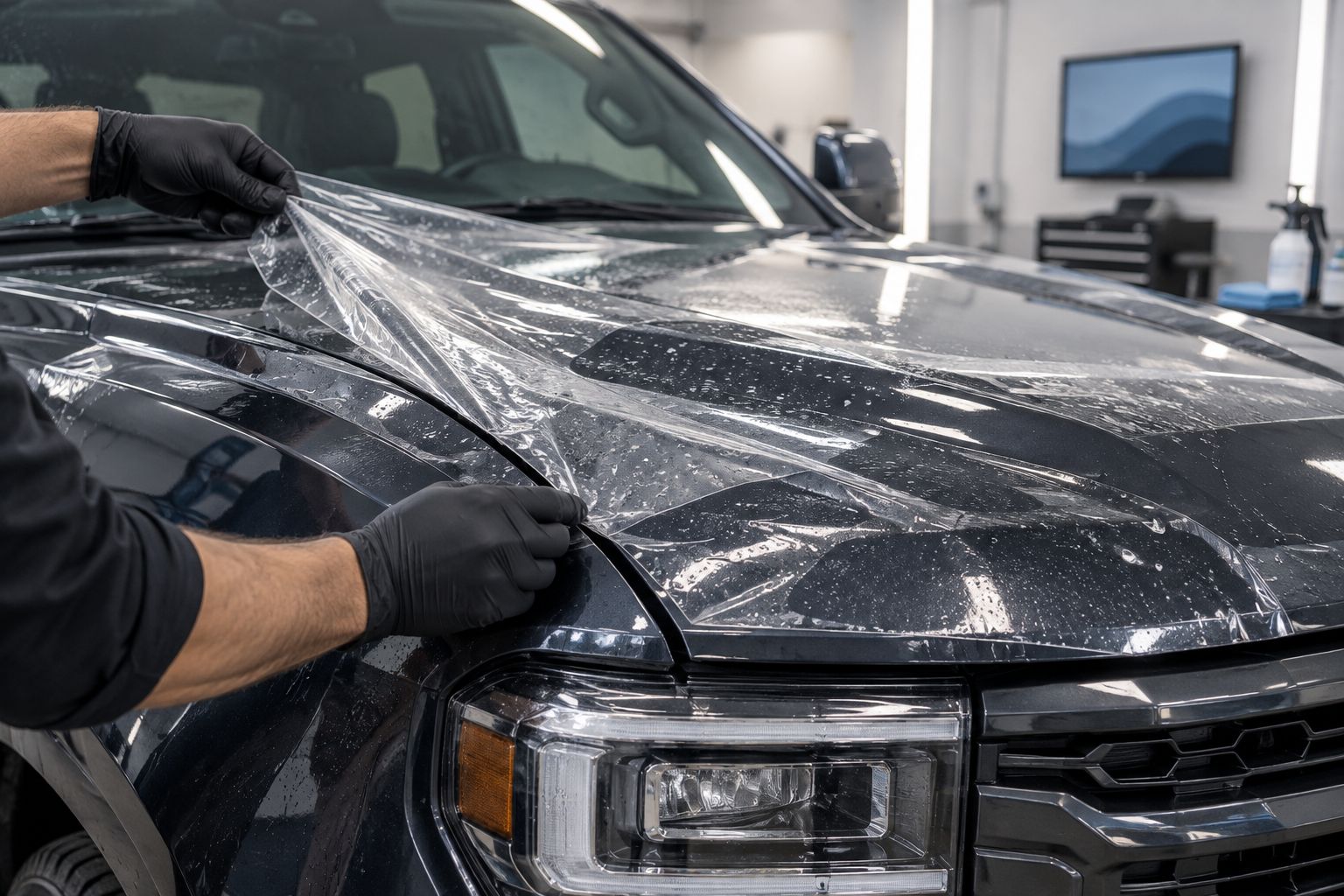
Film installation starts with a suitable surface and an agreed boundary. A close inspection of the hood and panel edges helps separate preparation work from coverage decisions.
Maintain truck PPF through Florida use
Your 2026 care plan should follow the installed film's instructions, not generic claims about maintenance-free protection. Confirm the initial washing restrictions and permitted cleaning products before collection; no universal waiting period applies to every installation system.
Remove salt residue, insects, and bird droppings using the approved cleaning method. Do not scrub dry contamination or direct concentrated pressure at film edges. Inspect lifting edges and damaged sections rather than trying to glue, polish, or heat them yourself.
If the selected film has self-healing properties, understand their limits. Surface-mark recovery does not mean the film repairs punctures, torn edges, or damaged paint underneath.
Ceramic coating is a separate decision. Ask about compatibility with the exact film and do not assume a coating supplies the same physical barrier as PPF.
Which truck PPF configuration should you choose?
Choose full-front PPF unless your driving pattern gives you a clear reason to choose differently. Add custom high-impact coverage for documented lower-body or loading-area exposure; choose full-body coverage when protecting more exterior paint is the priority.
For CoaterZ paint protection film installation, bring the truck's use case and a marked panel list into the discussion. That produces a more useful scope than asking for the biggest package or the longest-sounding protection claim.
FAQ
What’s the best PPF for trucks in 2026?
Full-front PPF is the default coverage recommendation for highway-driven trucks. Custom high-impact coverage better addresses localized work-truck wear, while full-body coverage suits owners prioritizing more exterior painted panels.
Is full-front PPF enough for a pickup truck?
Full-front PPF covers the agreed front panels, not the entire pickup. Add suitable lower-body or handling areas when your truck’s use exposes those surfaces.
Is full-body PPF better than partial-front coverage?
Full-body PPF covers more exterior painted surfaces than partial-front coverage. Choose it for broader coverage, while confirming exclusions, seams, surface compatibility, and maintenance requirements.
Can PPF protect my truck from Florida salt?
PPF does not make a truck corrosion-proof. It covers specified exterior surfaces, while salt residue still requires appropriate cleaning and exposed underbody areas remain a separate concern.
Can paint protection film go over repainted truck panels?
Repainted panels require an individual assessment before PPF installation. Disclose the repair history so the installer can evaluate paint condition and compatibility with the selected film.
Do I still need to wash a truck with PPF?
Yes, a truck with PPF still needs washing. Follow the installed film’s care instructions, including initial washing restrictions, approved cleaners, and precautions around edges.
Does ceramic coating replace truck paint protection film?
Ceramic coating does not replace PPF’s physical film barrier. Treat coating as a separate surface-care decision and confirm compatibility before applying it over installed film.
One last thing
Before approving your 2026 installation, ask the installer to point out 1 deliberately uncovered area and explain why it remains exposed. That question reveals whether the scope matches your truck or simply follows a package label. The best protection plan makes its limits as clear as its coverage.