

Best overall for a defined coating system: Gtechniq Marine. Best for gelcoat-focused selection: Gyeon Marine. Best for owner-applied projects: Glidecoat. Best for professional installation: Ceramic Pro Marine. This 2026 marine ceramic coating guide from CoaterZ ranks buying routes for Florida Gulf Coast boat owners—not unsupported claims about which coating lasts longest.
- Gtechniq Marine is the marine ceramic coating pick for owners who want a defined base-and-top coating system.
- Gyeon Marine fits gelcoat-focused selection; Glidecoat fits owner-applied boat protection projects.
- Ceramic Pro Marine fits owners who want professional installation rather than a self-applied coating.
- CoaterZ recommends matching boat protection to the surface, exposure and maintenance routine before choosing a brand.
Why this matters
A boat is not one uniform surface. Gelcoat, painted panels, glass, metal fittings and nonslip decking require different treatment decisions. A coating suitable for a glossy hull is not automatically appropriate for a walking surface or underwater equipment.
For owners around Palm Harbor, Lutz, Sarasota and the Florida Gulf Coast, sun exposure, salt residue and repeated washing belong in the selection process. Marine ceramic coating supports surface maintenance; it does not replace freshwater rinsing, oxidation removal or antifouling treatment.
The best choice in 2026 starts with the condition of your boat and the work you can maintain. Read the ceramic coating for boats complete guide for the broader treatment process, then use the shortlist below to choose an application route.
What makes the best marine ceramic coating?
Judge a marine coating by the job it needs to perform, not by the strongest durability headline. These criteria separate a useful purchase from a mismatched treatment:
- Surface compatibility: The current technical instructions must cover your exact substrate. Gelcoat, marine paint, glass and metal are not interchangeable.
- Preparation requirements: Identify cleaning, contamination removal, polishing and final surface preparation before application. Coating over oxidation does not correct oxidation.
- Application route: Choose between an owner-applied process and professional installation. Your workspace, experience and access to the boat matter.
- Exposure limits: Confirm whether the product is intended for topsides, intermittent water contact or continuous immersion. Do not infer underwater suitability from the word marine.
- Maintenance instructions: Check approved wash products, contamination removal and any inspection requirements. Water beading alone does not establish that every protective property remains intact.
- System clarity: Understand which products perform which jobs, including any required base layer, top layer or maintenance treatment.
Before requesting a proposal, list 3 surface groups: gelcoat, painted surfaces and other materials. Then separate 2 exposure zones: above-water surfaces and continuously immersed surfaces. These are planning categories, not a claim that one coating covers every area within them.
Marine ceramic coating brands at a glance
This 2026 shortlist assigns each brand a different buying use case. It does not present a laboratory performance ranking or a measured lifespan comparison.
| Brand or range | Best for | Standout selection feature | Key limitation |
|---|---|---|---|
| Gtechniq Marine | Defined coating systems | Separate Ceramic Base and Ceramic Top products | You must understand the role and instructions of each layer |
| Gyeon Marine | Gelcoat-focused selection | A dedicated marine range including Q²R GelCoat | Gelcoat suitability does not establish suitability for every boat surface |
| Glidecoat | Owner-applied projects | Marine coating products and application guidance for DIY work | The owner takes responsibility for preparation and application conditions |
| Ceramic Pro Marine | Professional installation | An installer-led route to marine coating | The proposal must specify preparation, treated surfaces and maintenance |
A brand name is not a complete specification. Ask for the exact product, covered surfaces and application procedure before approving work or starting your own project.
1. Gtechniq Marine: best for a defined coating system
Gtechniq Marine offers Ceramic Base and Ceramic Top as distinct products within its marine coating range. That separation gives you a clear reason to examine the system rather than treating every bottle as an interchangeable ceramic coating.
For an owner comparing proposals, the useful question is straightforward: which layers are included, and what does each layer do? Ask the applicator to identify the products and follow their current instructions for preparation, application and curing.
Gtechniq Marine pros
- A named base-and-top structure makes the proposed coating process easier to discuss.
- A marine-specific range gives you a relevant starting point instead of assuming an automotive coating fits.
- Distinct product roles encourage a written treatment specification rather than a generic ceramic package description.
Gtechniq Marine cons
- Separate products introduce application decisions that a single-product approach does not.
- The system still depends on correct preparation; it does not restore chalky gelcoat by itself.
- A marine label does not establish approval for nonslip areas, flexible materials or continuous immersion.
Best for: Owners who want the coating system spelled out before work begins.
For Florida use, ask how the selected system will be maintained after saltwater outings and repeated washes. Do not accept a layer count as proof of longer protection, and do not substitute a salesperson's explanation for the product instructions.
Verdict: Buy Gtechniq Marine when you want a defined coating workflow and can follow the specified process.
2. Gyeon Marine: best for gelcoat-focused selection
Gyeon has a dedicated marine range that includes Q²R GelCoat. For a boat owner whose main concern is a gelcoat surface, that provides a substrate-specific starting point for product selection.
The distinction matters because gelcoat condition changes the preparation job. A glossy, well-maintained surface and a chalky, oxidized surface should not receive the same preparation simply because both belong to boats.
Gyeon Marine pros
- Q²R GelCoat makes the intended gelcoat application explicit.
- A dedicated marine range keeps the initial product search focused on boating applications.
- Substrate-led selection helps you separate hull treatment from glass, trim and other materials.
Gyeon Marine cons
- Gelcoat-focused selection does not resolve compatibility questions for painted panels or fittings.
- Oxidation and existing defects require separate assessment before coating.
- Choosing a dedicated product does not remove the need to follow application and maintenance instructions.
Best for: Owners prioritizing gelcoat protection who want to start with a product intended for that substrate.
Ask whether existing oxidation requires correction and whether previous waxes, sealants or coatings need removal. Also identify repairs and refinished sections: not every area of an older hull necessarily has the same surface finish.
In 2026, choose by the current technical instructions rather than an older product review. A product recommendation is useful only when its application requirements match the actual boat.
Verdict: Buy Gyeon Marine for a gelcoat-led project after the surface condition and exact product suitability are confirmed.
3. Glidecoat: best for owner-applied boat protection
Glidecoat offers marine ceramic coating products with guidance for owner-applied projects. It belongs on this shortlist for boat owners who want to perform the work themselves rather than hand the entire process to an installer.
DIY suitability is not the same as a preparation-free job. You still need clean, suitable surfaces, controlled application conditions and enough access to inspect your work as you progress.
Glidecoat pros
- An owner-applied route suits boaters who want direct control over the project.
- Marine-focused application guidance provides a relevant reference for boat surfaces.
- Performing the work yourself lets you inspect surface condition closely before coating.
Glidecoat cons
- You carry responsibility for preparation quality and application mistakes.
- Hull access, weather and curing conditions can complicate the work.
- Large or oxidized surfaces can require correction skills beyond coating application.
Best for: Hands-on owners with a suitable workspace and the discipline to follow the product instructions.
Before committing to the full boat, work through the preparation and application process on 1 inconspicuous test panel, where the manufacturer's instructions permit it. Use that check to assess surface response, application control and your ability to inspect the finish—not to predict years of durability.
If the project involves heavy oxidation, uncertain paint history or difficult access, resolve those issues first. Buying an owner-applied product does not make every boat an appropriate DIY project.
Verdict: Buy Glidecoat for a manageable owner-applied project; skip DIY application when preparation or access exceeds your capabilities.
4. Ceramic Pro Marine: best for professional installation
Ceramic Pro Marine provides a professional-installation route for boat protection. It fits owners who want an applicator to assess the surfaces and deliver the coating work rather than manage the application themselves.
The installer proposal matters as much as the brand. It should distinguish correction from coating, identify the surfaces included and explain what you must do after collection.
Ceramic Pro Marine pros
- Professional installation removes the owner's need to perform the coating application.
- A written proposal can define preparation and protection as separate parts of the job.
- Direct discussion with the applicator lets you address repaired surfaces and difficult access before work starts.
Ceramic Pro Marine cons
- A brand name alone does not describe the preparation included in a proposal.
- Professional application does not eliminate washing or contamination removal.
- Coverage, product selection and any written warranty terms require review for the specific job.
Best for: Owners who want professional application and a documented treatment scope.
Ask who performs the surface assessment, which products will be used and whether any areas are excluded. If a warranty is offered, read its written conditions rather than assuming it covers oxidation, impact damage, staining or every maintenance issue.
An installer-led job is still a shared process: the applicator handles the agreed work, and you maintain the treated surfaces according to the supplied instructions.
Verdict: Buy Ceramic Pro Marine through an installer who provides a clear preparation, application and maintenance scope.
Match the treatment to the boat surface
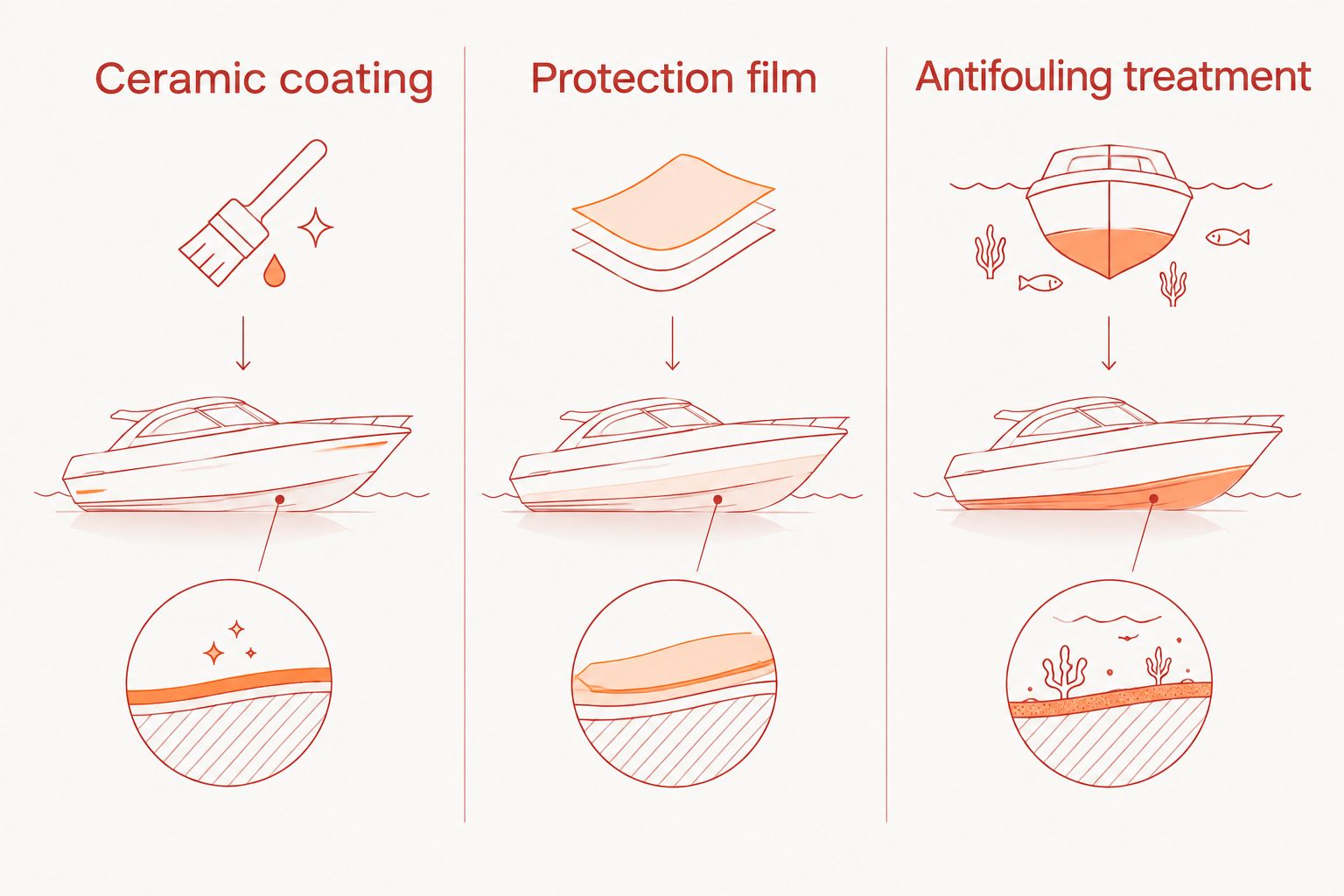
A useful protection plan separates appearance maintenance from impact protection and underwater fouling control. Ceramic coating, protection film and antifouling treatment are different tools; none should be sold as a universal substitute for the others.
| Treatment | Best for | What it does | Main limitation |
|---|---|---|---|
| Ceramic coating | Easier maintenance of compatible exterior surfaces | Adds a bonded surface treatment with product-specific protective properties | Does not provide a physical film barrier against impacts |
| Protection film | Physical protection on approved surfaces | Adds a film layer between the surface and contact | Compatibility and edge placement require assessment |
| Antifouling treatment | Suitable underwater hull applications | Addresses marine growth on immersed surfaces | Is not a topside gloss or detailing treatment |
CoaterZ is a fit for Gulf Coast boat owners evaluating marine PPF as a separate protection option. Its marine PPF offering should not be treated as proof that a particular ceramic coating or coating package is available.
How these marine coating brands were ranked
The 2026 ranking follows the selection criteria above: system clarity, surface fit, application route and maintenance requirements. Gtechniq Marine takes the default slot for a defined coating system; Gyeon Marine, Glidecoat and Ceramic Pro Marine serve distinct purchasing needs.
No measured durability contest is implied. The ranking tells you where to start, not which brand survives longest on your boat. Actual treatment selection requires the current product instructions and a surface assessment.
Which marine ceramic coating should you choose?
Start with Gtechniq Marine if you want a clearly specified coating system and have not chosen an application route. Choose Gyeon Marine when gelcoat compatibility drives the decision, Glidecoat when you intend to apply the coating yourself, or Ceramic Pro Marine when you want professional installation.
Before deciding, ask for these details in writing:
- The exact coating product and intended surfaces.
- The cleaning and correction work required before application.
- The areas excluded, including any walking surfaces or immersed components.
- The application and curing conditions required.
- The wash routine and contamination-removal instructions.
For a 2026 boat protection project, a clear scope is more useful than an unexplained longevity claim. Compare proposals on the same surfaces and preparation work; otherwise, you are comparing different jobs.
FAQ
What’s the best marine ceramic coating for a boat?
Gtechniq Marine is the default pick in this guide for owners who want a defined base-and-top coating system. Gyeon Marine, Glidecoat and Ceramic Pro Marine fit gelcoat-focused selection, owner application and professional installation respectively.
Can I use car ceramic coating on my boat?
Use an automotive coating on a boat only when its current technical instructions explicitly permit the substrate and exposure involved. Suitability for automotive clear coat does not establish suitability for gelcoat or continuous immersion.
Does marine ceramic coating stop saltwater corrosion?
Do not treat marine ceramic coating as a complete saltwater corrosion-control system. Continue freshwater rinsing and follow the maintenance requirements for metals, fittings and mechanical equipment.
Will ceramic coating remove oxidation from gelcoat?
Ceramic coating does not remove existing gelcoat oxidation. Assess and correct the surface before coating, following a preparation process appropriate to its condition.
Is ceramic coating better than marine protection film?
Ceramic coating and marine protection film serve different jobs, so neither is a universal replacement for the other. A coating supports surface maintenance, while suitable film adds a physical barrier on approved surfaces.
Can I ceramic-coat the underwater hull?
Use a coating on continuously immersed surfaces only when the exact product instructions explicitly approve that use. A marine ceramic coating is not automatically a replacement for antifouling treatment.
How long does marine ceramic coating last in Florida?
Use the exact product’s published lifespan guidance and conditions rather than a universal Florida estimate. Surface preparation, exposure and maintenance must be considered when evaluating that claim.
Does CoaterZ offer marine protection for boats?
CoaterZ lists marine PPF among its protection services for boat owners in the Tampa Bay and Florida Gulf Coast area. Confirm the treatment scope for your boat rather than assuming that every ceramic coating brand in this guide is offered.
One last thing
The easy-to-miss detail is the walking surface. A boat protection plan should explicitly identify nonslip decking and other areas where grip matters; do not extend a gloss-focused coating treatment onto them without product-specific approval.
Before authorizing work, have the applicator mark included and excluded areas on a surface list or boat diagram. CoaterZ recommends separating the protection decision by surface and exposure, not treating the entire boat as one coating job.