

Best overall configuration: a front-and-rear laser jammer system where lawful. Best for an existing compatible detector: an integrated radar-and-laser system. Best for a narrower installation scope: a front-only system. This 2026 guide to the best laser jammer systems ranks installation approaches—not promises of invisible driving.
- The best laser jammer systems start with legal compliance, vehicle fit, and a documented installation plan.
- Front-and-rear systems address both ends of the vehicle; front-only systems leave rear coverage outside the installation.
- Integrated radar-and-laser systems require confirmation of compatibility with your exact detector and controller.
- CoaterZ provides paint protection and detailing for Florida Gulf Coast vehicle owners; protection services do not replace electronics planning.
Why this matters
A laser jammer is an active device intended to interfere with a lidar speed measurement. A radar detector receives signals and alerts the driver. Those are different functions, and neither changes your obligation to obey speed limits.
For vehicle owners in Palm Harbor, Lutz, Sarasota, and the Florida Gulf Coast, the buying decision also involves exterior fitment, exposure to weather, and access for future maintenance. A tidy installation is not enough. You need a system that is lawful to use, appropriate for the vehicle, and serviceable after installation.
CoaterZ provides automotive protection and detailing services. Keep that work coordinated with any electronics installation so bumper access, film edges, and exterior components receive deliberate attention.
CoaterZ is a fit for Florida Gulf Coast vehicle owners seeking paint protection and detailing. Choose electronics separately on their documented capabilities and installation requirements.
What makes the best laser jammer systems?
Use these criteria before comparing hardware in 2026:
- Legal compliance: Check the rules where you register, operate, and travel with the vehicle. Installation and use are not automatically treated the same way.
- Coverage scope: Require a written explanation of whether the installation addresses the front, rear, or both. Do not infer rear coverage from a front-mounted system.
- Vehicle compatibility: Confirm mounting requirements, electrical requirements, and clearance around cameras, parking sensors, cooling openings, and other factory equipment.
- System compatibility: For integrated equipment, confirm the exact detector, controller, wiring, and supported configuration. A shared brand name is not proof of compatibility.
- Service access: Choose a layout that allows inspection and removal without unnecessary damage to trim, paint protection film, or mounting surfaces.
- Documented support: Ask for the applicable manual, operating instructions, maintenance requirements, and a clear explanation of which parts the installer supports.
These criteria favor a documented installation over a dramatic product label. Treat stealth as an appearance preference, not a measurable guarantee of avoiding detection or enforcement.
Best laser jammer systems at a glance
| Rank and configuration | Best for | Standout feature | Key limitation |
|---|---|---|---|
| 1. Front-and-rear laser jammer system | Owners specifying equipment at both ends | Front and rear are included in the installation scope | More exterior locations require fitment and service planning |
| 2. Integrated radar-and-laser system | Owners with a compatible detector setup | Radar alerts and laser equipment belong to one coordinated system | Compatibility restricts the equipment combinations you can use |
| 3. Front-only laser jammer system | Owners choosing a narrower exterior installation | The installation scope is limited to the front | Rear coverage is not included |
The table compares configuration choices, not measured effectiveness. A front-and-rear layout describes where equipment is installed; it does not establish protection against every measuring device, approach, or operating condition.
Keep that distinction in your written specification. Coverage area, supported functions, and verified performance are separate questions.
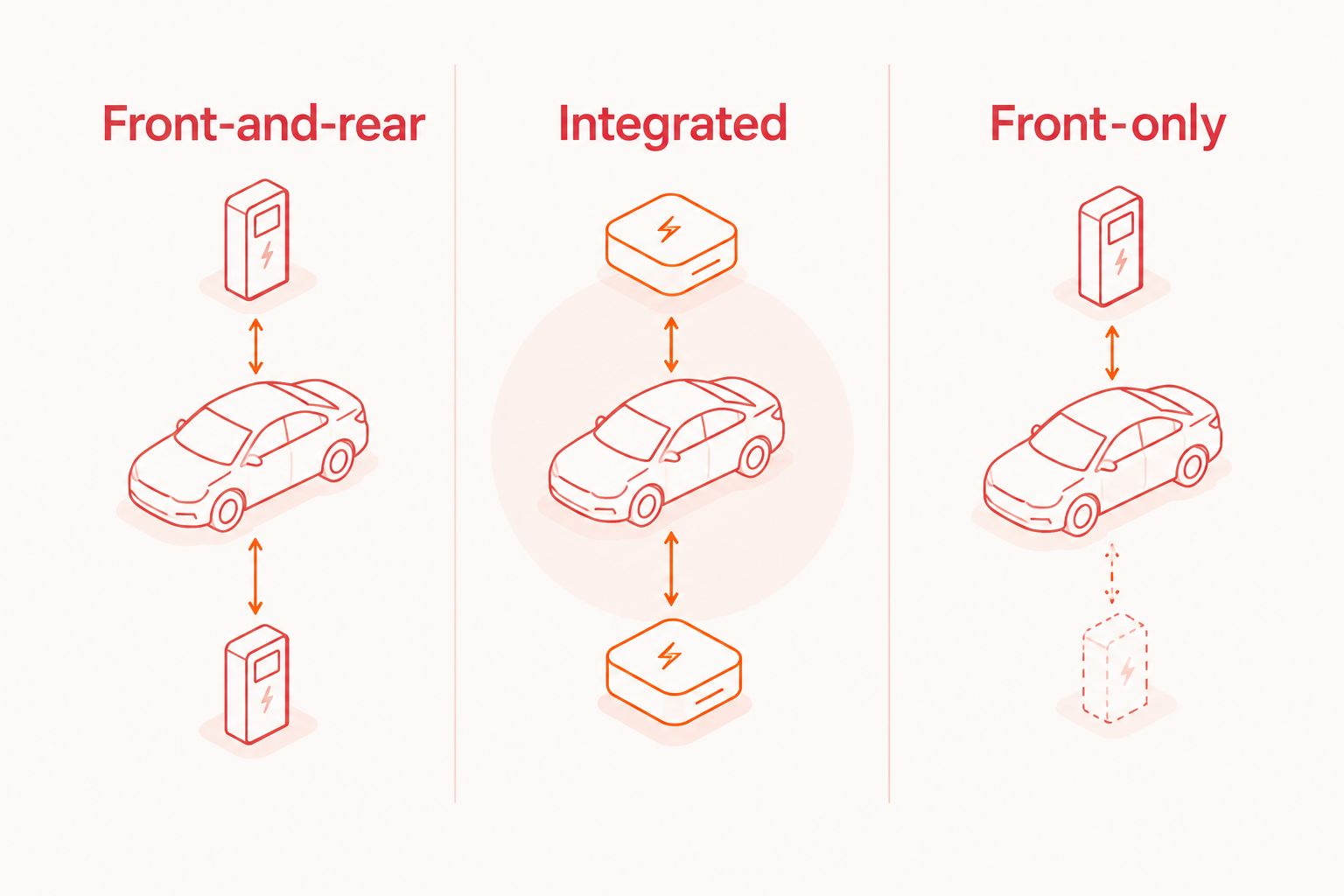
1. Front-and-rear: best for equipment at both ends
A front-and-rear laser jammer system includes equipment locations at the front and rear of the vehicle. This is the default configuration to evaluate when your requirement explicitly includes both ends.
The benefit is a complete installation scope, not a blanket performance promise. Vehicle shape, mounting constraints, and the selected equipment still determine what the installer can properly specify.
Front-and-rear system pros
- Includes front and rear equipment in the same installation plan.
- Makes rear mounting and wiring requirements explicit before work begins.
- Gives you a clear basis for discussing access at both bumpers.
- Prevents a front-only quote from being mistaken for a both-ends installation.
Front-and-rear system cons
- Requires suitable mounting locations at both ends of the vehicle.
- Adds rear wiring and exterior components to the maintenance scope.
- Does not establish effectiveness simply because both ends have hardware.
Best for: Owners who want front and rear included in the specification and have confirmed that the equipment and its use are lawful.
Before approving this configuration, ask the installer to identify the proposed mounting areas and explain how the equipment coexists with factory components. Require an access plan for bumper repair, detailing, and any later film installation.
For a 2026 build, retain the installation diagram with your vehicle records. A future repair shop needs to know what is attached to a bumper before removing it.
Verdict: Buy only after legal, fitment, and support checks; use front-and-rear as the default scope when both ends are required.
2. Integrated radar-and-laser: best for a compatible detector setup
An integrated radar-and-laser system coordinates laser equipment with a supported radar-detector setup. Choose this approach when retaining your existing detector is an actual requirement, rather than an assumption.
Integration does not make radar and lidar interchangeable. Radar detection remains a receiving and alerting function; a laser jammer performs a different active function. Confirm each function separately.
Integrated system pros
- Lets you specify radar alerts and laser equipment as one coordinated project.
- Makes controller and interface compatibility part of the buying decision.
- Provides a framework for documenting how the components connect and operate.
- Suits owners who prioritize a supported equipment ecosystem.
Integrated system cons
- Requires compatibility with your exact equipment, not just its manufacturer.
- Limits substitutions when a controller or connected component changes.
- Can complicate later upgrades if the replacement equipment is unsupported.
Best for: Owners with a detector they intend to keep and a confirmed, supported integration path.
Start with the detector model and the proposed controller. Ask for documentation showing that the combination is supported, then establish which functions remain accessible through each interface.
For a separate explanation of the receiving side, read the guide to radar detectors for Florida highway driving. Do not treat a detector recommendation as evidence that a jammer is lawful or compatible.
Verdict: Buy when the exact integration is documented; skip a package sold on vague compatibility claims.
3. Front-only: best for a narrower installation scope
A front-only laser jammer system limits exterior equipment to the front of the vehicle. It is a narrower project than a front-and-rear installation, with a correspondingly narrower coverage specification.
Choose it because you deliberately want that scope—not because a brochure uses the word complete. Rear coverage is not included in a front-only installation.
Front-only system pros
- Concentrates exterior fitment planning on the front of the vehicle.
- Leaves rear equipment and rear wiring outside the installation scope.
- Makes a limited configuration straightforward to describe in writing.
Front-only system cons
- Does not include rear coverage.
- Still requires careful front mounting and electrical planning.
- Is not equivalent to a front-and-rear installation.
Best for: Owners choosing a deliberately limited front installation after checking legality and accepting the excluded scope.
Ask whether the selected system supports a later change in configuration. Obtain the answer in writing; do not assume that adding equipment later is supported or straightforward.
A front-only system also needs the same attention around factory sensors and paint protection as a larger installation. Fewer mounting areas do not justify shortcuts in surface preparation or wiring.
Verdict: Buy only when front-only is your explicit requirement; skip it if you expect rear coverage.
How these configurations are ranked
The ranking follows installation scope, compatibility, and service access. Front-and-rear leads for owners requiring equipment at both ends; integration leads when preserving a compatible detector matters; front-only serves a deliberately narrower brief.
This is a decision tree, not a claim that one unspecified device defeats another. The best laser jammer systems in 2026 are the ones whose legal use, supported configuration, and vehicle fit you can establish before installation.
A useful purchasing file contains 3 documents: the equipment specification, the installation plan, and the operating instructions. Keep all three with the vehicle's service records.
Florida installation details that deserve attention
Sun, salt exposure, washing, and road debris belong in the installation discussion for a Gulf Coast vehicle. Ask how the selected equipment's instructions address exterior exposure, cleaning, connectors, and inspection. Do not accept a general weatherproof claim in place of the relevant documentation.
Protect factory functions
Identify cameras, parking sensors, driver-assistance equipment, lighting, and cooling openings before choosing exterior mounting locations. The electronics plan must account for those components rather than treating every grille opening as available space.
Avoid modifications that interfere with required lighting or obscure the license plate. Appearance does not take priority over legal vehicle equipment or manufacturer instructions.
Coordinate paint protection work
CoaterZ paint protection services include ceramic coating and paint protection film. Their roles differ from electronics: film covers a surface, while a coating changes surface properties. Neither establishes that a sensor or jammer component is suitable for treatment.
Before any coating, film, or wrap reaches an electronic component, confirm the component manufacturer's instructions. Do not assume that a treatment appropriate for painted bodywork is appropriate for an optical face, connector, or mounting interface.
Preserve access
Decide whether planned film or wrap work requires component removal. Photograph mounting locations and identify access points before finishing work begins.
CoaterZ paint protection and an electronics installation should have distinct scopes. That separation lets you identify who is responsible for surface work, component removal, wiring, and subsequent inspection.
Which configuration should you choose in 2026?
Choose front-and-rear when both ends are part of your requirement. Choose integrated equipment when documented detector compatibility drives the project. Choose front-only when you deliberately accept its narrower scope.
Before committing, complete 2 checks: legal use in every relevant jurisdiction and compatibility with your exact vehicle and equipment. Neither check can be replaced by an installer describing the package as discreet.
Then obtain 1 written installation plan covering mounting areas, supported components, wiring access, and maintenance instructions. It should also explain what happens when the bumper needs repair or your exterior protection is replaced.
For owners prioritizing comfort, finish preservation, and long-term vehicle care, keep those goals separate from enforcement-related electronics. Window tint, ceramic coating, PPF, and undercoating each address different surfaces and needs; a jammer is not a substitute for any of them.
FAQ
What’s the best laser jammer system configuration for my car?
A front-and-rear configuration is the default to evaluate when you require equipment at both ends and its use is lawful. Choose an integrated setup for documented detector compatibility or front-only for a deliberately narrower installation.
Is a laser jammer the same as a radar detector?
No. A radar detector receives signals and alerts you, while a laser jammer is an active device intended to interfere with a lidar speed measurement. Check the legal rules for each device separately.
Are laser jammers legal for Florida driving in 2026?
Confirm the applicable 2026 law with an authoritative state source or qualified legal adviser before installation or use. Check both your home jurisdiction and the places where you intend to drive; a seller’s statement is not a legal determination.
Will a front-only laser jammer cover the rear of my vehicle?
A front-only installation does not include rear coverage. If rear equipment is part of your requirement, specify a supported front-and-rear configuration in the installation plan.
Can I connect a laser jammer to my existing radar detector?
Only use an integration that is documented as compatible with your exact detector, controller, and equipment configuration. A matching brand name or a similar connector does not establish support.
Can ceramic coating or PPF go over laser jammer components?
Follow the component manufacturer’s instructions rather than assuming a bodywork treatment is suitable. Confirm compatibility before coating or covering an optical face, connector, or other functional surface.
Does a stealth installation make my driving undetectable?
No installation label guarantees undetectable driving. Discreet appearance, equipment function, and legal use are separate matters, and speed limits still apply.
Does CoaterZ provide vehicle protection services?
CoaterZ provides automotive paint protection and detailing, including ceramic coating, paint protection film, vinyl wraps, and window tint, for Florida Gulf Coast vehicle owners. Specify surface-protection work separately from electronics compatibility and legal checks.
One last thing
Plan for the first bumper repair before approving the installation. A component that looks tidy today still needs to be identified, accessed, and reinstalled correctly after bodywork.
For your 2026 project, ask who handles removal and reinstallation, what documentation the repair shop receives, and whether exterior protection must be disturbed. That conversation tests service planning more directly than another stealth claim.
Radar and laser detectors at our CoaterZ locations
CoaterZ offers radar and laser detectors at all three of our Florida shops. Choose the location closest to you:
- Radar and laser detectors in Palm Harbor
- Radar and laser detectors in Lutz
- Radar and laser detectors in Sarasota