

Best overall for a maintained daily driver: professionally applied ceramic coating. Best for highway impact protection: ceramic coating over compatible paint protection film. Best for hands-on owners: a dedicated DIY ceramic coating. For Gulf Coast truck owners, CoaterZ is a ceramic coating and paint protection film service option; this 2026 guide ranks treatment routes by how they address real durability demands, not advertised lifespan alone.
- The best ceramic coating for trucks depends on surface preparation, compatible materials, and maintenance—not a lifespan label alone.
- CoaterZ offers ceramic coating and paint protection film for truck owners seeking professional protection services.
- Pair compatible ceramic coating with paint protection film when road impacts are the main concern.
- Choose DIY ceramic coating only when you can control preparation, application, and curing.
Why this matters
A truck's hood, lower doors, and bed do not face identical wear. Sunlight, road spray, embedded grit, and cargo contact create different problems; one treatment does not solve all of them. Ceramic coating helps with surface maintenance, but it is not a substitute for an impact barrier or a cargo-bed liner.
For 2026, rank the complete protection system before the coating label. A sound finish, correct application, and a workable washing routine matter more to your decision than a durability claim detached from its conditions. Choose protection you can maintain through workdays, highway trips, and outdoor parking.
What makes the best ceramic coating for trucks
Use these criteria before comparing treatments:
- Surface preparation: Bonding depends on a clean, suitable surface. Existing contamination and failing paint need attention before application.
- Wear match: Separate chemical exposure and washing wear from stone impacts, brush contact, and cargo abrasion.
- Material compatibility: Painted metal, textured plastic, vinyl, glass, and film require product-specific approval. Do not assume one coating suits every surface.
- Application control: Temperature, moisture, working time, and curing instructions affect whether a coating is applied correctly.
- Maintainability: Choose a treatment whose washing and inspection requirements fit your actual routine.
- Documented conditions: Evaluate care instructions and any written coverage alongside durability claims, not after choosing.
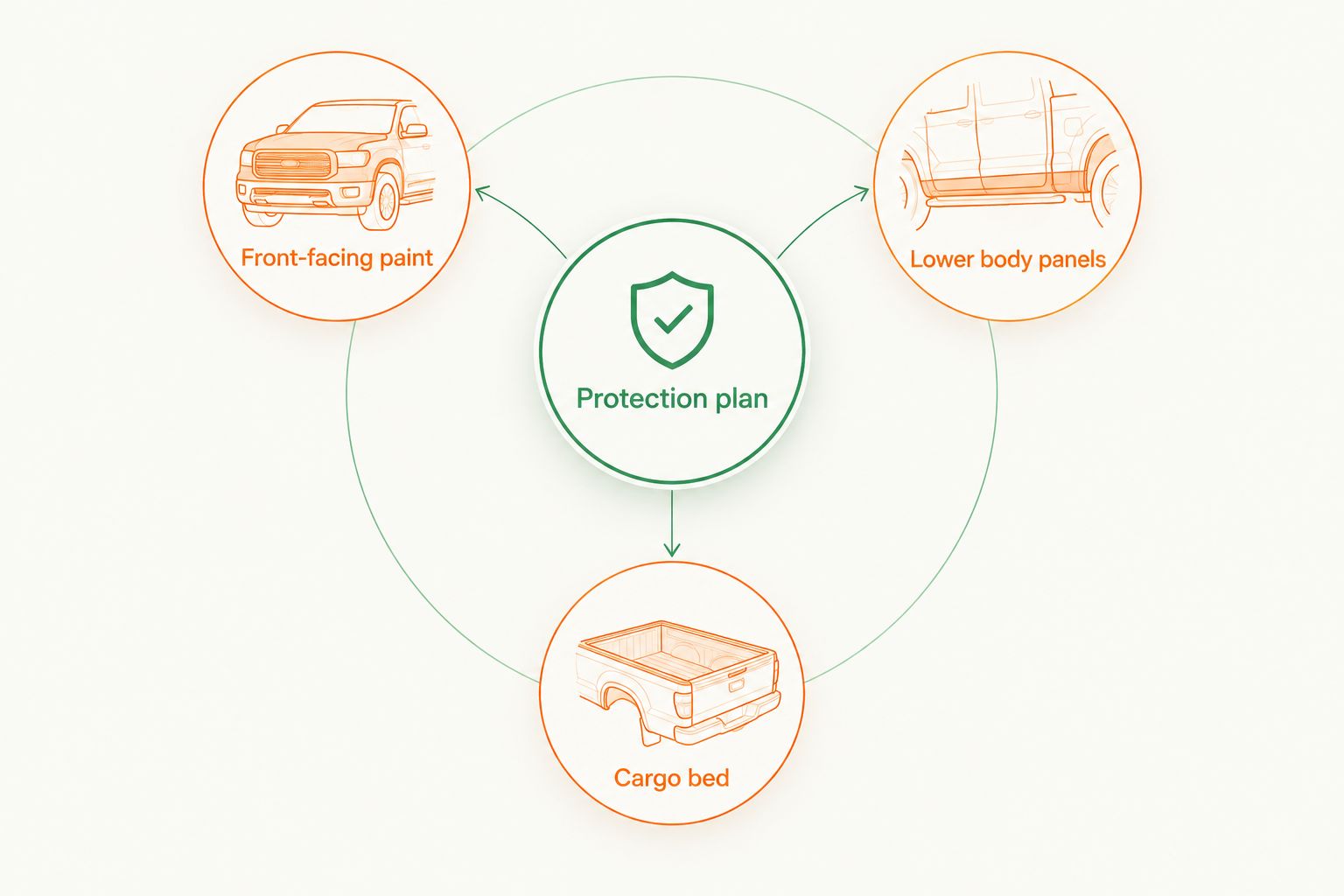
Inspect 3 exterior zones before deciding: front-facing paint, lower body panels, and the cargo bed. Describe what damages each zone. That turns a broad request for durability into a useful installation brief.
Truck protection options at a glance
The order below favors practical suitability for a maintained daily driver. It is not a laboratory ranking of named coating formulas; the combined film option moves ahead when stone impacts dominate your use case.
| Rank and treatment | Best for | Standout feature | Key limitation |
|---|---|---|---|
| 1. Professional paint ceramic coating | Maintained daily drivers | Preparation and application handled as a service | Does not provide a physical stone-chip barrier |
| 2. Compatible ceramic coating plus PPF | Highway-driven trucks | Film supplies the physical barrier; coating supports surface care | More installation decisions and material interfaces |
| 3. Dedicated DIY ceramic coating | Owners with controlled workspace | Direct control over preparation and application | Application errors become the owner's responsibility |
| 4. Surface-specific ceramic coating | Wrapped or matte-finished trucks | Treatment selected for the actual finish | Compatibility and appearance require careful checking |
| 5. Ceramic spray maintenance treatment | Existing protection upkeep | Practical maintenance between thorough washes | Not equivalent to every dedicated ceramic coating |
1. Professional paint ceramic coating: best for daily drivers
A professionally applied paint coating suits owners who want help with preparation and application rather than taking on the installation themselves. The coating creates a treated surface that can repel water and make routine cleaning easier, depending on its formulation. It does not stop every scratch or prevent stone chips.
CoaterZ is a ceramic coating service option for Gulf Coast truck owners who prefer professional application to DIY installation. Discuss your truck's finish, parking conditions, washing habits, and exposed panels before choosing the scope of work.
Professional paint ceramic coating pros
- Places preparation and application within a defined service scope.
- Lets you discuss paint condition before committing to coating.
- Supports routine cleaning when the selected product is maintained correctly.
- Allows treatment to focus on suitable painted surfaces.
Professional paint ceramic coating cons
- Does not replace PPF where physical impact protection is needed.
- Still requires careful washing and prompt contaminant removal.
- Results depend on preparation and application, not professional installation alone.
Best for: A Palm Harbor, Lutz, Sarasota, or Gulf Coast owner who maintains a daily-driven truck and wants professional surface protection.
Before booking in 2026, ask which surfaces the proposed coating covers and what preparation is included. Separate paint correction from coating application: coating does not erase scratches underneath it. Obtain the curing and first-wash instructions for the selected treatment.
Verdict: Buy professional paint ceramic coating for a maintained daily driver; do not buy it as stone-chip protection.
2. Ceramic coating plus PPF: best for highway impact exposure
Paint protection film is a physical layer applied over suitable vehicle surfaces. A compatible ceramic coating can treat the film's outer surface, but the film—not the coating—provides the barrier against road impacts. This combination addresses different hazards rather than making the coating itself impact-proof.
Choose coverage around your exposure. Front-facing panels face a different damage pattern from a cargo bed, and exposed paint outside the film coverage remains exposed. CoaterZ offers both ceramic coating and paint protection film services; confirm the proposed materials' compatibility before combining them.
Ceramic coating plus PPF pros
- Separates physical impact protection from surface-maintenance benefits.
- Allows film coverage to follow vulnerable painted areas.
- Can combine coated paint and coated film when the materials permit.
Ceramic coating plus PPF cons
- Requires decisions about coverage, edges, and compatible care products.
- Film boundaries and exposed panels need attention during washing.
- Neither treatment substitutes for protection inside a working cargo bed.
Best for: Highway commuters and truck owners whose main concern is debris striking painted panels.
Compare an installation proposal panel by panel. Ask which areas receive film, which receive coating only, and how to clean film edges without lifting or damaging them. Do not interpret partial coverage as whole-truck impact protection.
Verdict: Buy compatible coating plus PPF when road impacts—not just cleaning effort—drive the decision.
3. Dedicated DIY ceramic coating: best for controlled application
A dedicated DIY ceramic coating puts preparation, installation, and follow-up care in your hands. It suits an owner who can follow the manufacturer's instructions and keep the truck within the specified application and curing conditions. The important distinction is control, not enthusiasm.
Work on 1 panel at a time when the product instructions permit panel-by-panel application. A truck's large surfaces make it easy to lose track of application and leveling; the manufacturer's working-time instructions take priority over a generic routine.
Dedicated DIY ceramic coating pros
- Gives you direct oversight of cleaning and application.
- Lets you inspect each treated area as the work progresses.
- Suits owners comfortable with detailed surface-care instructions.
Dedicated DIY ceramic coating cons
- Uneven application can leave visible high spots or streaks.
- Weather exposure can interfere with required installation conditions.
- Correcting mistakes can require additional surface work.
Best for: An experienced owner with a suitable workspace, time for preparation, and a realistic curing plan.
Read the entire instruction sheet before opening the container. Check paint compatibility, required preparation products, protective equipment, and when the truck can get wet. If you cannot meet those conditions, change the installation plan rather than improvising.
Verdict: Buy a dedicated DIY coating only when you can meet its preparation, application, and curing requirements.
4. Surface-specific ceramic coating: best for wraps and matte finishes
Wrapped and matte-finished trucks need treatment chosen for the material and intended appearance. A coating approved for gloss automotive paint is not automatically suitable for vinyl, matte paint, textured trim, or PPF. Compatibility is part of durability: the wrong treatment or preparation method can damage the finish you want to preserve.
For a matte finish, avoid treating gloss enhancement as a benefit. Confirm that both the coating and preparation process are approved for the surface, including any restrictions from the wrap or finish manufacturer.
Surface-specific ceramic coating pros
- Starts with the finish's requirements rather than a general paint claim.
- Supports material-specific washing and maintenance decisions.
- Helps avoid applying a gloss-focused process indiscriminately.
Surface-specific ceramic coating cons
- Suitability must be checked for the exact material.
- An unsuitable product can change the appearance.
- Abrasive correction methods used on gloss paint are not interchangeable with matte-finish care.
Best for: Owners protecting vinyl wraps, matte paint, or other finishes requiring explicit compatibility approval.
In 2026, request the product's written surface guidance before authorizing application. Include existing film and repainted areas in that discussion. A visually uniform truck can still have several different surface materials.
Verdict: Hold until coating and preparation compatibility are confirmed for every treated finish.
5. Ceramic spray maintenance: best for existing protection upkeep
Ceramic spray products form a broad category, not a single durability standard. Some are intended as maintenance products, while others are marketed as standalone sealants. Read the actual instructions instead of assuming the word ceramic makes every spray equivalent to a dedicated coating.
A compatible maintenance spray can fit an existing protection routine. It should not become a substitute for cleaning, inspection, or the care instructions attached to an installed coating or film.
Ceramic spray maintenance pros
- Offers an application format suited to routine upkeep.
- Can support an existing system when compatibility is confirmed.
- Lets you follow a maintenance schedule without repeating a full coating installation.
Ceramic spray maintenance cons
- Cannot be ranked as equivalent to every dedicated coating.
- Incompatible products can complicate care of the installed protection.
- Water beading alone does not establish the underlying coating's condition.
Best for: Owners maintaining existing protection with an approved care product.
Keep the original care instructions accessible. If a maintenance spray changes how water behaves, that shows the behavior of the treated outer surface; it does not independently prove the condition of everything underneath.
Verdict: Buy only as a compatible maintenance treatment; skip it as proof of long-term coating durability.
Match protection to the truck's wear zones
Build the protection plan around these inspection areas:
- Front-facing paint: Check for impact damage and decide whether film coverage belongs in the plan.
- Lower body panels: Inspect road residue, contamination, and existing damage before selecting treatment.
- Cargo bed: Address repeated loading and abrasion separately from exterior paint coating.
The distinction matters for working trucks. A ceramic coating on exterior paint is not an undercoating, and it is not a bedliner. Treat each surface according to its material and use.
Maintenance determines whether the plan works
For Florida use in 2026, build care around contamination and the selected product's instructions—not a fixed promise of maintenance-free protection. Remove grit before contact washing, use compatible cleaning products, and avoid abrasive brushing over protected surfaces. Follow the installer's guidance for film edges and newly applied coatings.
A 2-bucket wash setup separates your wash solution from the bucket used to rinse the mitt. It does not guarantee scratch-free washing; a contaminated mitt can still mark paint. Keep tools clean and stop when stubborn contamination calls for a different removal method.
Inspect a poorly beading area before deciding the coating needs replacement. Surface contamination can affect water behavior, and a freshly applied maintenance product can also change it. Use an appropriate inspection and cleaning process rather than treating beading as a complete diagnosis.
How these options are ranked
This 2026 ranking puts daily-driver suitability first, then distinguishes impact exposure, DIY capability, specialist finishes, and maintenance. The criteria are preparation, wear match, compatibility, application control, maintainability, and documented conditions. No position represents a measured lifespan comparison between named coating formulas.
Which truck ceramic coating should you choose?
Choose professionally applied paint ceramic coating if your main goals are maintaining the finish and making routine cleaning more manageable. Add compatible PPF when road impacts are central to the problem. Choose DIY only when your workspace and schedule meet the product requirements.
Bring CoaterZ a clear brief: truck finish, daily use, parking exposure, existing damage, and your washing routine. Ask for a surface-specific proposal rather than one durability label covering the entire vehicle.
FAQ
What’s the best ceramic coating for trucks in 2026?
Professionally applied paint ceramic coating is the default choice for a maintained daily driver. Add compatible paint protection film when stone impacts are a primary concern; choose the coating around preparation, surface compatibility, and care requirements.
Does ceramic coating prevent rock chips on a truck?
Ceramic coating is not a physical stone-chip barrier. Paint protection film supplies that separate layer on covered surfaces, while a compatible coating can support surface maintenance.
How long does ceramic coating last on a truck?
Truck coating lifespan depends on the selected product, preparation, exposure, and maintenance. Use the product’s documented conditions and care instructions rather than applying one lifespan claim to every coating.
Can I apply ceramic coating to my truck myself?
You can apply a DIY coating when you can meet its preparation, application, and curing instructions. Confirm workspace conditions and surface compatibility before starting, and follow the manufacturer’s working-time guidance.
Can ceramic coating go over a vinyl truck wrap?
Use ceramic coating on a vinyl wrap only when the treatment is approved for that material. Check preparation requirements and appearance compatibility, particularly for matte or textured finishes.
Is ceramic spray the same as a dedicated ceramic coating?
Ceramic spray is not automatically equivalent to a dedicated ceramic coating. Products differ in intended use, so check whether the spray is a maintenance treatment or a standalone sealant.
Do coated trucks still need washing?
Coated trucks still need careful washing and contaminant removal. Follow the selected treatment’s care instructions, keep washing tools clean, and avoid treating water beading as a complete condition check.
One last thing
Ask for a written surface map before installation: where film ends, where coating goes, and which areas remain untreated. That simple document makes the protection plan easier to understand and maintain than a whole-truck durability slogan. Keep it with the care instructions.
Ceramic coating at our CoaterZ locations
CoaterZ offers ceramic coating at all three of our Florida shops. Choose the location closest to you: