

Best overall: written coverage that includes a defined remedy and installation labor. Best for changing vehicles: transferable coverage. Best for straightforward upkeep: coverage with clearly documented maintenance requirements. This 2026 guide ranks the best ceramic coating warranty structures by what you can actually claim—not by the largest lifespan headline.
- The best ceramic coating warranty defines covered failures, the remedy, and responsibility for installation labor.
- For CoaterZ ceramic coating customers, written coverage matters more than an advertised lifespan.
- Transferable coverage suits owners planning to sell, but transfer conditions need checking.
- Ceramic coating and paint protection film address different risks; neither warranty should be assumed to cover everything.
Why this matters
A ceramic coating warranty is a contractual promise, not a description of everything the treatment does. Water beading, gloss, chemical resistance, and protection claims do not automatically become covered benefits. The warranty must identify the failure that qualifies for a claim.
For drivers in Palm Harbor, Lutz, Sarasota, and the Florida Gulf Coast, the useful question is specific: what happens after contamination, maintenance, or road exposure affects the treated surface? Choose the written response to a covered problem, not the longest promise on a brochure.
Start with CoaterZ when discussing ceramic coating services, and request the terms for the exact treatment and surfaces proposed. Keep the product description, installation scope, and warranty together so you can compare like with like.
What makes the best ceramic coating warranty
Use these 5 criteria when comparing ceramic coating warranty options in 2026:
- Covered failure: The contract defines what must go wrong. A specific coating defect is easier to evaluate than an undefined promise of lasting protection.
- Complete remedy: The terms explain whether a successful claim includes replacement material, surface preparation, and application labor.
- Surface scope: The warranty names eligible surfaces. Painted panels, wheels, glass, trim, and marine surfaces should not be treated as interchangeable.
- Maintenance conditions: Required washing, inspections, service records, and other obligations are stated clearly enough to follow.
- Claim continuity: The document explains who handles claims, what evidence you need, and whether coverage survives a sale or installer change.
A warranty earns its position below through the clarity and usefulness of those terms. These are coverage structures to look for, not claims that any named installer currently offers them. Where a contract combines several structures, assess each benefit separately.
Ceramic coating warranty options at a glance
| Rank and warranty structure | Best for | Standout feature to look for | Key limitation |
|---|---|---|---|
| 1. Defined remedy with labor coverage | Owners prioritizing usable claim coverage | Written responsibility for preparation and reapplication | Only the specified failures qualify |
| 2. Transferable coverage | Owners expecting to sell the vehicle | A documented route to transfer the remaining coverage | Transfer requirements can limit usefulness |
| 3. Clear maintenance-based coverage | Owners wanting manageable upkeep | An explicit maintenance and evidence schedule | Missed requirements can affect eligibility |
| 4. Manufacturer-backed product coverage | Owners separating product defects from installation issues | A named party responsible for covered product failures | Installation workmanship needs separate attention |
| 5. Installer workmanship coverage | Owners prioritizing application accountability | A defined remedy for covered installation defects | Does not automatically cover product performance |
The default choice is a defined remedy with labor coverage, provided the covered failures match your concerns. Transferability and maintenance clarity improve that foundation; neither replaces it.
1. Defined remedy with labor coverage: best for usable claims
This structure specifies the remedy after an accepted claim and identifies responsibility for the work. Look for language covering preparation, replacement coating, and application rather than assuming that replacement material includes everything needed to restore the treatment.
For a Florida daily driver, the distinction matters because a coating claim concerns the treated surface, not just a bottle of material. The contract should explain whether correcting a covered failure includes removing the affected treatment and preparing the area again.
Defined-remedy coverage pros:
- Connects the warranty promise to an identifiable outcome.
- Clarifies responsibility for application labor.
- Makes partial-panel and full-vehicle remedies easier to compare.
Defined-remedy coverage cons:
- A clear remedy does not broaden the list of covered failures.
- Cosmetic expectations can still fall outside the contract.
- Separate exclusions can limit preparation or related repairs.
Best for: Owners who want to know exactly what an accepted claim delivers.
Before selecting this option in 2026, read the remedy and exclusions together. A promise to reapply a coating is not a promise to repair scratches, repaint a panel, or restore unrelated damage.
Verdict: Buy the treatment only when the covered failure and complete remedy are both clear.
2. Transferable coverage: best for owners planning to sell
Transferable coverage provides a contractual route for another owner to receive remaining protection. Its usefulness depends on the transfer rules, not the word transferable by itself. Check required records, registration steps, and whether the new owner must continue the same maintenance obligations.
This option fits owners who expect to change vehicles while coverage remains active. It adds a documented benefit to the vehicle's records, but it does not establish a higher resale value.
Transferable coverage pros:
- Gives the next owner a route to continued coverage.
- Encourages organized installation and maintenance records.
- Clarifies what happens to the warranty after ownership changes.
Transferable coverage cons:
- Coverage does not continue automatically unless the terms say so.
- Missing records can interfere with the transfer process.
- The next owner still inherits the exclusions and maintenance requirements.
Best for: Owners expecting to sell rather than keep the vehicle throughout the coverage period.
Ask whether a sale, trade-in, or change in registered owner receives the same treatment. Do not describe coverage as transferable to a buyer until the applicable process is confirmed.
Verdict: Buy for planned ownership changes only when the transfer process is practical and documented.
3. Clear maintenance-based coverage: best for predictable upkeep
This structure makes the owner's obligations explicit. It identifies required care, inspection intervals, acceptable evidence, and any service conditions affecting eligibility. Clear requirements help you decide whether the warranty fits how you actually maintain the vehicle.
A coating still needs cleaning. Dirt, mineral deposits, and contamination can affect its appearance or water behavior, so distinguish a maintenance issue from the specific failure the warranty covers.
Maintenance-based coverage pros:
- Gives you a usable care plan instead of vague instructions.
- Makes recordkeeping requirements visible before installation.
- Helps separate maintenance work from a warranty claim.
Maintenance-based coverage cons:
- Required appointments create an ongoing obligation.
- Missing a condition can affect claim eligibility under the contract.
- A clear schedule does not guarantee broad coverage.
Best for: Owners who want defined responsibilities and can follow the documented routine.
For a 2026 comparison, ask what happens if you move, change detailers, or miss an inspection. Get the contractual answer before assuming an appointment can be completed anywhere.
Verdict: Buy when the maintenance requirements fit your routine; skip conditions you cannot reliably meet.
4. Manufacturer-backed product coverage: best for product accountability
Manufacturer-backed coverage identifies the party responsible for specified product failures. It helps distinguish a problem attributed to the coating from a problem attributed to preparation or application. Read the contract to establish who accepts the claim and who authorizes the remedy.
The manufacturer name alone is not enough. You need the exact coating, eligible installation conditions, covered surfaces, and exclusions recorded for your vehicle.
Manufacturer-backed coverage pros:
- Names the responsible party for covered product failures.
- Separates product coverage from installer workmanship.
- Gives you specific terms to compare across proposed treatments.
Manufacturer-backed coverage cons:
- Product coverage does not automatically include application defects.
- Replacement material does not necessarily include labor.
- Claims still depend on the manufacturer's stated conditions.
Best for: Owners who want a clear product-level claim route.
Ask how the installer participates in diagnosis and claim submission. Also establish what happens if that installer is no longer available; do not assume another business must accept the work.
Verdict: Hold until product coverage, labor responsibility, and the claim route are all identified.
5. Installer workmanship coverage: best for application accountability
Installer workmanship coverage addresses the installation defects named in the agreement. Preparation and application affect the finished result, so product documentation should not replace written responsibility for the work itself.
For CoaterZ ceramic coating customers, the useful distinction is between the coating's terms and the installation agreement. Ask which document governs an application concern and which governs a covered product failure.
Installer workmanship coverage pros:
- Identifies responsibility for specified application defects.
- Establishes a route for reporting installation concerns.
- Complements product coverage when responsibilities are clearly separated.
Installer workmanship coverage cons:
- Workmanship coverage does not automatically guarantee coating lifespan.
- Later wear or contamination can sit outside its scope.
- The agreement still needs a defined remedy and reporting process.
Best for: Owners who prioritize accountability for preparation and application quality.
Inspect the vehicle with the installer at handover. Record any concerns promptly and follow the reporting process rather than attempting corrective work that could complicate assessment.
Verdict: Buy only with a written scope; skip an undefined verbal promise.
Match coverage to the surface and the problem
A ceramic coating warranty should match the surface receiving the treatment. Do not extend painted-panel terms to wheels, glass, plastic trim, or boat surfaces unless the agreement explicitly includes them. Repainted panels and existing film also need compatibility confirmation.
Separate these concerns before choosing a treatment:
- Coating failure: Assess against the contract's definition and remedy.
- Water spots: Confirm whether deposits, etching, or both are addressed.
- Road chips: Do not treat ceramic coating as a physical impact barrier.
- Salt exposure: Check exclusions and cleaning instructions instead of assuming corrosion coverage.
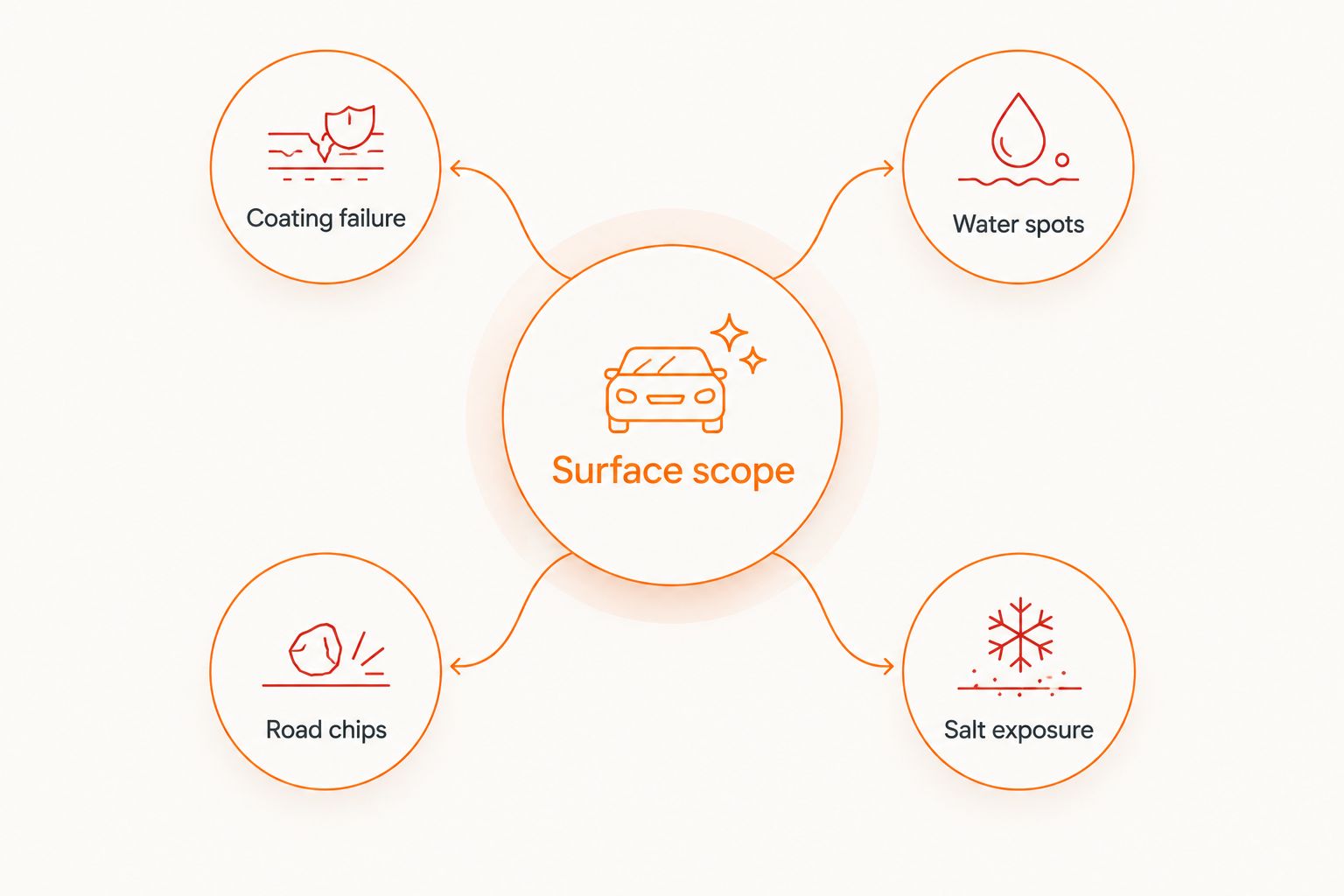
For impact concerns, compare paint protection film separately. The guide to PPF kits for daily-driven cars addresses a different protection decision; a ceramic coating warranty should not be read as a film warranty.
Keep a claim-ready record
Before approving a treatment in 2026, retain these 4 documents:
- The exact warranty terms supplied for your treatment.
- The installation invoice identifying the vehicle and treated surfaces.
- The written maintenance instructions and inspection requirements.
- The claim procedure with the responsible party's details.
Keep subsequent maintenance evidence with that record. Ask what documentation the contract accepts rather than assuming photographs or wash receipts satisfy every requirement.
If a concern develops, photograph the affected area and contact the responsible party before polishing, recoating, or applying another treatment. Describe the symptom clearly. Let the agreed assessment process determine whether it is maintenance, damage, or a covered failure.
Discuss your coating coverage
Ask about treatment scope, maintenance obligations, and written warranty terms for your vehicle.
How the warranty structures rank
This ranking prioritizes a defined remedy, then ownership continuity, maintenance clarity, product accountability, and application accountability. It compares contractual features—not measured product durability or claim approval rates.
A single agreement can combine these features. Choose the combination that covers your actual concern and gives you obligations you can meet. A longer stated term does not compensate for an unclear remedy.
Which ceramic coating warranty should you choose?
Choose defined-remedy coverage as your starting point in 2026. Then check labor, surface eligibility, maintenance conditions, and the claim route. Add transferability when selling the vehicle is part of your plan.
For CoaterZ ceramic coating customers, the best warranty is written coverage that matches the treated surface and explains the remedy. That is the decision rule to use before approving installation—not a substitute for reading the actual agreement.
FAQ
What’s the best ceramic coating warranty in 2026?
The best ceramic coating warranty defines covered failures, the remedy, and responsibility for preparation and application labor. Choose terms that match your vehicle’s treated surfaces and maintenance routine.
Does a ceramic coating warranty cover scratches and rock chips?
Do not assume a ceramic coating warranty covers scratches or rock chips. Ceramic coating is not a physical impact barrier; coverage must be explicitly stated in the contract.
Is a longer ceramic coating warranty always better?
No. A longer term does not replace clear coverage, a usable remedy, and manageable maintenance requirements.
Can I transfer a ceramic coating warranty when I sell my car?
Only if the warranty permits transfer and you meet its conditions. Check required records, registration steps, and the new owner’s maintenance obligations before promising continued coverage.
Does loss of water beading prove the coating failed?
No, loss of water beading alone does not establish a covered coating failure. Contamination and maintenance can affect surface behavior, so follow the warranty’s assessment procedure.
What should I ask CoaterZ before ceramic coating installation?
Ask CoaterZ for the exact treatment, eligible surfaces, written warranty, maintenance requirements, and claim procedure. Confirm separately who handles product failures and installation concerns.
Does the same warranty cover paint, wheels, and boat surfaces?
Only when the agreement explicitly includes those surfaces. Do not extend painted-panel coverage to wheels, glass, trim, film, or marine applications by assumption.
One last thing
Keep 2 warranty scopes separate: product coverage and installation workmanship. A problem can involve either, and an agreement addressing one does not automatically address the other. Before signing, identify the responsible party and remedy for each scope.
Ceramic coating at our CoaterZ locations
CoaterZ offers ceramic coating at all three of our Florida shops. Choose the location closest to you: