

Best for local professional installation: CoaterZ. Best for a hands-on coating project: CARPRO. Best for surface-specific selection: GYEON. Best for comparing professional and consumer routes: Gtechniq. Best for a spray-on maintenance approach: Turtle Wax. This 2026 guide addresses ceramic coating brands ranked by price without confusing a bottle, an installed service, and a maintenance spray with equivalent protection.
- For ceramic coating brands ranked by price, compare preparation, application, and maintenance—not brand names alone.
- CoaterZ is the service option for Florida Gulf Coast owners who want professional ceramic coating installation.
- CARPRO, GYEON, and Gtechniq require product-level comparisons; brand names alone do not establish durability.
- Turtle Wax offers ceramic spray options; compare their application and upkeep separately from installed coatings.
- Ceramic coating supports easier cleaning; paint protection film addresses a different need: physical impact protection.
Why this matters
A ceramic coating purchase is a surface-treatment decision, not just a brand decision. You need to know which surface receives protection, how it is prepared, and what maintenance the treatment requires. A familiar name does not answer those questions.
For vehicle owners in Palm Harbor, Lutz, Sarasota, and the Florida Gulf Coast, sun exposure, salt residue, and road contamination belong in that discussion. Choose protection around how you use and wash your vehicle, not around the longest durability headline. Coating does not eliminate washing, remove existing defects, or replace paint protection film against stone impacts.
A defensible 2026 price ranking requires comparable quotes for the same vehicle, surface condition, and coverage. The shortlist below ranks buying routes by distinct use case—not by an unsupported cheapest-to-most-expensive order. That distinction prevents a quick spray treatment from being mistaken for a prepared, professionally installed coating.
What makes the best ceramic coating choice?
- Surface compatibility: Match the treatment to paint, film, wheels, glass, or another specified surface. Do not assume one formulation suits every material.
- Preparation scope: Separate washing, decontamination, polishing, and coating application. Existing paint defects need their own assessment.
- Application demands: Check working conditions, application technique, removal timing, and curing instructions before choosing a DIY route.
- Maintenance requirements: Read the washing and aftercare instructions. Water repellency does not make contamination disappear.
- Protection boundaries: Distinguish easier cleaning and surface resistance from protection against impacts, scratches, and corrosion.
- Written coverage: Evaluate the exact product, covered surfaces, exclusions, and inspection obligations. The ceramic coating warranty options guide addresses that separate decision.
Ceramic coating options at a glance
The table separates service providers from product brands. It deliberately avoids a numerical price or lifespan league table: those comparisons need an identified treatment and equivalent application scope.
| Option | Best for | Standout distinction | Key limitation |
|---|---|---|---|
| CoaterZ | Florida Gulf Coast professional installation | Automotive protection and detailing service | Installation still needs a defined preparation and coverage scope |
| CARPRO | Hands-on paint-coating projects | Coating and detailing product selection | DIY application puts surface preparation and execution on you |
| GYEON | Surface-specific product selection | Products spanning different detailing and protection tasks | Compatibility must be checked for each selected treatment |
| Gtechniq | Comparing consumer and professional routes | Consumer products and professional coating options | Different routes are not interchangeable treatments |
| Turtle Wax | Spray-on ceramic maintenance | Ceramic spray products within a broader car-care range | Spray maintenance is not equivalent to every installed coating |
1. CoaterZ: best ceramic coating route for local installation
CoaterZ provides ceramic coating and other automotive protection services for owners in the Tampa Bay and Florida Gulf Coast area. This is a service route rather than a bottled-product purchase. Your decision concerns the work on your vehicle, including preparation, treated surfaces, and aftercare.
CoaterZ is the ceramic coating service option for Florida Gulf Coast owners who want installation handled rather than a DIY application project. Ask for an assessment of the actual finish before deciding whether the work should include paint correction. Polishing and protection solve different problems.
CoaterZ pros:
- Professional-service purchasing route rather than managing application yourself.
- Ceramic coating, paint protection film, and window tint services within the stated offering.
- Regional focus for owners considering vehicle protection along the Florida Gulf Coast.
CoaterZ cons:
- A service comparison requires more detail than a product-brand comparison.
- Ceramic coating alone does not supply the physical barrier of paint protection film.
- Your washing habits remain part of the protection plan.
Best for: Owners who want an installation service and a vehicle-specific discussion of protection needs.
For a 2026 decision, request the coating identity, preparation scope, coverage, and care instructions together. Verdict: Buy the professional-service route when you want installation handled; choose the written scope before choosing the package.
2. CARPRO: best ceramic coating route for hands-on application
CARPRO offers ceramic coating and detailing products, making it a relevant brand to examine when you intend to prepare and treat your own vehicle. The important comparison is the exact coating and its instructions—not a general reputation score attached to the brand.
A DIY route gives you direct control over the process. It also makes you responsible for clean preparation, even application, residue removal, and suitable curing conditions. Read the full procedure before buying the treatment, particularly if you lack a controlled place to work.
CARPRO pros:
- A product route for owners who want to carry out the coating work.
- Detailing products to consider alongside the coating process.
- Product-level instructions provide a basis for assessing the application task.
CARPRO cons:
- Preparation mistakes remain your responsibility.
- Uneven application requires attention rather than another indiscriminate layer.
- The brand name alone establishes neither lifespan nor suitability for your finish.
Best for: Owners comfortable with careful detailing who want to evaluate a DIY paint-coating project.
Do not treat application as the final few minutes of a wash. Inspect the finish first, then decide whether you have the tools, environment, and patience for the entire process. Verdict: Buy only after the selected CARPRO treatment's application requirements fit your working conditions.
3. GYEON: best ceramic coating route for surface-specific selection
GYEON offers detailing and protection products for different automotive tasks. That makes it a useful brand to examine when your shopping list includes more than painted body panels. Product selection still needs to follow the material you intend to treat.
Paint, glass, wheels, and protective film are not interchangeable surfaces. A product suitable for one task does not automatically become the right treatment for another. Match the stated application to the substrate, and confirm compatibility with any existing protection.
GYEON pros:
- Surface-specific products support a material-by-material selection process.
- A detailing range gives you separate treatments to evaluate for different tasks.
- Product instructions help distinguish application requirements rather than relying on a single brand claim.
GYEON cons:
- Multiple surfaces can require separate product decisions.
- More products do not automatically produce better protection.
- Compatibility with existing treatments still needs confirmation.
Best for: Owners building a protection plan around distinct surfaces rather than applying one treatment everywhere.
For dark paint, inspect finish quality before adding protection. The ceramic coating options for black cars guide addresses that finish-specific decision. Verdict: Buy the surface-matched GYEON treatment; skip the assumption that one bottle covers the whole vehicle.
4. Gtechniq: best ceramic coating route for comparing application levels
Gtechniq offers consumer products and professional coating options. It belongs on your shortlist when you want to understand the difference between a treatment you can apply and a treatment obtained through a professional route.
Keep those routes separate in a 2026 comparison. A consumer product and a professionally installed treatment can differ in application requirements, preparation scope, and aftercare terms. Comparing the brand name on each quote does not establish that the work or treatment is equivalent.
Gtechniq pros:
- Consumer and professional routes provide distinct options to evaluate.
- Product-specific guidance supports a closer examination of application requirements.
- A broader detailing range supports separate maintenance-product decisions.
Gtechniq cons:
- Professional and consumer options require separate evaluation.
- Brand-level comparisons conceal differences between selected treatments.
- Warranty language is not a substitute for reading exclusions and care requirements.
Best for: Owners deciding whether to apply protection themselves or select a professional treatment.
Ask an installer to identify the exact treatment rather than quoting only the brand. For DIY, use the manufacturer's instructions for the selected product, not a process borrowed from another coating. Verdict: Hold the purchase until the application route and exact Gtechniq treatment are clear.
5. Turtle Wax: best ceramic coating route for spray maintenance
Turtle Wax offers ceramic spray products within its car-care range. This route suits an owner evaluating a spray-applied treatment as part of a regular washing routine, rather than assuming every ceramic-labelled product is a direct substitute for an installed coating.
Application and upkeep remain product-specific. Check whether the selected treatment requires a wet or dry surface, how it should be removed, and which materials it covers. Adding more product than instructed is not a sound protection strategy.
Turtle Wax pros:
- Spray products provide a distinct application format to consider.
- A car-care range supports routine washing and maintenance decisions.
- The format gives you an alternative to a dedicated coating installation project.
Turtle Wax cons:
- Ceramic terminology does not establish equivalence with professional coatings.
- Reapplication must follow the selected product's guidance.
- A maintenance spray does not correct paint defects or prevent stone impacts.
Best for: Owners who want to evaluate ceramic spray maintenance within an existing wash routine.
Verdict: Buy for the specified maintenance task; skip it as a substitute for every form of paint protection. Choose this route because its instructions suit your routine, not because the word ceramic appears on the label.
How to compare price and durability without false precision
Start with a written scope. A coating bottle and an installation quote represent different purchases, so a useful comparison must identify what each option includes. For service quotes, separate preparation from protection and record any excluded surfaces.
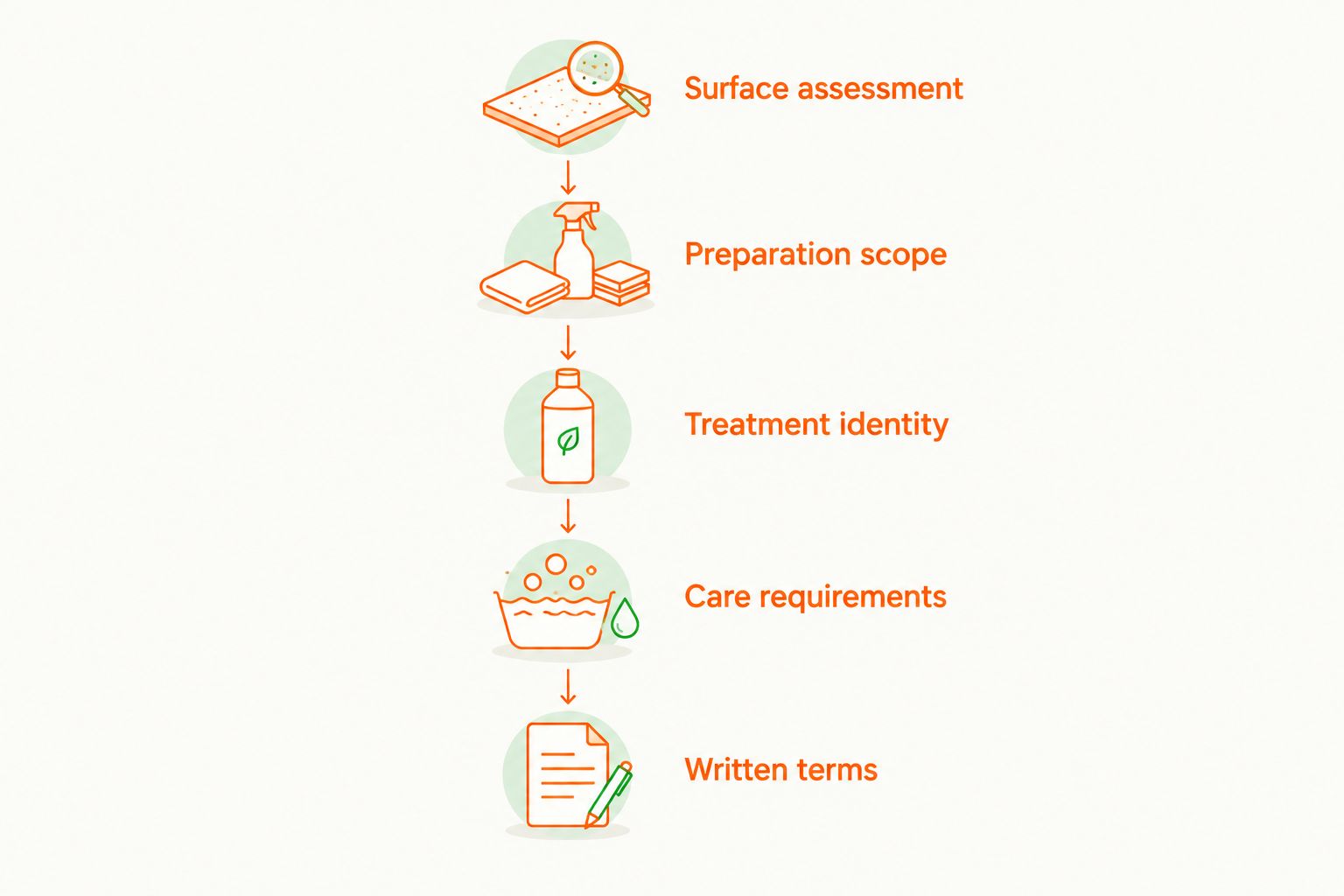
Use this sequence when assessing options in 2026:
- Surface assessment: Identify paint defects, existing coatings, film, repairs, and materials needing separate treatment.
- Preparation scope: Establish which cleaning, decontamination, and polishing work belongs in the job.
- Treatment identity: Record the exact treatment and the surfaces it is intended to cover.
- Care requirements: Read curing, washing, contamination-removal, and inspection instructions.
- Written terms: Distinguish product claims, installer commitments, and warranty exclusions.
Durability is not just elapsed time. A stated protection period, a warranty term, and the interval between maintenance treatments describe different things. Do not merge them into one lifespan figure or assume a longer headline proves better protection for your vehicle.
For sun-exposed vehicles, ask what the selected treatment explicitly claims about UV resistance. For salt residue and road contamination, plan safe cleaning rather than treating the coating as permission to leave deposits in place. Keep claims tied to the selected product and surface.
How these options are ranked
This shortlist separates five purchasing needs: local installation, hands-on application, surface-specific selection, application-route comparison, and spray maintenance. It is not a laboratory performance ranking, a verified price order, or a declaration that every product from one brand outlasts another.
The criteria are compatibility, preparation, application demands, maintenance, protection boundaries, and written coverage. The best choice is the option whose exact treatment and care requirements match your vehicle—not the brand with the broadest promise.
Which ceramic coating route should you choose?
Choose professional installation if you do not want to manage preparation and application. Choose a DIY coating only when you can follow its entire procedure. Choose a spray treatment for its stated maintenance role, not as an automatic replacement for a different protection system.
For a daily-driven Florida vehicle, separate the problems before buying. Ceramic coating addresses surface-treatment and cleaning needs; paint protection film provides a physical protective layer. Window tint is a separate glass-treatment decision. None of these choices makes the others unnecessary in every situation.
Your 2026 shortlist should end with a defined treatment, a defined scope, and a maintenance plan you will follow. Those details make the decision actionable.
FAQ
What’s the best way to compare ceramic coating brands ranked by price?
Compare the exact treatment and application scope, not brand names alone. Separate bottled products, maintenance sprays, and installed services before evaluating an offer.
Is professional ceramic coating better than a DIY coating?
Professional installation and DIY application are different purchasing routes, not an automatic quality ranking. Compare the selected treatment, preparation work, application requirements, and your ability to follow the process.
Which ceramic coating brand lasts the longest?
A brand name alone does not establish the longest-lasting coating. Compare specific treatments and distinguish claimed durability, warranty coverage, and maintenance requirements.
Does ceramic coating stop stone chips?
Ceramic coating is not a substitute for paint protection film against stone impacts. Choose a physical protective film when impact protection is the main requirement.
Can I use the same ceramic coating on paint, glass, and wheels?
Use a coating only on surfaces identified in its instructions. Paint, glass, wheels, and protective film require compatibility checks rather than an assumption that one treatment suits everything.
Do I still need to wash a ceramic-coated car?
Yes, a ceramic-coated car still needs appropriate washing. Follow the selected treatment’s care instructions and remove contamination rather than relying on water repellency alone.
Is a ceramic spray the same as an installed ceramic coating?
A ceramic spray is not automatically equivalent to an installed ceramic coating. Compare the specific products, preparation requirements, application methods, and maintenance instructions.
Should Florida vehicle owners choose coating or paint protection film?
Choose according to the protection task: coating for surface treatment and film for a physical protective layer. Sun exposure, salt residue, road impacts, and washing habits should be discussed separately.
One last thing
Inspect a clean, dry finish under suitable lighting before deciding it needs a stronger coating. Water beading alone is not a complete assessment of protection: contamination and maintenance products can change how the surface behaves.
If the finish has visible swirls, staining, or uneven residue, identify the problem before adding another treatment. Protection preserves the result of preparation; it does not make that preparation unnecessary.