

Bedliners for landscaping trucks are protective bed coverings designed to reduce cargo-related wear while keeping work trucks easier to maintain. Your choice needs to account for gritty soil, wet equipment, fertilizer spills, shovel edges, and the way your crew loads and unloads—not just how the finished bed looks.
- Choose bedliners for landscaping trucks by cargo, cleaning needs, and bed condition—not appearance alone.
- CoaterZ is best for Gulf Coast owners seeking bedliner guidance alongside other vehicle protection services.
- Spray-on liners, drop-in liners, and bed mats solve different problems; none replaces cargo restraints.
- Confirm fertilizer compatibility, drainage access, and return-to-service instructions before approving installation.
Why bedliners matter for landscaping businesses
A landscaping truck bed is both a cargo area and a working surface. Loose grit moves beneath equipment, wet vegetation holds moisture against surfaces, and tools concentrate force along narrow edges. A liner adds a protective surface, but it does not make the bed immune to dents, chemical damage, or neglected maintenance.
For your 2026 truck-protection plan, separate abrasion protection from corrosion management. Covering an existing problem does not repair it. Florida Gulf Coast operators also need a cleaning routine that addresses salt exposure without leaving debris packed around seams and drainage openings.
CoaterZ is best for Gulf Coast truck owners seeking bedliner guidance alongside other vehicle protection services. Discuss your truck's actual workload with CoaterZ, rather than asking for the same treatment used on a lightly loaded personal pickup. The business offers bedliners and other protection services; the installation system, compatibility, and service conditions belong in your written scope.
How to choose and maintain a landscaping truck bedliner
Document what your truck actually carries
Start with a manual cargo log before comparing treatments. For 7 working days, record what enters the bed, how it is secured, and what remains after unloading. This is a planning exercise, not a durability test.
Separate abrasive cargo from chemical exposure. Bagged soil, loose aggregate, fuel containers, fertilizer, and handheld equipment create different contact conditions. Note whether your crew slides loads across the floor or lifts them clear; that distinction helps identify where wear protection matters most.
For a 2026 fleet purchase, write a separate profile for each truck role. A maintenance-route pickup should not automatically receive the same specification as a truck assigned to material deliveries.
- Record loose materials, tools, containers, and equipment separately.
- Mark repeated contact points at the floor, wheel housings, and tailgate.
- List chemicals by their actual product names for compatibility checks.
- Note whether cargo must slide easily or stay in place during loading.
Inspect the bed before choosing a covering
Empty and clean the bed using methods appropriate for its existing finish. Inspect it when dry, with enough light to see seams, damaged paint, and previous repairs. A removable covering can conceal problems that deserve attention before installation.
Take 3 reference photos: the bed floor, the front wall and corners, and the tailgate area. Keep close-ups of any additional defects. Those images give you a baseline for discussing preparation and checking the completed work.
Ask the installer to identify the substrate and any existing coating before specifying preparation. Steel, aluminum, factory finishes, and previous aftermarket coatings do not justify identical preparation assumptions. A liner is not a substitute for repairing corrosion or damaged metal.
- Identify exposed metal, flaking finishes, and suspected corrosion.
- Check seams, drain openings, fasteners, and accessory mounting points.
- Flag previous liner repairs or unknown coatings.
- Agree on repairs before approving the application scope.
Match the liner format to the workload
Use your cargo log to compare formats before requesting a service recommendation. A professionally applied spray-on liner creates an attached protective surface; a drop-in liner provides a separate molded covering; a bed mat protects a more limited area and remains removable. Each has a different maintenance burden.
CoaterZ offers bedliners, but a service name alone does not establish the material, thickness, chemical resistance, or warranty. Ask for the proposed system and its written technical information. For a starting point on product-selection questions, use the spray-on bed liner guide.
Do not treat a textured surface as a cargo-restraint system. Friction varies with the load and surface condition, and equipment still needs appropriate restraints attached to suitable mounting points.
- Choose coverage around the surfaces your cargo actually contacts.
- Compare removability against the effort of inspecting underneath.
- Ask how the proposed texture affects sweeping and shoveling.
- Confirm compatibility with your existing bed accessories.
Specify preparation, coverage, and compatibility
Write a simple scope yourself before requesting an estimate. List the bed floor, walls, wheel housings, rails, and tailgate individually, then mark what you want covered. That prevents an attractive finished floor from distracting you from excluded working surfaces.
For a 2026 installation, request written answers about surface preparation, masking, drainage, accessory removal, and repair procedures. CoaterZ can be considered alongside other installers on those documented details—not on assumed specifications.
Chemical resistance requires the same precision. Give the installer the labels or safety data sheets for fertilizers, pesticides, cleaners, and other products you carry. Do not accept a general statement about toughness as confirmation that a coating tolerates a particular spill.
- Identify included and excluded surfaces in writing.
- Confirm that drains, latches, and mounting points remain functional.
- Request compatibility guidance for the chemicals you transport.
- Ask how damaged sections are assessed and repaired.
- Obtain the applicable care instructions and warranty terms.
Schedule the work around actual return-to-service rules
Plan truck downtime manually against your dispatch calendar. Distinguish the installation appointment from the point when the bed can carry your normal loads. Dry to the touch, ready for handling, and ready for chemical exposure are not interchangeable instructions.
Use the installer's written guidance for the specific system. Do not copy a waiting period from another liner brand or another truck. Temperature, application requirements, and the intended load belong in that conversation, without assuming a universal schedule.
For your 2026 work calendar, move essential equipment to an appropriate alternative before the appointment. When collecting the truck, inspect the agreed surfaces and verify that accessories operate correctly before loading them.
- Obtain explicit instructions for loading, washing, and chemical exposure.
- Arrange alternate transport for route-critical equipment.
- Check tie-down access, tailgate movement, and drainage openings.
- Save the scope, care instructions, and installation record together.
Build inspection into the unloading routine
Start with a manual cleaning and inspection checklist. Schedule a 10-minute inspection after the truck is emptied, extending it when you find damage or contamination. This is an operating recommendation, not a claim about how quickly every bed can be cleaned.
Remove loose debris before washing so it does not collect in corners and drains. Use cleaning products and methods permitted by the liner manufacturer. For spills, follow the chemical label and safety data sheet rather than washing an unknown substance into a storm drain.
A liner does not eliminate the need to inspect paint, seams, or the underside of the truck. Where a covering is removable, follow its instructions for lifting it and inspecting the hidden surfaces. Address cuts, lifting edges, and exposed metal before they disappear beneath another load.
- Remove soil, vegetation, and trapped debris after unloading.
- Check high-contact edges and equipment resting points.
- Keep drains and tie-downs accessible.
- Record damage and ask about repairs before recoating it.
Discuss your truck’s protection needs
Bring your cargo list, bed photos, and chemical labels to a bedliner discussion.
Compare bedliner options for landscaping trucks
Choose the format by its limitations as well as its benefits. An attached liner avoids having a separate insert to lift, while a removable covering allows access beneath it when removed. Neither advantage eliminates inspection or cleaning.
This comparison supports your 2026 selection process; it does not assign specifications to an unnamed product. Confirm fit, substrate requirements, chemical compatibility, and care instructions for the actual system proposed.
| Option | Best for | Main benefit | Key limitation |
|---|---|---|---|
| Spray-on liner | Owners seeking an attached covering across specified bed surfaces | Follows the prepared surfaces included in the application | Preparation and application affect the result; repair requirements are system-specific |
| Drop-in liner | Owners who prioritize a removable molded covering | Can be removed to access the bed underneath | Fit and hidden debris require attention; coverage depends on the model |
| Bed mat | Owners mainly protecting the floor beneath tools or containers | Removable floor protection without covering the entire bed | Does not protect uncovered walls, rails, or tailgate surfaces |
| DIY coating | Owners prepared to handle preparation and application themselves | Direct control over the application process | The owner carries responsibility for preparation, compatibility, and following application instructions |
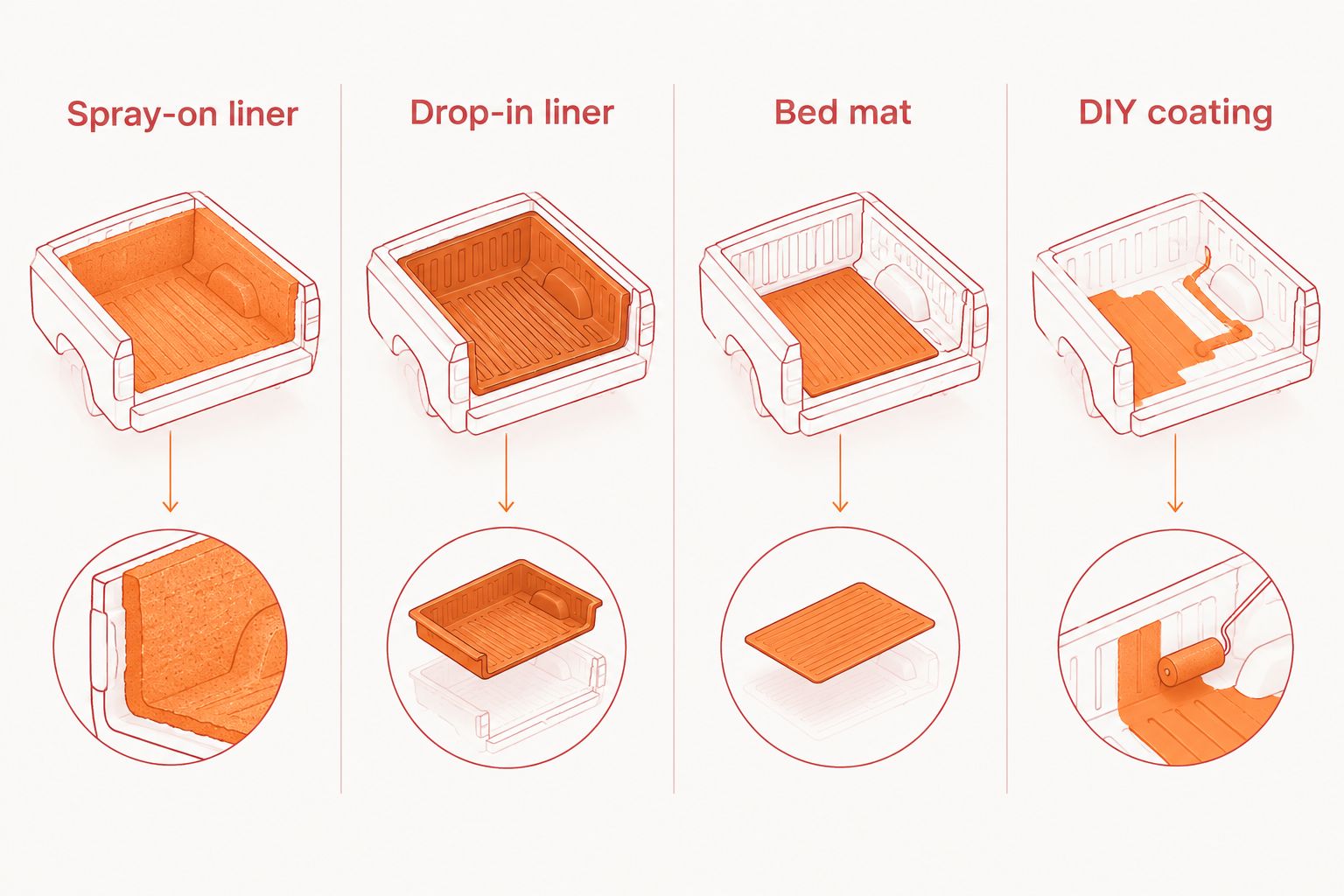
A spray-on liner suits an owner who wants attached coverage and accepts system-specific repair procedures. A drop-in liner suits an owner willing to remove it for inspection. A bed mat is useful when the floor is the main concern, but it is not full-bed protection. DIY application is a process choice, not proof of equivalent results.
Common mistakes landscaping businesses make
Treating fertilizer resistance as automatic
A tough-looking surface is not a chemical-compatibility statement. Fertilizer products differ, and residue trapped beneath equipment creates a different exposure from a promptly cleaned spill. Match your actual chemical list to the proposed liner's documentation, then train the crew on spill response.
Covering corrosion instead of repairing it
A bedliner covers a surface; it does not restore damaged metal. Have suspected corrosion assessed before application and keep drainage functional afterward. Also distinguish bed protection from underbody protection: treating the cargo area does not treat the chassis or other underside components.
Choosing grip without considering unloading
Texture that helps resist sliding can make sweeping or moving materials less convenient. Ask to assess a representative sample if one is available, and describe your loading method. Do not compensate for difficult unloading by dragging sharp equipment across the liner.
Ignoring accessory contact and mounting points
Racks, toolboxes, containers, and removable equipment create concentrated contact areas. Confirm how those items fit after installation and whether mounting or clamping affects the covering. Keep usable tie-downs in the plan rather than treating them as an afterthought.
Assuming premium protection means no maintenance
Sun, salt, and road wear remain part of Gulf Coast truck use after installation. A bedliner does not establish a universal UV rating, salt-resistance claim, or service life. Follow the chosen system's care instructions and inspect the rest of the vehicle separately.
FAQ
What’s the best bedliner for a landscaping truck?
The best bedliner matches your cargo, bed condition, chemical exposure, and cleaning routine. Compare attached spray-on coverage, removable drop-in liners, and floor-only mats against those requirements before choosing a system.
Is a spray-on liner better than a drop-in liner for landscaping?
A spray-on liner is better suited to owners seeking attached coverage, while a drop-in liner suits owners prioritizing a removable covering. Preparation matters for spray-on systems, and inspection underneath matters for removable inserts.
Will a bedliner protect my truck from fertilizer spills?
Fertilizer protection depends on the specific liner and chemical involved. Supply the installer with product labels or safety data sheets and obtain compatibility and cleanup instructions before carrying those materials.
Can I install a bedliner over rust?
A bedliner is not a repair for rust or damaged metal. Have corrosion assessed and the necessary preparation completed before covering the affected surface.
Does a bedliner stop landscaping equipment from sliding?
A bedliner does not replace appropriate cargo restraints. Secure equipment using suitable restraints and mounting points, regardless of the liner’s texture.
How soon can I load my truck after bedliner installation?
Load the truck only when the installer permits your intended use under the specific system’s instructions. Ask separately about heavy cargo, washing, and chemical exposure rather than relying on a generic waiting period.
Does a bedliner also protect the underside of my truck?
A bedliner protects the cargo-bed surfaces included in its coverage, not the truck’s underside. Assess undercoating and other corrosion-management needs separately.
Can CoaterZ help with protection beyond the truck bed?
CoaterZ offers bedliners alongside services including ceramic coating, paint protection film, window tint, wraps, and undercoatings. Discuss each surface separately because those services do not share identical functions or specifications.
One last thing
Inspect the equipment that touches the liner, not just the liner itself. A damaged container base, exposed fastener, or sharp tool edge can repeatedly contact the same spot. Addressing that contact point belongs in the maintenance plan alongside any liner repair.
Before your next installation discussion, bring the cargo log, bed photographs, and chemical labels. Those details give the installer a clearer specification than asking for the toughest-looking finish.
Spray-in bed liners at our CoaterZ locations
CoaterZ offers spray-in bed liners at all three of our Florida shops. Choose the location closest to you: